 Add to Chrome
 Add to Firefox
 Add to Edge
How Do Language Models Acquire Character-Level Information?
Feb 05, 2026
Language models (LMs) have been reported to implicitly encode character-level information, despite not being explicitly provided during training. However, the mechanisms underlying this phenomenon remain largely unexplored. To reveal the mechanisms, we analyze how models acquire character-level knowledge by comparing LMs trained under controlled settings, such as specifying the pre-training dataset or tokenizer, with those trained under standard settings. We categorize the contributing factors into those independent of tokenization. Our analysis reveals that merge rules and orthographic constraints constitute primary factors arising from tokenization, whereas semantic associations of substrings and syntactic information function as key factors independent of tokenization.

Improving Sentence Embeddings with an Automatically Generated NLI Dataset
Feb 23, 2024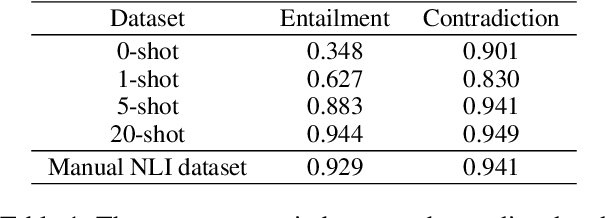
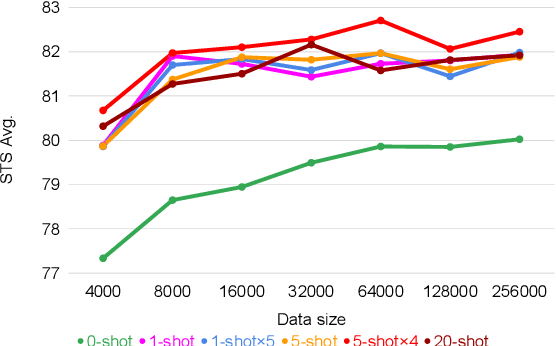
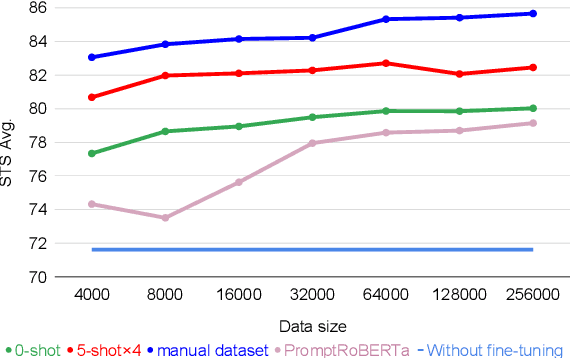
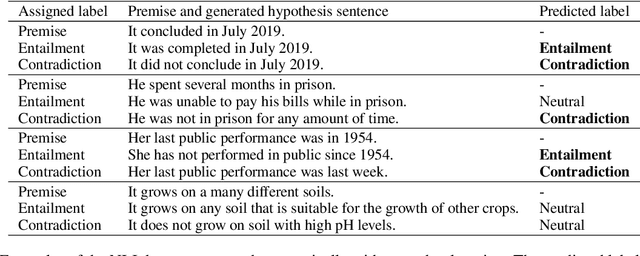
Decoder-based large language models (LLMs) have shown high performance on many tasks in natural language processing. This is also true for sentence embedding learning, where a decoder-based model, PromptEOL, has achieved the best performance on semantic textual similarity (STS) tasks. However, PromptEOL makes great use of fine-tuning with a manually annotated natural language inference (NLI) dataset. We aim to improve sentence embeddings learned in an unsupervised setting by automatically generating an NLI dataset with an LLM and using it to fine-tune PromptEOL. In experiments on STS tasks, the proposed method achieved an average Spearman's rank correlation coefficient of 82.21 with respect to human evaluation, thus outperforming existing methods without using large, manually annotated datasets.