 Add to Chrome
 Add to Firefox
 Add to Edge
KVSmooth: Mitigating Hallucination in Multi-modal Large Language Models through Key-Value Smoothing
Feb 04, 2026
Despite the significant progress of Multimodal Large Language Models (MLLMs) across diverse tasks, hallucination -- corresponding to the generation of visually inconsistent objects, attributes, or relations -- remains a major obstacle to their reliable deployment. Unlike pure language models, MLLMs must ground their generation process in visual inputs. However, existing models often suffer from semantic drift during decoding, causing outputs to diverge from visual facts as the sequence length increases. To address this issue, we propose KVSmooth, a training-free and plug-and-play method that mitigates hallucination by performing attention-entropy-guided adaptive smoothing on hidden states. Specifically, KVSmooth applies an exponential moving average (EMA) to both keys and values in the KV-Cache, while dynamically quantifying the sink degree of each token through the entropy of its attention distribution to adaptively adjust the smoothing strength. Unlike computationally expensive retraining or contrastive decoding methods, KVSmooth operates efficiently during inference without additional training or model modification. Extensive experiments demonstrate that KVSmooth significantly reduces hallucination ($\mathit{CHAIR}_{S}$ from $41.8 \rightarrow 18.2$) while improving overall performance ($F_1$ score from $77.5 \rightarrow 79.2$), achieving higher precision and recall simultaneously. In contrast, prior methods often improve one at the expense of the other, validating the effectiveness and generality of our approach.

NTFormer: A Composite Node Tokenized Graph Transformer for Node Classification
Jun 27, 2024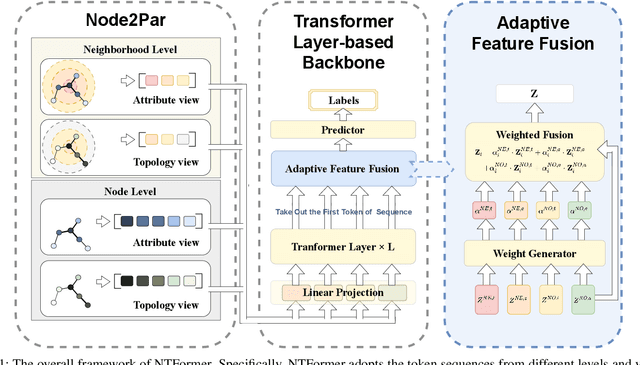
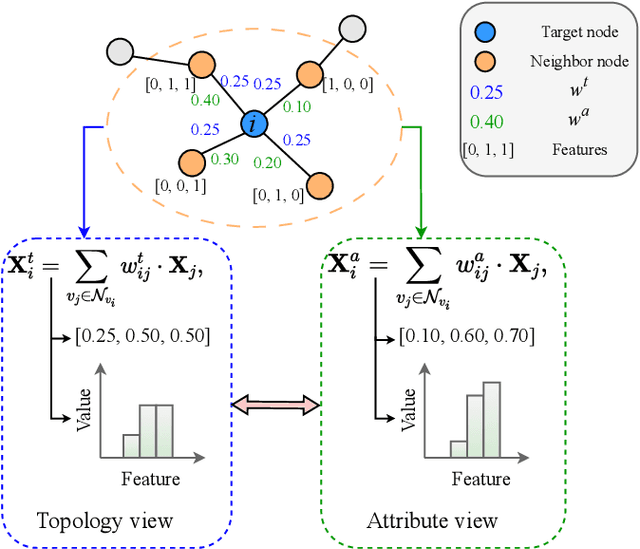
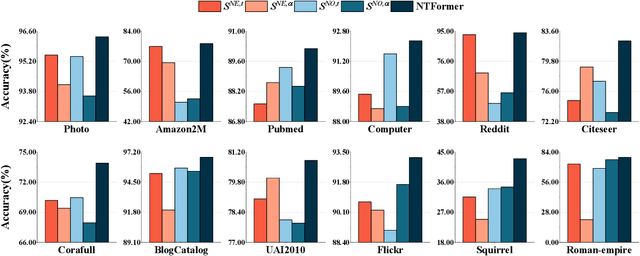
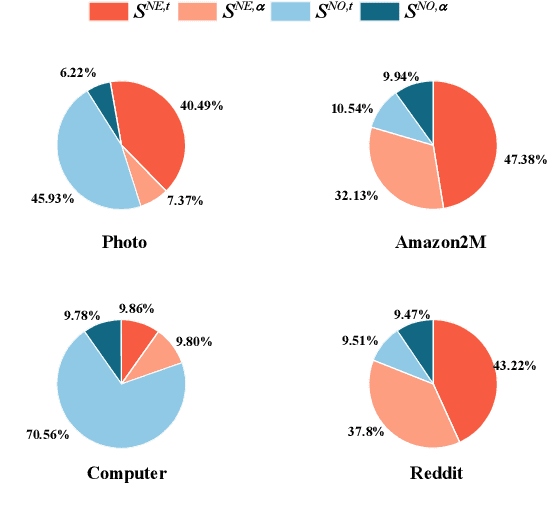
Recently, the emerging graph Transformers have made significant advancements for node classification on graphs. In most graph Transformers, a crucial step involves transforming the input graph into token sequences as the model input, enabling Transformer to effectively learn the node representations. However, we observe that existing methods only express partial graph information of nodes through single-type token generation. Consequently, they require tailored strategies to encode additional graph-specific features into the Transformer to ensure the quality of node representation learning, limiting the model flexibility to handle diverse graphs. To this end, we propose a new graph Transformer called NTFormer to address this issue. NTFormer introduces a novel token generator called Node2Par, which constructs various token sequences using different token elements for each node. This flexibility allows Node2Par to generate valuable token sequences from different perspectives, ensuring comprehensive expression of rich graph features. Benefiting from the merits of Node2Par, NTFormer only leverages a Transformer-based backbone without graph-specific modifications to learn node representations, eliminating the need for graph-specific modifications. Extensive experiments conducted on various benchmark datasets containing homophily and heterophily graphs with different scales demonstrate the superiority of NTFormer over representative graph Transformers and graph neural networks for node classification.