 Add to Chrome
 Add to Firefox
 Add to Edge
Towards Unified Multi-task EEG Analysis with Low-Rank Adaptation
Apr 28, 2026
Recent self-supervised pre-training methods for electroencephalogram (EEG) have shown promising results. However, the pre-trained models typically require full fine-tuning on each downstream task individually to achieve good performance. In practical applications involving multiple tasks, utilizing a separate model for each task is not ideal regarding computational and spatial cost. In this study, we go one step further and explore the simultaneous adaptation of a pre-trained model to multiple different tasks. The EEG signals exhibit significant heterogeneity due to their collection from various subjects using diverse devices and experimental setups, resulting in potential conflicts among different tasks that impede joint optimization. To tackle this challenge, we propose MTEEG, a multi-task EEG analysis framework which incorporates task-specific low-rank adaptation (LoRA) modules to disentangle the parameter space and alleviate task conflicts. To investigate the trade-off between task specification and interaction, we propose three variants of MTEEG that integrate the LoRA modules in different ways and evaluate them on six downstream tasks, demonstrating that MTEEG can surpass state-of-the-art single-task methods on the majority of metrics. MTEEG shows the potential of multi-task EEG analysis and promotes the development of general-purpose brain-computer interfaces in the future.

Autoregressive Visual Decoding from EEG Signals
Feb 26, 2026Electroencephalogram (EEG) signals have become a popular medium for decoding visual information due to their cost-effectiveness and high temporal resolution. However, current approaches face significant challenges in bridging the modality gap between EEG and image data. These methods typically rely on complex adaptation processes involving multiple stages, making it hard to maintain consistency and manage compounding errors. Furthermore, the computational overhead imposed by large-scale diffusion models limit their practicality in real-world brain-computer interface (BCI) applications. In this work, we present AVDE, a lightweight and efficient framework for visual decoding from EEG signals. First, we leverage LaBraM, a pre-trained EEG model, and fine-tune it via contrastive learning to align EEG and image representations. Second, we adopt an autoregressive generative framework based on a "next-scale prediction" strategy: images are encoded into multi-scale token maps using a pre-trained VQ-VAE, and a transformer is trained to autoregressively predict finer-scale tokens starting from EEG embeddings as the coarsest representation. This design enables coherent generation while preserving a direct connection between the input EEG signals and the reconstructed images. Experiments on two datasets show that AVDE outperforms previous state-of-the-art methods in both image retrieval and reconstruction tasks, while using only 10% of the parameters. In addition, visualization of intermediate outputs shows that the generative process of AVDE reflects the hierarchical nature of human visual perception. These results highlight the potential of autoregressive models as efficient and interpretable tools for practical BCI applications.
Self-Supervised Masked Mesh Learning for Unsupervised Anomaly Detection on 3D Cortical Surfaces
Dec 07, 2024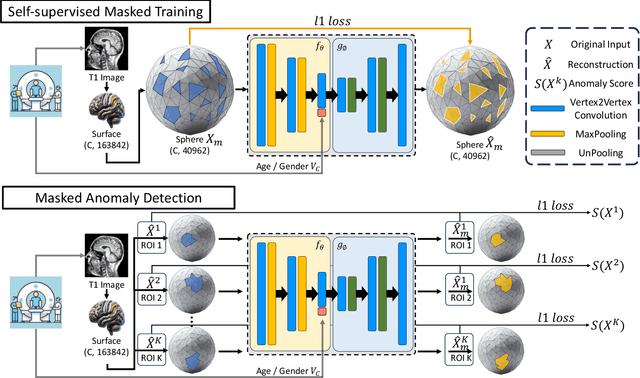
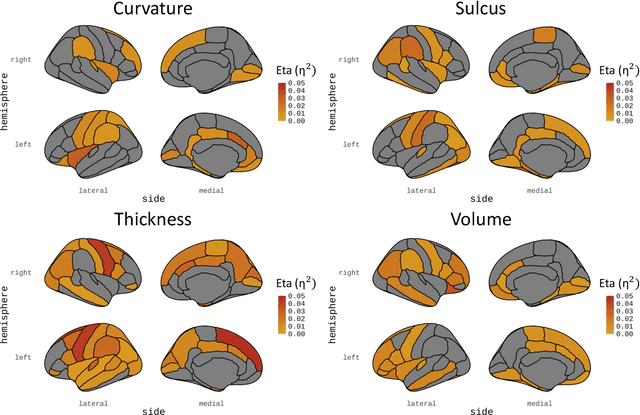
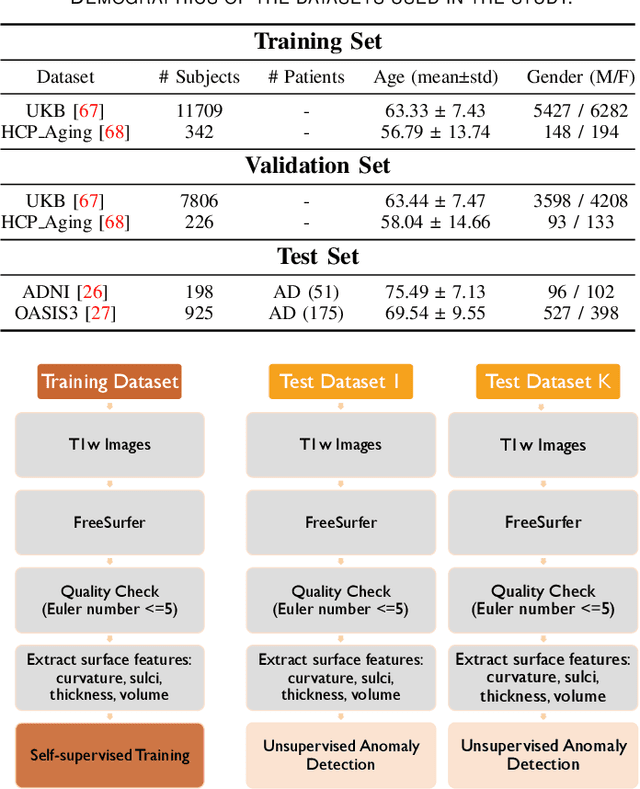
Unsupervised anomaly detection in brain imaging is challenging. In this paper, we propose a self-supervised masked mesh learning for unsupervised anomaly detection in 3D cortical surfaces. Our framework leverages the intrinsic geometry of the cortical surface to learn a self-supervised representation that captures the underlying structure of the brain. We introduce a masked mesh convolutional neural network (MMN) that learns to predict masked regions of the cortical surface. By training the MMN on a large dataset of healthy subjects, we learn a representation that captures the normal variation in the cortical surface. We then use this representation to detect anomalies in unseen individuals by calculating anomaly scores based on the reconstruction error of the MMN. We evaluate our framework by training on population-scale dataset UKB and HCP-Aging and testing on two datasets of Alzheimer's disease patients ADNI and OASIS3. Our results show that our framework can detect anomalies in cortical thickness, cortical volume, and cortical sulcus features, which are known to be sensitive biomarkers for Alzheimer's disease. Our proposed framework provides a promising approach for unsupervised anomaly detection based on normative variation of cortical features.