 Add to Chrome
 Add to Firefox
 Add to Edge
Maxwait: A Generalized Mechanism for Distributed Time-Sensitive Systems
Jan 29, 2026
Distributed time-sensitive systems must balance timing requirements (availability) and consistency in the presence of communication delays and synchronization uncertainty. This paper presents maxwait, a simple coordination mechanism with surprising generality that makes these tradeoffs explicit and configurable. We demonstrate that this mechanism subsumes classical distributed system methods such as PTIDES, Chandy-and-Misra with or without null messages, Jefferson's Time-Warp, and Lamport's time-based fault detection, while enabling real-time behavior in distributed cyber-physical applications. The mechanism can also realize many commonly used distributed system patterns, including logical execution time (LET), publish and subscribe, actors, conflict-free replicated data types (CRDTs), and remote procedure calls with futures. More importantly, it adds to these mechanisms better control over timing, bounded time fault detection, and the option of making them more deterministic, all within a single semantic framework. Implemented as an extension of the Lingua Franca coordination language, maxwait enforces logical-time consistency when communication latencies are bounded and provides structured fault handling when bounds are violated.

Let the Barbarians In: How AI Can Accelerate Systems Performance Research
Dec 22, 2025Artificial Intelligence (AI) is beginning to transform the research process by automating the discovery of new solutions. This shift depends on the availability of reliable verifiers, which AI-driven approaches require to validate candidate solutions. Research focused on improving systems performance is especially well-suited to this paradigm because system performance problems naturally admit such verifiers: candidates can be implemented in real systems or simulators and evaluated against predefined workloads. We term this iterative cycle of generation, evaluation, and refinement AI-Driven Research for Systems (ADRS). Using several open-source ADRS instances (i.e., OpenEvolve, GEPA, and ShinkaEvolve), we demonstrate across ten case studies (e.g., multi-region cloud scheduling, mixture-of-experts load balancing, LLM-based SQL, transaction scheduling) that ADRS-generated solutions can match or even outperform human state-of-the-art designs. Based on these findings, we outline best practices (e.g., level of prompt specification, amount of feedback, robust evaluation) for effectively using ADRS, and we discuss future research directions and their implications. Although we do not yet have a universal recipe for applying ADRS across all of systems research, we hope our preliminary findings, together with the challenges we identify, offer meaningful guidance for future work as researcher effort shifts increasingly toward problem formulation and strategic oversight. Note: This paper is an extension of our prior work [14]. It adds extensive evaluation across multiple ADRS frameworks and provides deeper analysis and insights into best practices.
HPRM: High-Performance Robotic Middleware for Intelligent Autonomous Systems
Dec 02, 2024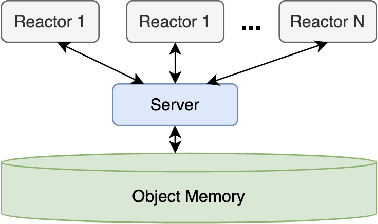
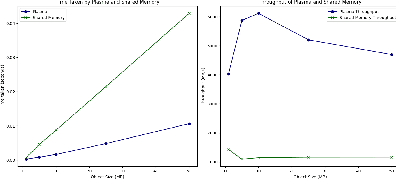
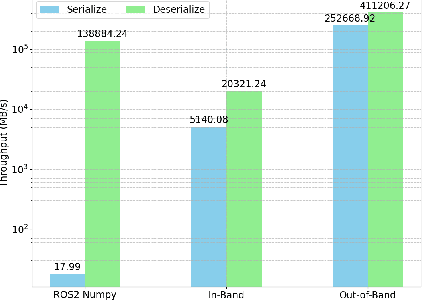
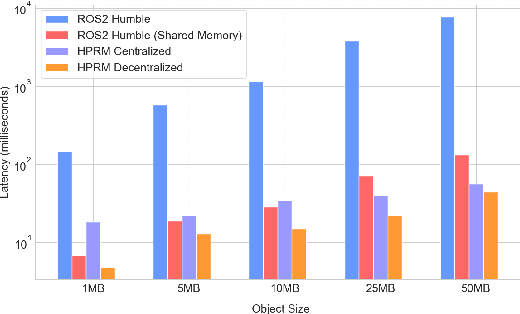
The rise of intelligent autonomous systems, especially in robotics and autonomous agents, has created a critical need for robust communication middleware that can ensure real-time processing of extensive sensor data. Current robotics middleware like Robot Operating System (ROS) 2 faces challenges with nondeterminism and high communication latency when dealing with large data across multiple subscribers on a multi-core compute platform. To address these issues, we present High-Performance Robotic Middleware (HPRM), built on top of the deterministic coordination language Lingua Franca (LF). HPRM employs optimizations including an in-memory object store for efficient zero-copy transfer of large payloads, adaptive serialization to minimize serialization overhead, and an eager protocol with real-time sockets to reduce handshake latency. Benchmarks show HPRM achieves up to 173x lower latency than ROS2 when broadcasting large messages to multiple nodes. We then demonstrate the benefits of HPRM by integrating it with the CARLA simulator and running reinforcement learning agents along with object detection workloads. In the CARLA autonomous driving application, HPRM attains 91.1% lower latency than ROS2. The deterministic coordination semantics of HPRM, combined with its optimized IPC mechanisms, enable efficient and predictable real-time communication for intelligent autonomous systems.