 Add to Chrome
 Add to Firefox
 Add to Edge
Generalizable and Animatable 3D Full-Head Gaussian Avatar from a Single Image
Jan 19, 2026
Building 3D animatable head avatars from a single image is an important yet challenging problem. Existing methods generally collapse under large camera pose variations, compromising the realism of 3D avatars. In this work, we propose a new framework to tackle the novel setting of one-shot 3D full-head animatable avatar reconstruction in a single feed-forward pass, enabling real-time animation and simultaneous 360$^\circ$ rendering views. To facilitate efficient animation control, we model 3D head avatars with Gaussian primitives embedded on the surface of a parametric face model within the UV space. To obtain knowledge of full-head geometry and textures, we leverage rich 3D full-head priors within a pretrained 3D generative adversarial network (GAN) for global full-head feature extraction and multi-view supervision. To increase the fidelity of the 3D reconstruction of the input image, we take advantage of the symmetric nature of the UV space and human faces to fuse local fine-grained input image features with the global full-head textures. Extensive experiments demonstrate the effectiveness of our method, achieving high-quality 3D full-head modeling as well as real-time animation, thereby improving the realism of 3D talking avatars.

Synergizing Motion and Appearance: Multi-Scale Compensatory Codebooks for Talking Head Video Generation
Dec 01, 2024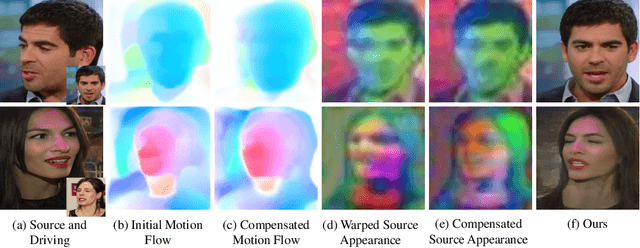

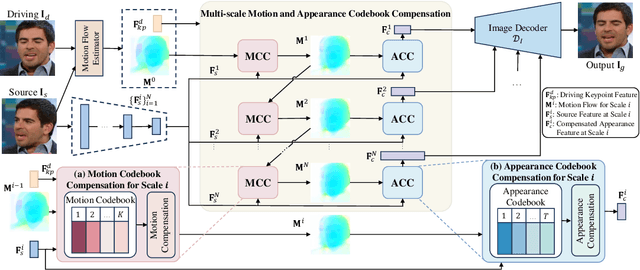
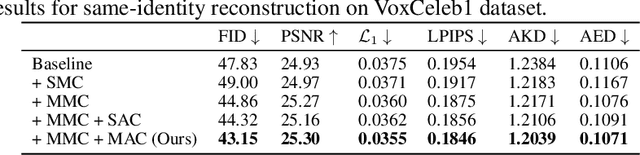
Talking head video generation aims to generate a realistic talking head video that preserves the person's identity from a source image and the motion from a driving video. Despite the promising progress made in the field, it remains a challenging and critical problem to generate videos with accurate poses and fine-grained facial details simultaneously. Essentially, facial motion is often highly complex to model precisely, and the one-shot source face image cannot provide sufficient appearance guidance during generation due to dynamic pose changes. To tackle the problem, we propose to jointly learn motion and appearance codebooks and perform multi-scale codebook compensation to effectively refine both the facial motion conditions and appearance features for talking face image decoding. Specifically, the designed multi-scale motion and appearance codebooks are learned simultaneously in a unified framework to store representative global facial motion flow and appearance patterns. Then, we present a novel multi-scale motion and appearance compensation module, which utilizes a transformer-based codebook retrieval strategy to query complementary information from the two codebooks for joint motion and appearance compensation. The entire process produces motion flows of greater flexibility and appearance features with fewer distortions across different scales, resulting in a high-quality talking head video generation framework. Extensive experiments on various benchmarks validate the effectiveness of our approach and demonstrate superior generation results from both qualitative and quantitative perspectives when compared to state-of-the-art competitors.