 Add to Chrome
 Add to Firefox
 Add to Edge
Data-Efficient Physics-Informed Learning to Model Synchro-Waveform Dynamics of Grid-Integrated Inverter-Based Resources
Jan 23, 2026
Inverter-based resources (IBRs) exhibit fast transient dynamics during network disturbances, which often cannot be properly captured by phasor and SCADA measurements. This shortcoming has recently been addressed with the advent of waveform measurement units (WMUs), which provide high-resolution, time-synchronized raw voltage and current waveform samples from multiple locations in the power system. However, transient model learning based on synchro-waveform measurements remains constrained by the scarcity of network disturbances and the complexity of the underlying nonlinear dynamics of IBRs. We propose to address these problems by developing a data-efficient physics-informed machine learning (PIML) framework for synchro-waveform analytics that estimates the IBR terminal current response from only a few network disturbance signatures. Here, the physics of the electrical circuits are used to compensate for limited data availability by constraining the learning process through known circuit relationships. Two cases are considered, with known and unknown circuit parameters. In the latter case, the framework jointly learns the transient dynamics of the IBRs and the parameters of the electrical circuit. Case studies using WMU disturbance data across multiple sampling rates shows consistently lower current estimation error with substantially fewer training events than a purely data-driven baseline.

Fusing Multiple Algorithms for Heterogeneous Online Learning
Dec 09, 2023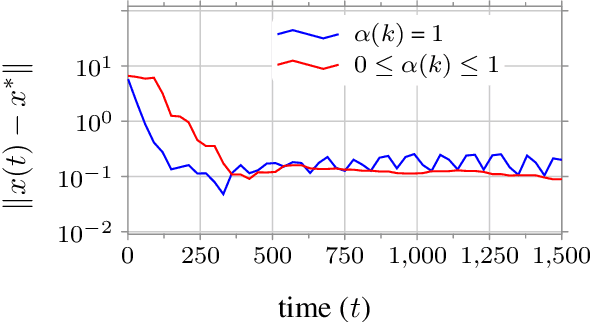
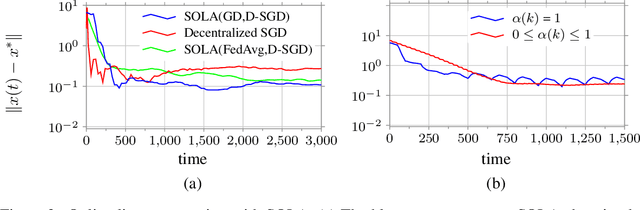
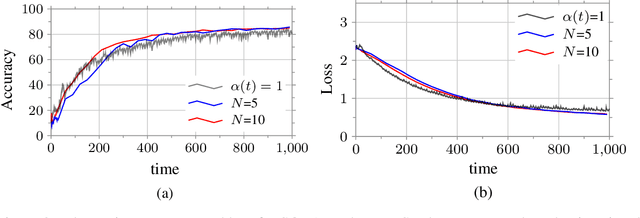
This study addresses the challenge of online learning in contexts where agents accumulate disparate data, face resource constraints, and use different local algorithms. This paper introduces the Switched Online Learning Algorithm (SOLA), designed to solve the heterogeneous online learning problem by amalgamating updates from diverse agents through a dynamic switching mechanism contingent upon their respective performance and available resources. We theoretically analyze the design of the selecting mechanism to ensure that the regret of SOLA is bounded. Our findings show that the number of changes in selection needs to be bounded by a parameter dependent on the performance of the different local algorithms. Additionally, two test cases are presented to emphasize the effectiveness of SOLA, first on an online linear regression problem and then on an online classification problem with the MNIST dataset.