 Add to Chrome
 Add to Firefox
 Add to Edge
DDP-WM: Disentangled Dynamics Prediction for Efficient World Models
Feb 03, 2026
World models are essential for autonomous robotic planning. However, the substantial computational overhead of existing dense Transformerbased models significantly hinders real-time deployment. To address this efficiency-performance bottleneck, we introduce DDP-WM, a novel world model centered on the principle of Disentangled Dynamics Prediction (DDP). We hypothesize that latent state evolution in observed scenes is heterogeneous and can be decomposed into sparse primary dynamics driven by physical interactions and secondary context-driven background updates. DDP-WM realizes this decomposition through an architecture that integrates efficient historical processing with dynamic localization to isolate primary dynamics. By employing a crossattention mechanism for background updates, the framework optimizes resource allocation and provides a smooth optimization landscape for planners. Extensive experiments demonstrate that DDP-WM achieves significant efficiency and performance across diverse tasks, including navigation, precise tabletop manipulation, and complex deformable or multi-body interactions. Specifically, on the challenging Push-T task, DDP-WM achieves an approximately 9 times inference speedup and improves the MPC success rate from 90% to98% compared to state-of-the-art dense models. The results establish a promising path for developing efficient, high-fidelity world models. Codes will be available at https://github.com/HCPLab-SYSU/DDP-WM.

DART: Differentiable Dynamic Adaptive Region Tokenizer for Vision Transformer and Mamba
Jun 12, 2025Recently, non-convolutional models such as the Vision Transformer (ViT) and Vision Mamba (Vim) have achieved remarkable performance in computer vision tasks. However, their reliance on fixed-size patches often results in excessive encoding of background regions and omission of critical local details, especially when informative objects are sparsely distributed. To address this, we introduce a fully differentiable Dynamic Adaptive Region Tokenizer (DART), which adaptively partitions images into content-dependent patches of varying sizes. DART combines learnable region scores with piecewise differentiable quantile operations to allocate denser tokens to information-rich areas. Despite introducing only approximately 1 million (1M) additional parameters, DART improves accuracy by 2.1% on DeiT (ImageNet-1K). Unlike methods that uniformly increase token density to capture fine-grained details, DART offers a more efficient alternative, achieving 45% FLOPs reduction with superior performance. Extensive experiments on DeiT, Vim, and VideoMamba confirm that DART consistently enhances accuracy while incurring minimal or even reduced computational overhead. Code is available at https://github.com/HCPLab-SYSU/DART.
VisionGRU: A Linear-Complexity RNN Model for Efficient Image Analysis
Dec 24, 2024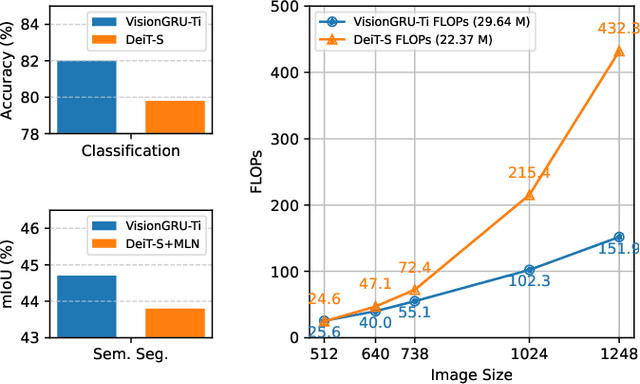
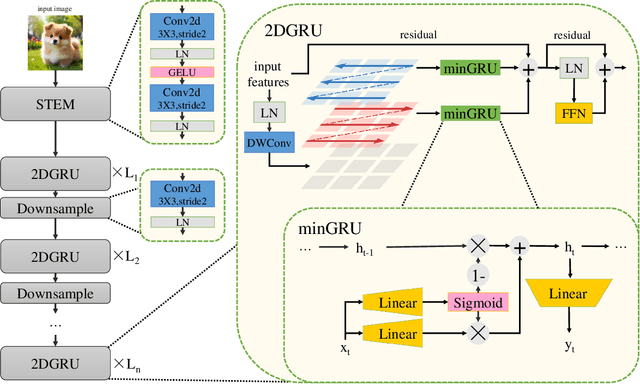
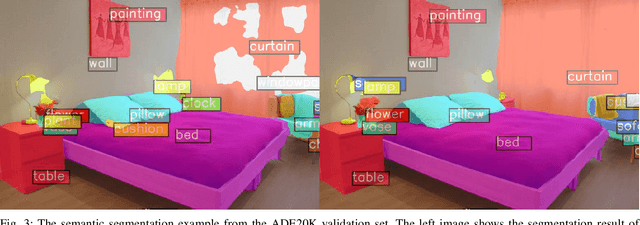
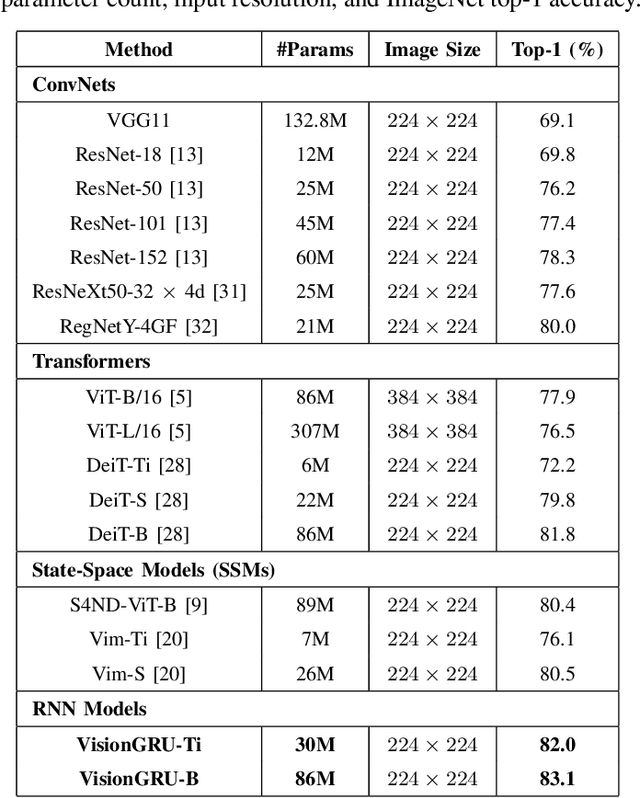
Convolutional Neural Networks (CNNs) and Vision Transformers (ViTs) are two dominant models for image analysis. While CNNs excel at extracting multi-scale features and ViTs effectively capture global dependencies, both suffer from high computational costs, particularly when processing high-resolution images. Recently, state-space models (SSMs) and recurrent neural networks (RNNs) have attracted attention due to their efficiency. However, their performance in image classification tasks remains limited. To address these challenges, this paper introduces VisionGRU, a novel RNN-based architecture designed for efficient image classification. VisionGRU leverages a simplified Gated Recurrent Unit (minGRU) to process large-scale image features with linear complexity. It divides images into smaller patches and progressively reduces the sequence length while increasing the channel depth, thus facilitating multi-scale feature extraction. A hierarchical 2DGRU module with bidirectional scanning captures both local and global contexts, improving long-range dependency modeling, particularly for tasks like semantic segmentation. Experimental results on the ImageNet and ADE20K datasets demonstrate that VisionGRU outperforms ViTs, significantly reducing memory usage and computational costs, especially for high-resolution images. These findings underscore the potential of RNN-based approaches for developing efficient and scalable computer vision solutions. Codes will be available at https://github.com/YangLiu9208/VisionGRU.