 Add to Chrome
 Add to Firefox
 Add to Edge
One-step Language Modeling via Continuous Denoising
Feb 18, 2026
Language models based on discrete diffusion have attracted widespread interest for their potential to provide faster generation than autoregressive models. In practice, however, they exhibit a sharp degradation of sample quality in the few-step regime, failing to realize this promise. Here we show that language models leveraging flow-based continuous denoising can outperform discrete diffusion in both quality and speed. By revisiting the fundamentals of flows over discrete modalities, we build a flow-based language model (FLM) that performs Euclidean denoising over one-hot token encodings. We show that the model can be trained by predicting the clean data via a cross entropy objective, where we introduce a simple time reparameterization that greatly improves training stability and generation quality. By distilling FLM into its associated flow map, we obtain a distilled flow map language model (FMLM) capable of few-step generation. On the LM1B and OWT language datasets, FLM attains generation quality matching state-of-the-art discrete diffusion models. With FMLM, our approach outperforms recent few-step language models across the board, with one-step generation exceeding their 8-step quality. Our work calls into question the widely held hypothesis that discrete diffusion processes are necessary for generative modeling over discrete modalities, and paves the way toward accelerated flow-based language modeling at scale. Code is available at https://github.com/david3684/flm.

A New Interpretation of the Certainty-Equivalence Approach for PAC Reinforcement Learning with a Generative Model
Jan 05, 2025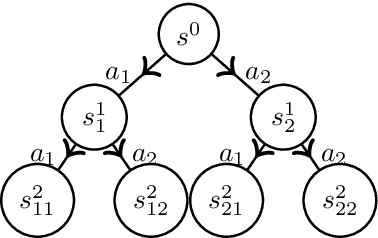
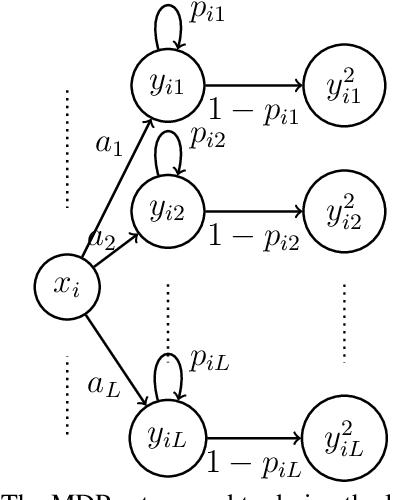
Reinforcement learning (RL) enables an agent interacting with an unknown MDP $M$ to optimise its behaviour by observing transitions sampled from $M$. A natural entity that emerges in the agent's reasoning is $\widehat{M}$, the maximum likelihood estimate of $M$ based on the observed transitions. The well-known \textit{certainty-equivalence} method (CEM) dictates that the agent update its behaviour to $\widehat{\pi}$, which is an optimal policy for $\widehat{M}$. Not only is CEM intuitive, it has been shown to enjoy minimax-optimal sample complexity in some regions of the parameter space for PAC RL with a generative model~\citep{Agarwal2020GenModel}. A seemingly unrelated algorithm is the ``trajectory tree method'' (TTM)~\citep{Kearns+MN:1999}, originally developed for efficient decision-time planning in large POMDPs. This paper presents a theoretical investigation that stems from the surprising finding that CEM may indeed be viewed as an application of TTM. The qualitative benefits of this view are (1) new and simple proofs of sample complexity upper bounds for CEM, in fact under a (2) weaker assumption on the rewards than is prevalent in the current literature. Our analysis applies to both non-stationary and stationary MDPs. Quantitatively, we obtain (3) improvements in the sample-complexity upper bounds for CEM both for non-stationary and stationary MDPs, in the regime that the ``mistake probability'' $\delta$ is small. Additionally, we show (4) a lower bound on the sample complexity for finite-horizon MDPs, which establishes the minimax-optimality of our upper bound for non-stationary MDPs in the small-$\delta$ regime.
Analysis of Tomographic Reconstruction of 2D Images using the Distribution of Unknown Projection Angles
Apr 13, 2023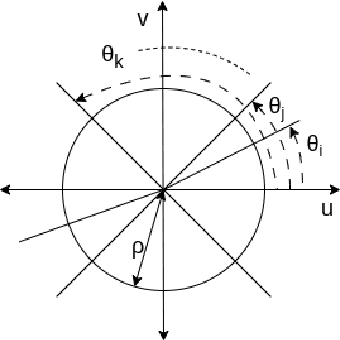
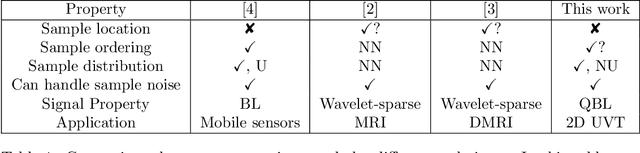
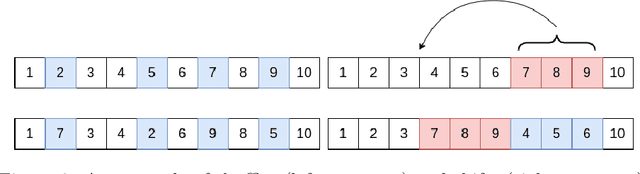
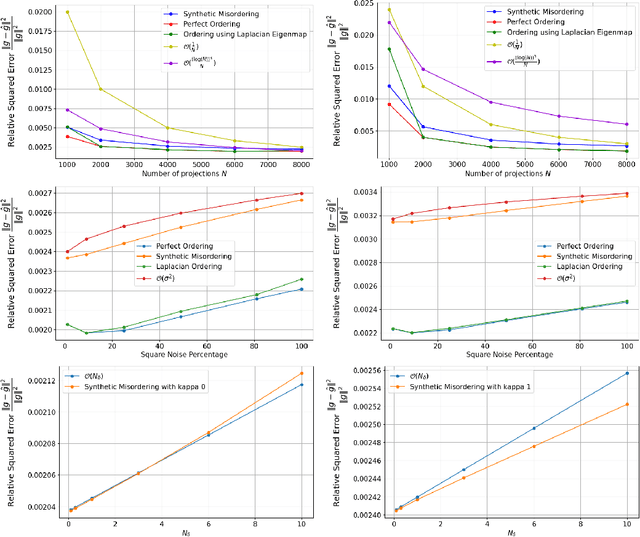
It is well known that a band-limited signal can be reconstructed from its uniformly spaced samples if the sampling rate is sufficiently high. More recently, it has been proved that one can reconstruct a 1D band-limited signal even if the exact sample locations are unknown, but given just the distribution of the sample locations and their ordering in 1D. In this work, we extend the analytical bounds on the reconstruction error in such scenarios for quasi-bandlimited signals. We also prove that the method for such a reconstruction is resilient to a certain proportion of errors in the specification of the sample location ordering. We then express the problem of tomographic reconstruction of 2D images from 1D Radon projections under unknown angles with known angle distribution, as a special case for reconstruction of quasi-bandlimited signals from samples at unknown locations with known distribution. Building upon our theoretical background, we present asymptotic bounds for 2D quasi-bandlimited image reconstruction from 1D Radon projections in the unknown angles setting, which commonly occurs in cryo-electron microscopy (cryo-EM). To the best of our knowledge, this is the first piece of work to perform such an analysis for 2D cryo-EM, even though the associated reconstruction algorithms have been known for a long time.
Compressive Image Classification using Deterministic Sensing Matrices
Oct 15, 2022
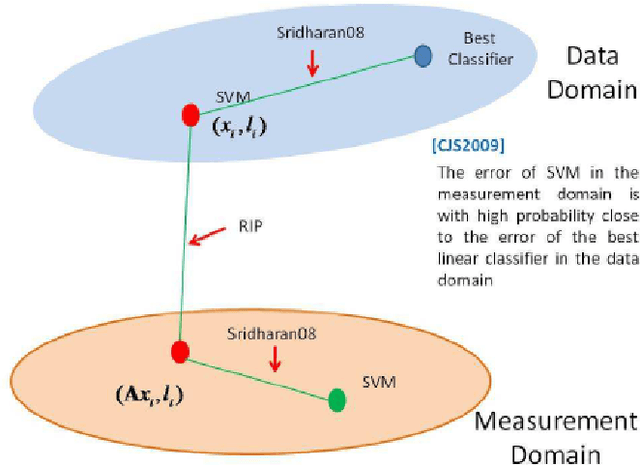


We look at the use of deterministic sensing matrices for compressed sensing and provide worst-case bounds on the classification accuracy of SVMs on compressively sensed data.
Reinforcement Learning for ConnectX
Oct 15, 2022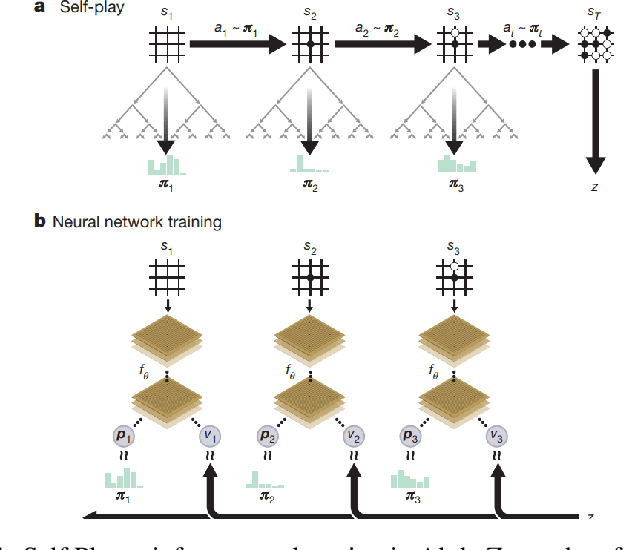


ConnectX is a two-player game that generalizes the popular game Connect 4. The objective is to get X coins across a row, column, or diagonal of an M x N board. The first player to do so wins the game. The parameters (M, N, X) are allowed to change in each game, making ConnectX a novel and challenging problem. In this paper, we present our work on the implementation and modification of various reinforcement learning algorithms to play ConnectX.