 Add to Chrome
 Add to Firefox
 Add to Edge
ARREST: Adversarial Resilient Regulation Enhancing Safety and Truth in Large Language Models
Jan 07, 2026
Human cognition, driven by complex neurochemical processes, oscillates between imagination and reality and learns to self-correct whenever such subtle drifts lead to hallucinations or unsafe associations. In recent years, LLMs have demonstrated remarkable performance in a wide range of tasks. However, they still lack human cognition to balance factuality and safety. Bearing the resemblance, we argue that both factual and safety failures in LLMs arise from a representational misalignment in their latent activation space, rather than addressing those as entirely separate alignment issues. We hypothesize that an external network, trained to understand the fluctuations, can selectively intervene in the model to regulate falsehood into truthfulness and unsafe output into safe output without fine-tuning the model parameters themselves. Reflecting the hypothesis, we propose ARREST (Adversarial Resilient Regulation Enhancing Safety and Truth), a unified framework that identifies and corrects drifted features, engaging both soft and hard refusals in addition to factual corrections. Our empirical results show that ARREST not only regulates misalignment but is also more versatile compared to the RLHF-aligned models in generating soft refusals due to adversarial training. We make our codebase available at https://github.com/sharanya-dasgupta001/ARREST.

HalluShift++: Bridging Language and Vision through Internal Representation Shifts for Hierarchical Hallucinations in MLLMs
Dec 08, 2025Multimodal Large Language Models (MLLMs) have demonstrated remarkable capabilities in vision-language understanding tasks. While these models often produce linguistically coherent output, they often suffer from hallucinations, generating descriptions that are factually inconsistent with the visual content, potentially leading to adverse consequences. Therefore, the assessment of hallucinations in MLLM has become increasingly crucial in the model development process. Contemporary methodologies predominantly depend on external LLM evaluators, which are themselves susceptible to hallucinations and may present challenges in terms of domain adaptation. In this study, we propose the hypothesis that hallucination manifests as measurable irregularities within the internal layer dynamics of MLLMs, not merely due to distributional shifts but also in the context of layer-wise analysis of specific assumptions. By incorporating such modifications, \textsc{\textsc{HalluShift++}} broadens the efficacy of hallucination detection from text-based large language models (LLMs) to encompass multimodal scenarios. Our codebase is available at https://github.com/C0mRD/HalluShift_Plus.
HalluShift: Measuring Distribution Shifts towards Hallucination Detection in LLMs
Apr 13, 2025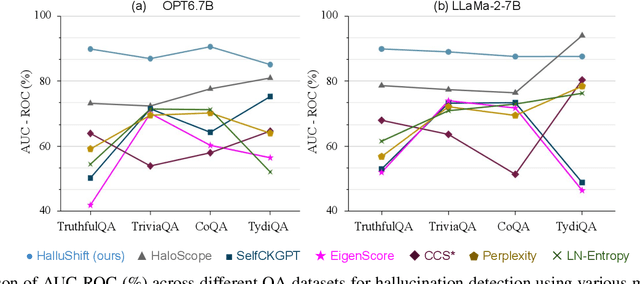
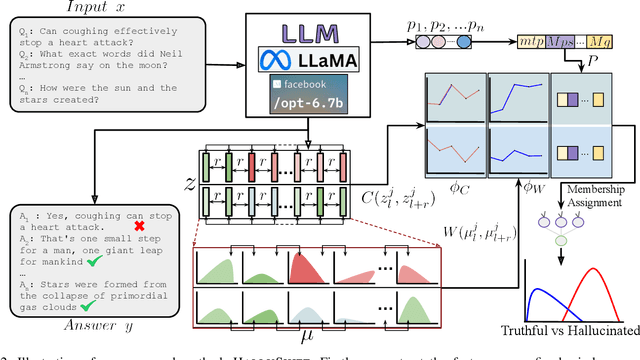
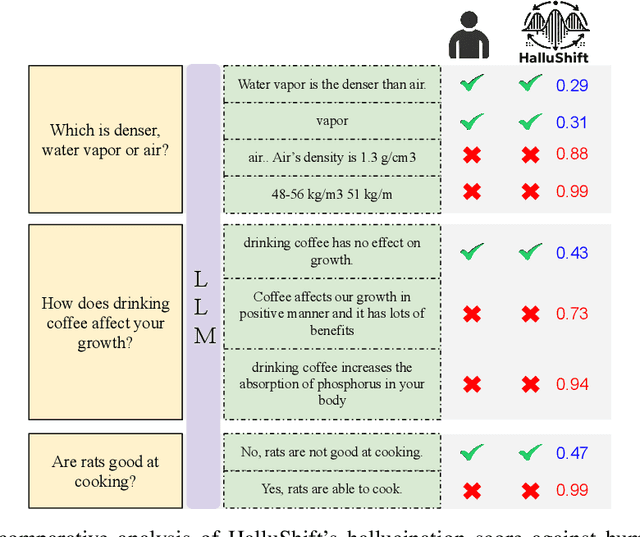
Large Language Models (LLMs) have recently garnered widespread attention due to their adeptness at generating innovative responses to the given prompts across a multitude of domains. However, LLMs often suffer from the inherent limitation of hallucinations and generate incorrect information while maintaining well-structured and coherent responses. In this work, we hypothesize that hallucinations stem from the internal dynamics of LLMs. Our observations indicate that, during passage generation, LLMs tend to deviate from factual accuracy in subtle parts of responses, eventually shifting toward misinformation. This phenomenon bears a resemblance to human cognition, where individuals may hallucinate while maintaining logical coherence, embedding uncertainty within minor segments of their speech. To investigate this further, we introduce an innovative approach, HalluShift, designed to analyze the distribution shifts in the internal state space and token probabilities of the LLM-generated responses. Our method attains superior performance compared to existing baselines across various benchmark datasets. Our codebase is available at https://github.com/sharanya-dasgupta001/hallushift.