 Add to Chrome
 Add to Firefox
 Add to Edge
Kimi K2.5: Visual Agentic Intelligence
Feb 02, 2026
We introduce Kimi K2.5, an open-source multimodal agentic model designed to advance general agentic intelligence. K2.5 emphasizes the joint optimization of text and vision so that two modalities enhance each other. This includes a series of techniques such as joint text-vision pre-training, zero-vision SFT, and joint text-vision reinforcement learning. Building on this multimodal foundation, K2.5 introduces Agent Swarm, a self-directed parallel agent orchestration framework that dynamically decomposes complex tasks into heterogeneous sub-problems and executes them concurrently. Extensive evaluations show that Kimi K2.5 achieves state-of-the-art results across various domains including coding, vision, reasoning, and agentic tasks. Agent Swarm also reduces latency by up to $4.5\times$ over single-agent baselines. We release the post-trained Kimi K2.5 model checkpoint to facilitate future research and real-world applications of agentic intelligence.

Great Memory, Shallow Reasoning: Limits of $k$NN-LMs
Aug 21, 2024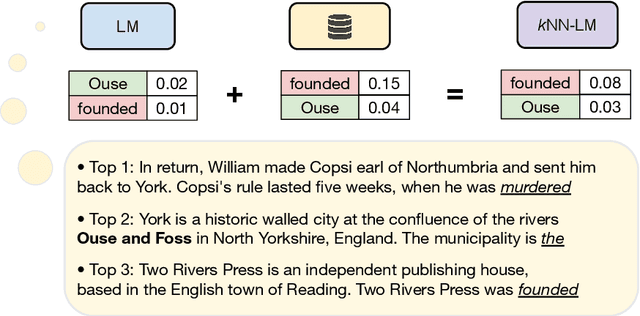
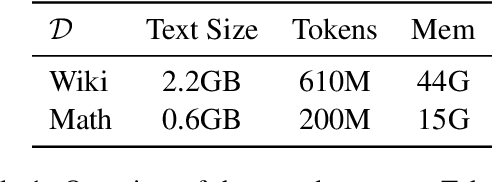
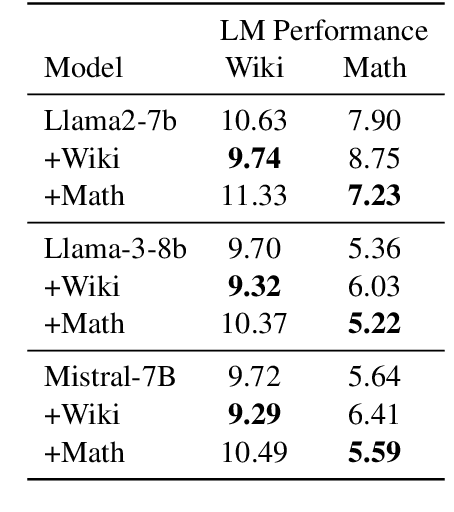
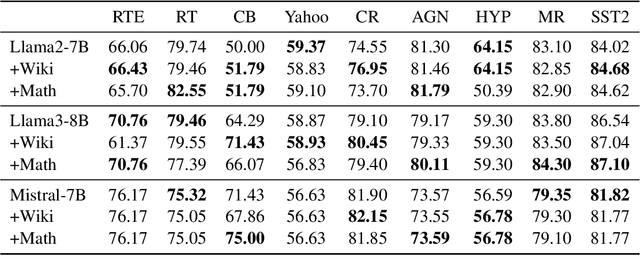
$K$-nearest neighbor language models ($k$NN-LMs), which integrate retrieval with next-word prediction, have demonstrated strong performance in language modeling as well as downstream NLP benchmarks. These results have led researchers to argue that models trained on poor quality or outdated data could perform well by employing a $k$NN extension that has access to a higher-quality datastore. In this work, we ask whether this improved ability to recall information really translates into downstream abilities. We extensively evaluate $k$NN-LMs on a diverse set of tasks, ranging from sentiment classification and commonsense reasoning to multi-hop reasoning. Results show that $k$NN-LMs excel at memory-intensive tasks, where utilizing the patterns in the input is sufficient for determining the output, but struggle with reasoning tasks that require integrating multiple pieces of information to derive new knowledge. We further demonstrate through oracle experiments and qualitative analysis that even with perfect retrieval, $k$NN-LMs still fail to determine the correct answers, placing an upper bound on their reasoning performance. Code and datastores are released at https://github.com/GSYfate/knnlm-limits/.