 Add to Chrome
 Add to Firefox
 Add to Edge
Bridging the Semantic Chasm: Synergistic Conceptual Anchoring for Generalized Few-Shot and Zero-Shot OOD Perception
Jan 30, 2026
This manuscript presents a pioneering Synergistic Neural Agents Network (SynerNet) framework designed to mitigate the phenomenon of cross-modal alignment degeneration in Vision-Language Models (VLMs) when encountering Out-of-Distribution (OOD) concepts. Specifically, four specialized computational units - visual perception, linguistic context, nominal embedding, and global coordination - collaboratively rectify modality disparities via a structured message-propagation protocol. The principal contributions encompass a multi-agent latent space nomenclature acquisition framework, a semantic context-interchange algorithm for enhanced few-shot adaptation, and an adaptive dynamic equilibrium mechanism. Empirical evaluations conducted on the VISTA-Beyond benchmark demonstrate that SynerNet yields substantial performance augmentations in both few-shot and zero-shot scenarios, exhibiting precision improvements ranging from 1.2% to 5.4% across a diverse array of domains.

Reservoir Computing with Thin-film Ferromagnetic Devices
Jan 29, 2021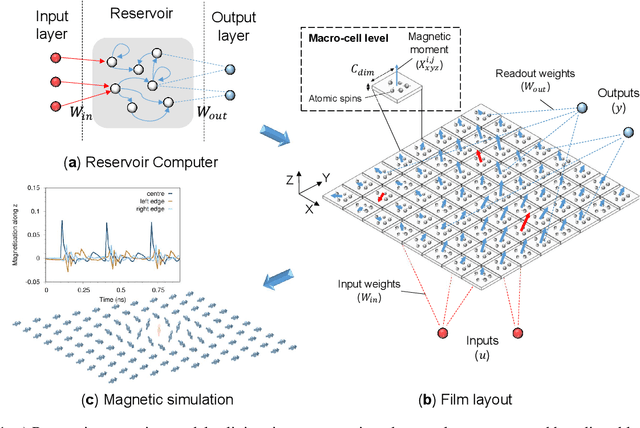
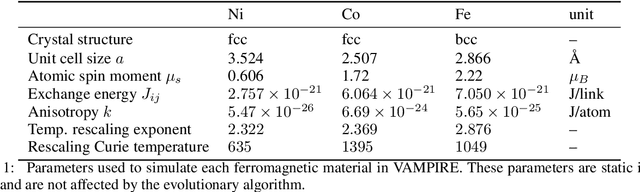
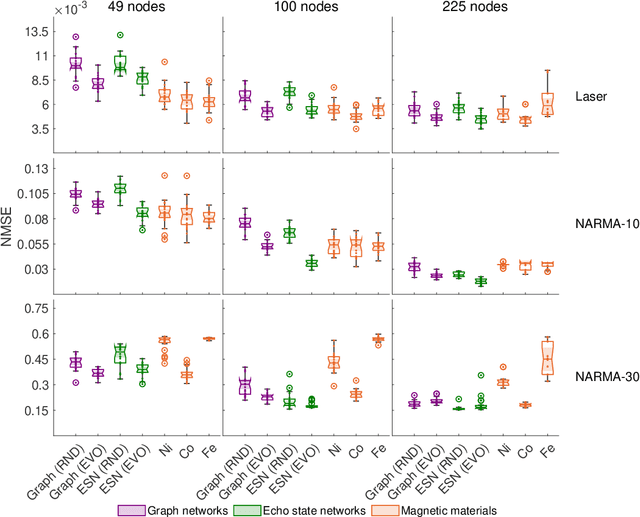
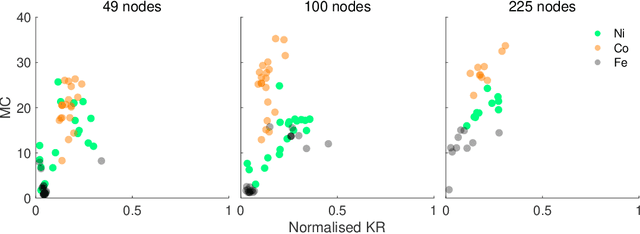
Advances in artificial intelligence are driven by technologies inspired by the brain, but these technologies are orders of magnitude less powerful and energy efficient than biological systems. Inspired by the nonlinear dynamics of neural networks, new unconventional computing hardware has emerged with the potential for extreme parallelism and ultra-low power consumption. Physical reservoir computing demonstrates this with a variety of unconventional systems from optical-based to spintronic. Reservoir computers provide a nonlinear projection of the task input into a high-dimensional feature space by exploiting the system's internal dynamics. A trained readout layer then combines features to perform tasks, such as pattern recognition and time-series analysis. Despite progress, achieving state-of-the-art performance without external signal processing to the reservoir remains challenging. Here we show, through simulation, that magnetic materials in thin-film geometries can realise reservoir computers with greater than or similar accuracy to digital recurrent neural networks. Our results reveal that basic spin properties of magnetic films generate the required nonlinear dynamics and memory to solve machine learning tasks. Furthermore, we show that neuromorphic hardware can be reduced in size by removing the need for discrete neural components and external processing. The natural dynamics and nanoscale size of magnetic thin-films present a new path towards fast energy-efficient computing with the potential to innovate portable smart devices, self driving vehicles, and robotics.