 Add to Chrome
 Add to Firefox
 Add to Edge
Knob: A Physics-Inspired Gating Interface for Interpretable and Controllable Neural Dynamics
Feb 26, 2026
Existing neural network calibration methods often treat calibration as a static, post-hoc optimization task. However, this neglects the dynamic and temporal nature of real-world inference. Moreover, existing methods do not provide an intuitive interface enabling human operators to dynamically adjust model behavior under shifting conditions. In this work, we propose Knob, a framework that connects deep learning with classical control theory by mapping neural gating dynamics to a second-order mechanical system. By establishing correspondences between physical parameters -- damping ratio ($ζ$) and natural frequency ($ω_n$) -- and neural gating, we create a tunable "safety valve". The core mechanism employs a logit-level convex fusion, functioning as an input-adaptive temperature scaling. It tends to reduce model confidence particularly when model branches produce conflicting predictions. Furthermore, by imposing second-order dynamics (Knob-ODE), we enable a \textit{dual-mode} inference: standard i.i.d. processing for static tasks, and state-preserving processing for continuous streams. Our framework allows operators to tune "stability" and "sensitivity" through familiar physical analogues. This paper presents an exploratory architectural interface; we focus on demonstrating the concept and validating its control-theoretic properties rather than claiming state-of-the-art calibration performance. Experiments on CIFAR-10-C validate the calibration mechanism and demonstrate that, in Continuous Mode, the gate responses are consistent with standard second-order control signatures (step settling and low-pass attenuation), paving the way for predictable human-in-the-loop tuning.

Everywhere Attack: Attacking Locally and Globally to Boost Targeted Transferability
Jan 01, 2025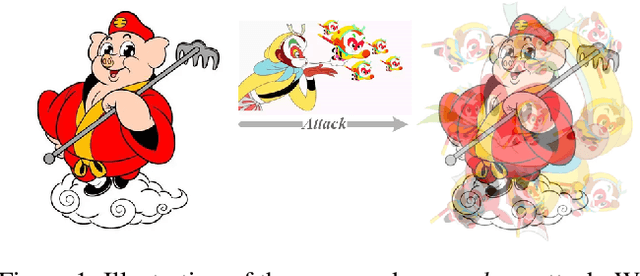
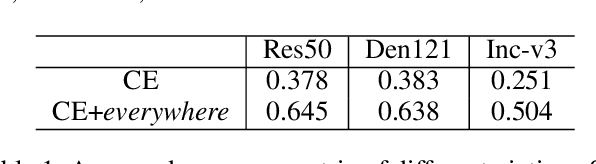
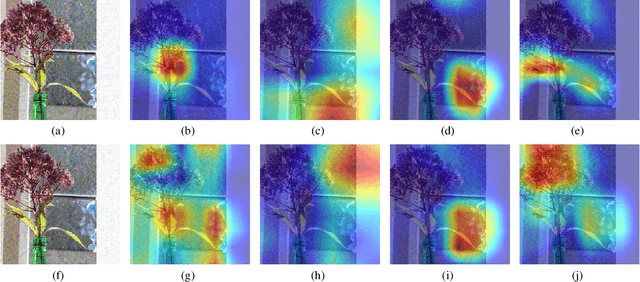
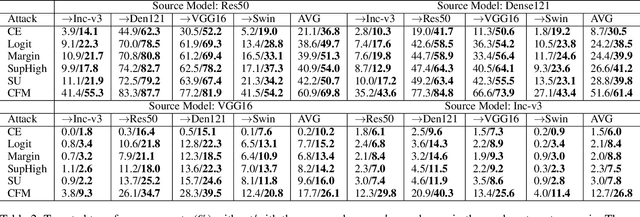
Adversarial examples' (AE) transferability refers to the phenomenon that AEs crafted with one surrogate model can also fool other models. Notwithstanding remarkable progress in untargeted transferability, its targeted counterpart remains challenging. This paper proposes an everywhere scheme to boost targeted transferability. Our idea is to attack a victim image both globally and locally. We aim to optimize 'an army of targets' in every local image region instead of the previous works that optimize a high-confidence target in the image. Specifically, we split a victim image into non-overlap blocks and jointly mount a targeted attack on each block. Such a strategy mitigates transfer failures caused by attention inconsistency between surrogate and victim models and thus results in stronger transferability. Our approach is method-agnostic, which means it can be easily combined with existing transferable attacks for even higher transferability. Extensive experiments on ImageNet demonstrate that the proposed approach universally improves the state-of-the-art targeted attacks by a clear margin, e.g., the transferability of the widely adopted Logit attack can be improved by 28.8%-300%.We also evaluate the crafted AEs on a real-world platform: Google Cloud Vision. Results further support the superiority of the proposed method.
Two Heads Are Better Than One: Averaging along Fine-Tuning to Improve Targeted Transferability
Dec 30, 2024
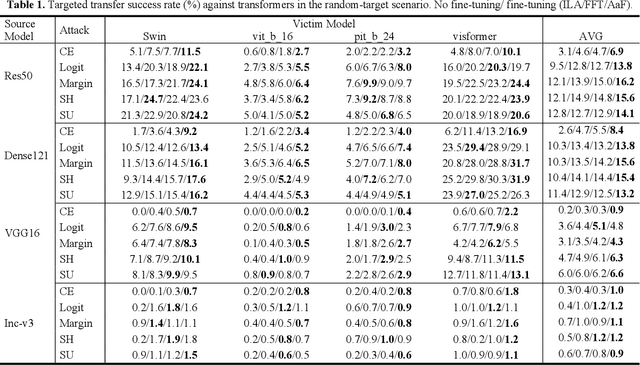
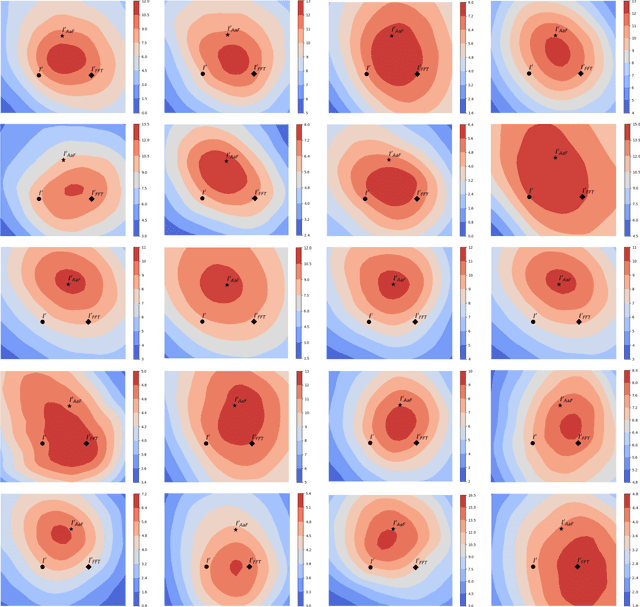
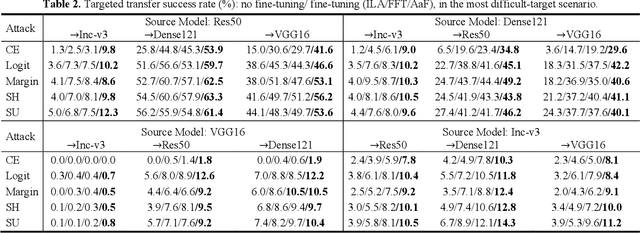
With much longer optimization time than that of untargeted attacks notwithstanding, the transferability of targeted attacks is still far from satisfactory. Recent studies reveal that fine-tuning an existing adversarial example (AE) in feature space can efficiently boost its targeted transferability. However, existing fine-tuning schemes only utilize the endpoint and ignore the valuable information in the fine-tuning trajectory. Noting that the vanilla fine-tuning trajectory tends to oscillate around the periphery of a flat region of the loss surface, we propose averaging over the fine-tuning trajectory to pull the crafted AE towards a more centered region. We compare the proposed method with existing fine-tuning schemes by integrating them with state-of-the-art targeted attacks in various attacking scenarios. Experimental results uphold the superiority of the proposed method in boosting targeted transferability. The code is available at github.com/zengh5/Avg_FT.