 Add to Chrome
 Add to Firefox
 Add to Edge
Decompose Sparsely Where You Should, Absorb Densely Where You Should No
Jun 12, 2026
Sparse autoencoders (SAEs) are typically trained to reconstruct the \textbf{entire} residual stream through a sparse dictionary, implicitly assuming that all activation content is amenable to sparse, monosemantic decomposition. We question this assumption and hypothesize that activations contain a low-rank, dense component that is computationally important to the model yet inherently unsuitable for sparse representation, which serves as a major source of the persistent dense latents widely observed in trained SAEs. To test this, we add a small rank-$r$ linear bottleneck in parallel with standard SAEs (BatchTopK and Matryoshka), allowing dense structure to be absorbed before sparse reconstruction. On Gemma-2-2B layer 12, a rank-24 bottleneck reduces dense latent count by up to 84\% while improving sparse probing and targeted probe perturbation on both architectures at matched sparsity. The absorbed component is (i) \textbf{structurally identifiable} as the top principal components and outlier dimensions; (ii) \textbf{causally necessary}, with removing it raising next-token cross-entropy by 7.5$\times$, far exceeding the 2.8$\times$ from removing the geometrically near-identical top-24 PCA directions; and (iii) \textbf{redundantly encoded by sparse dictionaries}, with ablating 787 maximally aligned sparse features raising cross-entropy by only 2.9$\times$ and ablating 2,048 topic-aligned features leaving MMLU topic classification virtually unchanged, whereas removing the scaffold drops it from 98.7\% to chance. Together, our findings identify a compact, semantically informative and causally important component of residual stream activations (which we term a \textbf{computational scaffold}) that standard sparse dictionaries represent inefficiently, suggesting that the scope of sparsity-based interpretability methods warrants careful re-examination.

Beyond Steering Vector: Flow-based Activation Steering for Inference-Time Intervention
May 07, 2026Activation steering has emerged as a promising alternative for controlling language-model behavior at inference time by modifying intermediate representations while keeping model parameters frozen. However, large-scale evaluations such as AxBench show that existing steering methods are often outperformed by simple in-context prompting and generalize poorly to unseen concepts. We hypothesize that these limitations arise from unvalidated simplifying assumptions shared across prior methods, which typically restrict steering interventions to fixed, single-step, position-invariant transforms. We propose FLAS (Flow-based Activation Steering), which learns a general, concept-conditioned velocity field $v_t(h,t,c)$ that transports unsteered activations to steered ones without relying on these assumptions. On AxBench, FLAS is the first learned method to consistently outperform prompting, reaching held-out harmonic means of $1.015$ on Gemma-2-2B-IT and $1.113$ on Gemma-2-9B-IT without per-concept tuning. Analysis of the learned flow shows curved, multi-step, token-varying trajectories, which suggests that previous hypotheses on activation space geometry might be incomplete.
Koopman neural operator as a mesh-free solver of non-linear partial differential equations
Jan 24, 2023

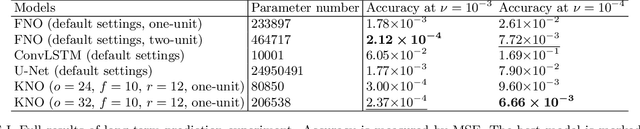

The lacking of analytic solutions of diverse partial differential equations (PDEs) gives birth to series of computational techniques for numerical solutions. In machine learning, numerous latest advances of solver designs are accomplished in developing neural operators, a kind of mesh-free approximators of the infinite-dimensional operators that map between different parameterization spaces of equation solutions. Although neural operators exhibit generalization capacities for learning an entire PDE family simultaneously, they become less accurate and explainable while learning long-term behaviours of non-linear PDE families. In this paper, we propose Koopman neural operator (KNO), a new neural operator, to overcome these challenges. With the same objective of learning an infinite-dimensional mapping between Banach spaces that serves as the solution operator of target PDE family, our approach differs from existing models by formulating a non-linear dynamic system of equation solution. By approximating the Koopman operator, an infinite-dimensional linear operator governing all possible observations of the dynamic system, to act on the flow mapping of dynamic system, we can equivalently learn the solution of an entire non-linear PDE family by solving simple linear prediction problems. In zero-shot prediction and long-term prediction experiments on representative PDEs (e.g., the Navier-Stokes equation), KNO exhibits notable advantages in breaking the tradeoff between accuracy and efficiency (e.g., model size) while previous state-of-the-art models are limited. These results suggest that more efficient PDE solvers can be developed by the joint efforts from physics and machine learning.