 Add to Chrome
 Add to Firefox
 Add to Edge
CutisAI: Deep Learning Framework for Automated Dermatology and Cancer Screening
Jan 05, 2026
The rapid growth of dermatological imaging and mobile diagnostic tools calls for systems that not only demonstrate empirical performance but also provide strong theoretical guarantees. Deep learning models have shown high predictive accuracy; however, they are often criticized for lacking well, calibrated uncertainty estimates without which these models are hardly deployable in a clinical setting. To this end, we present the Conformal Bayesian Dermatological Classifier (CBDC), a well, founded framework that combines Statistical Learning Theory, Topological Data Analysis (TDA), and Bayesian Conformal Inference. CBDC offers distribution, dependent generalization bounds that reflect dermatological variability, proves a topological stability theorem that guarantees the invariance of convolutional neural network embeddings under photometric and morphological perturbations and provides finite conformal coverage guarantees for trustworthy uncertainty quantification. Through exhaustive experiments on the HAM10000, PH2, and ISIC 2020 datasets, we show that CBDC not only attains classification accuracy but also generates calibrated predictions that are interpretable from a clinical perspective. This research constitutes a theoretical and practical leap for deep dermatological diagnostics, thereby opening the machine learning theory clinical applicability interface.

Performance evaluation of deep neural networks for forecasting time-series with multiple structural breaks and high volatility
Nov 14, 2019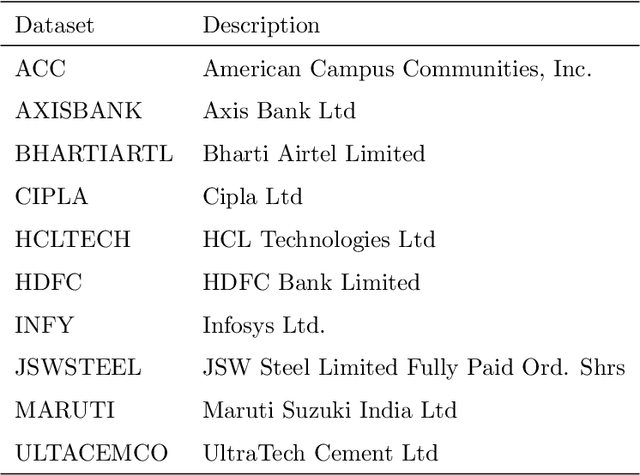
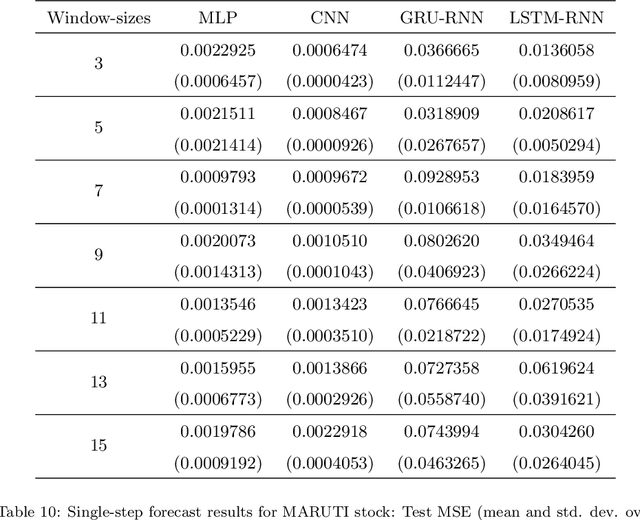
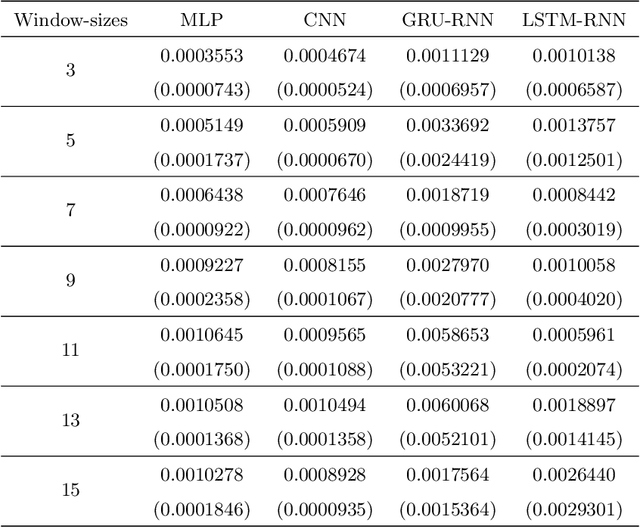
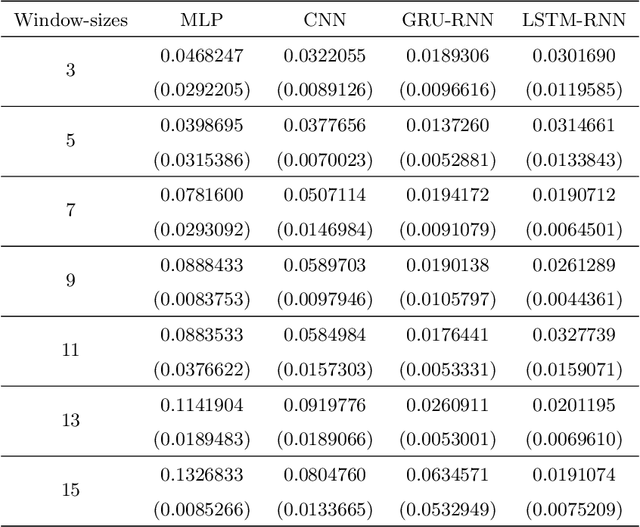
The problem of automatic forecasting of time-series data has been a long-standing challenge for the machine learning and forecasting community. The problem is relatively simple when the series is stationary. However, the majority of the real-world time-series problems have non-stationary characteristics making the understanding of the trend and seasonality very complex. Further, it is assumed that the future response is dependent on the past data and, therefore, can be modeled using a function approximator. Our interest in this paper is to study the applicability of the popular deep neural networks (DNN) comprehensively as function approximators for non-stationary time-series forecasting. We employ the following DNN models: Multi-layer Perceptron (MLP), Convolutional Neural Network (CNN), and RNN with Long-Short Term Memory (LSTM-RNN) and RNN with Gated-Recurrent Unit (GRU-RNN). These powerful DNN methods have been evaluated over popular Indian financial stocks data comprising of five stocks from National Stock Exchange Nifty-50 (NSE-Nifty50), and five stocks from Bombay Stock Exchange 30 (BSE-30). Further, the performance evaluation of these DNNs in terms of their predictive power has been done using two fashions: (1) single-step forecasting, (2) multi-step forecasting. Our extensive simulation experiments on these ten datasets report that the performance of these DNNs for single-step forecasting is pretty convincing as the predictions are found to follow the truely observed values closely. However, we also find that all these DNN models perform miserably in the case of multi-step time-series forecasting, based on the datasets used by us. Consequently, we observe that none of these DNN models are reliable for multi-step time-series forecasting.