 Add to Chrome
 Add to Firefox
 Add to Edge
TBDFiltering: Sample-Efficient Tree-Based Data Filtering
Jan 29, 2026
The quality of machine learning models depends heavily on their training data. Selecting high-quality, diverse training sets for large language models (LLMs) is a difficult task, due to the lack of cheap and reliable quality metrics. While querying existing LLMs for document quality is common, this is not scalable to the large number (billions) of documents used in training. Instead, practitioners often use classifiers trained on sparse quality signals. In this paper, we propose a text-embedding-based hierarchical clustering approach that adaptively selects the documents to be evaluated by the LLM to estimate cluster quality. We prove that our method is query efficient: under the assumption that the hierarchical clustering contains a subtree such that each leaf cluster in the tree is pure enough (i.e., it mostly contains either only good or only bad documents), with high probability, the method can correctly predict the quality of each document after querying a small number of documents. The number of such documents is proportional to the size of the smallest subtree with (almost) pure leaves, without the algorithm knowing this subtree in advance. Furthermore, in a comprehensive experimental study, we demonstrate the benefits of our algorithm compared to other classifier-based filtering methods.

Easy Learning from Label Proportions
Feb 13, 2023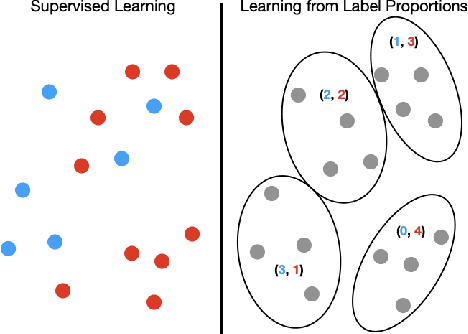
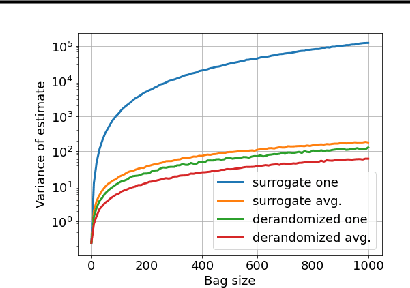
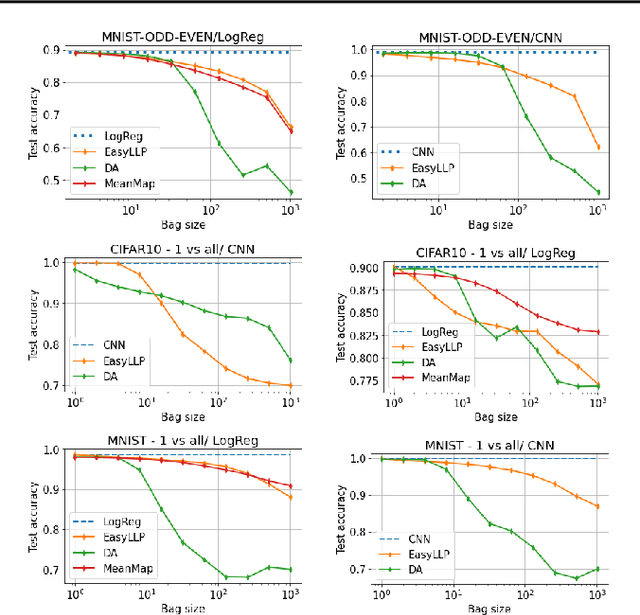
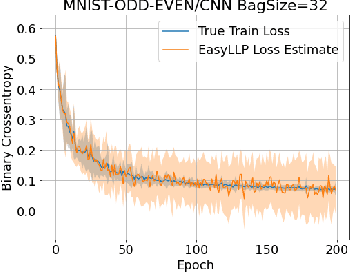
We consider the problem of Learning from Label Proportions (LLP), a weakly supervised classification setup where instances are grouped into "bags", and only the frequency of class labels at each bag is available. Albeit, the objective of the learner is to achieve low task loss at an individual instance level. Here we propose Easyllp: a flexible and simple-to-implement debiasing approach based on aggregate labels, which operates on arbitrary loss functions. Our technique allows us to accurately estimate the expected loss of an arbitrary model at an individual level. We showcase the flexibility of our approach by applying it to popular learning frameworks, like Empirical Risk Minimization (ERM) and Stochastic Gradient Descent (SGD) with provable guarantees on instance level performance. More concretely, we exhibit a variance reduction technique that makes the quality of LLP learning deteriorate only by a factor of k (k being bag size) in both ERM and SGD setups, as compared to full supervision. Finally, we validate our theoretical results on multiple datasets demonstrating our algorithm performs as well or better than previous LLP approaches in spite of its simplicity.