 Add to Chrome
 Add to Firefox
 Add to Edge
SafeMIL: Learning Offline Safe Imitation Policy from Non-Preferred Trajectories
Nov 14, 2025
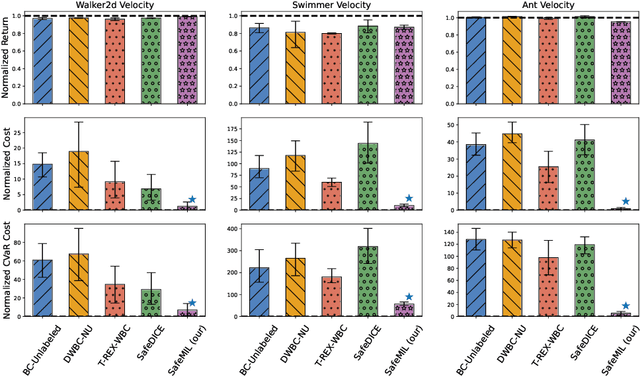
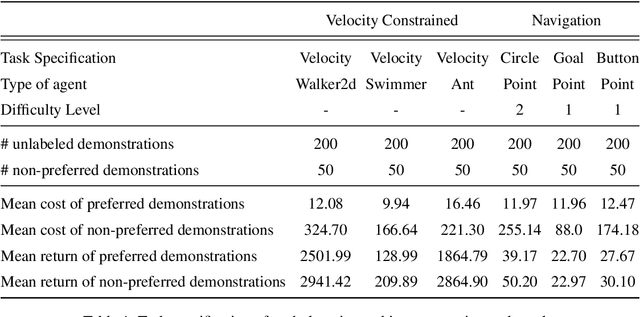
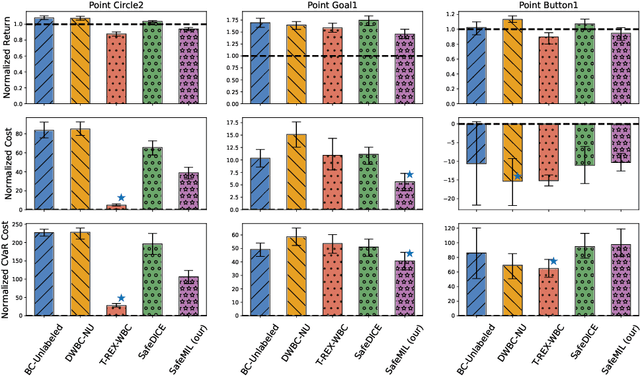
In this work, we study the problem of offline safe imitation learning (IL). In many real-world settings, online interactions can be risky, and accurately specifying the reward and the safety cost information at each timestep can be difficult. However, it is often feasible to collect trajectories reflecting undesirable or risky behavior, implicitly conveying the behavior the agent should avoid. We refer to these trajectories as non-preferred trajectories. Unlike standard IL, which aims to mimic demonstrations, our agent must also learn to avoid risky behavior using non-preferred trajectories. In this paper, we propose a novel approach, SafeMIL, to learn a parameterized cost that predicts if the state-action pair is risky via Multiple Instance Learning. The learned cost is then used to avoid non-preferred behaviors, resulting in a policy that prioritizes safety. We empirically demonstrate that our approach can learn a safer policy that satisfies cost constraints without degrading the reward performance, thereby outperforming several baselines.

GAN-MPC: Training Model Predictive Controllers with Parameterized Cost Functions using Demonstrations from Non-identical Experts
Jun 07, 2023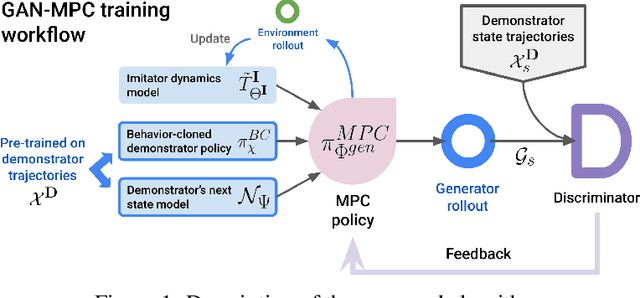

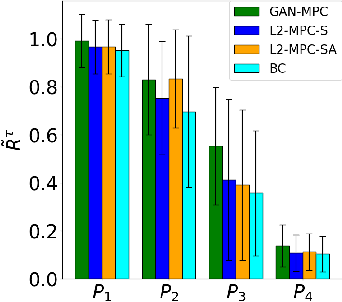
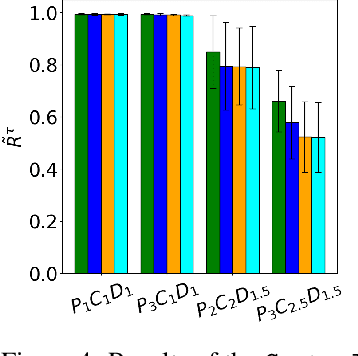
Model predictive control (MPC) is a popular approach for trajectory optimization in practical robotics applications. MPC policies can optimize trajectory parameters under kinodynamic and safety constraints and provide guarantees on safety, optimality, generalizability, interpretability, and explainability. However, some behaviors are complex and it is difficult to hand-craft an MPC objective function. A special class of MPC policies called Learnable-MPC addresses this difficulty using imitation learning from expert demonstrations. However, they require the demonstrator and the imitator agents to be identical which is hard to satisfy in many real world applications of robotics. In this paper, we address the practical problem of training Learnable-MPC policies when the demonstrator and the imitator do not share the same dynamics and their state spaces may have a partial overlap. We propose a novel approach that uses a generative adversarial network (GAN) to minimize the Jensen-Shannon divergence between the state-trajectory distributions of the demonstrator and the imitator. We evaluate our approach on a variety of simulated robotics tasks of DeepMind Control suite and demonstrate the efficacy of our approach at learning the demonstrator's behavior without having to copy their actions.