 Add to Chrome
 Add to Firefox
 Add to Edge
Flocking phase transition and threat responses in bio-inspired autonomous drone swarms
Dec 24, 2025
Collective motion inspired by animal groups offers powerful design principles for autonomous aerial swarms. We present a bio-inspired 3D flocking algorithm in which each drone interacts only with a minimal set of influential neighbors, relying solely on local alignment and attraction cues. By systematically tuning these two interaction gains, we map a phase diagram revealing sharp transitions between swarming and schooling, as well as a critical region where susceptibility, polarization fluctuations, and reorganization capacity peak. Outdoor experiments with a swarm of ten drones, combined with simulations using a calibrated flight-dynamics model, show that operating near this transition enhances responsiveness to external disturbances. When confronted with an intruder, the swarm performs rapid collective turns, transient expansions, and reliably recovers high alignment within seconds. These results demonstrate that minimal local-interaction rules are sufficient to generate multiple collective phases and that simple gain modulation offers an efficient mechanism to adjust stability, flexibility, and resilience in drone swarms.

Predicting long-term collective animal behavior with deep learning
Feb 14, 2023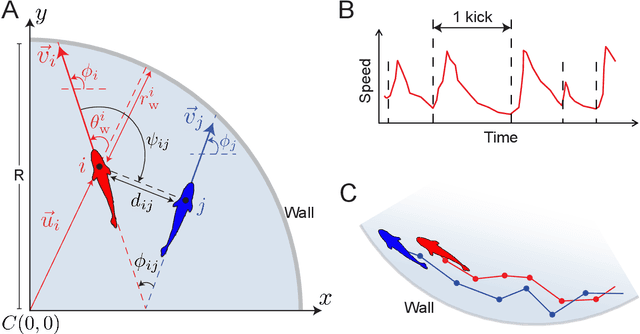
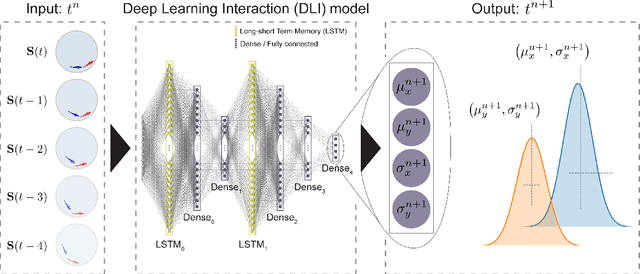
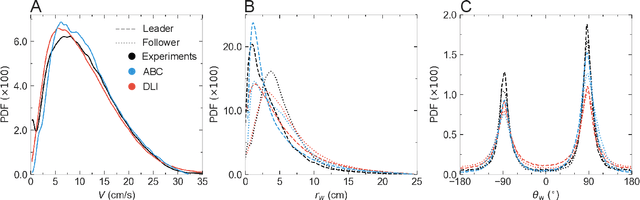
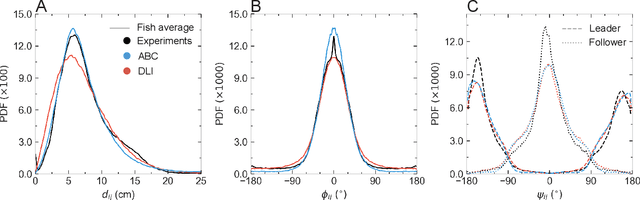
Deciphering the social interactions that govern collective behavior in animal societies has greatly benefited from advancements in modern computing. Computational models diverge into two kinds of approaches: analytical models and machine learning models. This work introduces a deep learning model for social interactions in the fish species Hemigrammus rhodostomus, and compares its results to experiments and to the results of a state-of-the-art analytical model. To that end, we propose a systematic methodology to assess the faithfulness of a model, based on the introduction of a set of stringent observables. We demonstrate that machine learning models of social interactions can directly compete against their analytical counterparts. Moreover, this work demonstrates the need for consistent validation across different timescales and highlights which design aspects critically enables our deep learning approach to capture both short- and long-term dynamics. We also show that this approach is scalable to other fish species.