 Add to Chrome
 Add to Firefox
 Add to Edge
Reducing Estimation Uncertainty Using Normalizing Flows and Stratification
Feb 16, 2026
Estimating the expectation of a real-valued function of a random variable from sample data is a critical aspect of statistical analysis, with far-reaching implications in various applications. Current methodologies typically assume (semi-)parametric distributions such as Gaussian or mixed Gaussian, leading to significant estimation uncertainty if these assumptions do not hold. We propose a flow-based model, integrated with stratified sampling, that leverages a parametrized neural network to offer greater flexibility in modeling unknown data distributions, thereby mitigating this limitation. Our model shows a marked reduction in estimation uncertainty across multiple datasets, including high-dimensional (30 and 128) ones, outperforming crude Monte Carlo estimators and Gaussian mixture models. Reproducible code is available at https://github.com/rnoxy/flowstrat.

Adversarial Autoencoders for Generating 3D Point Clouds
Nov 19, 2018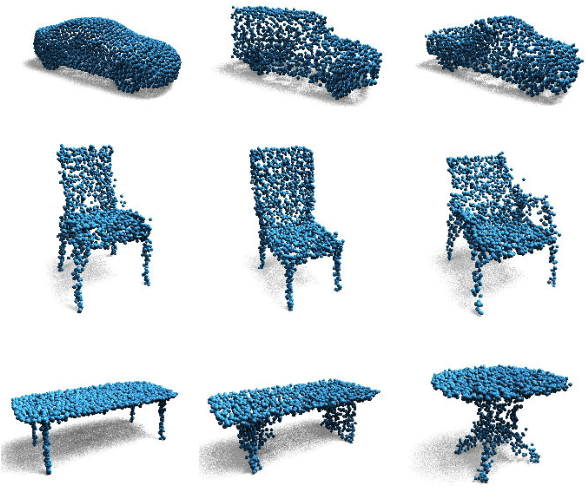
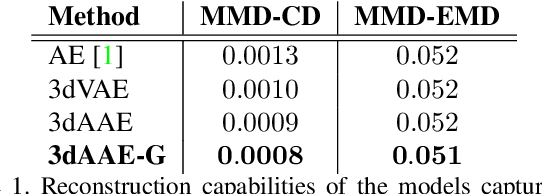
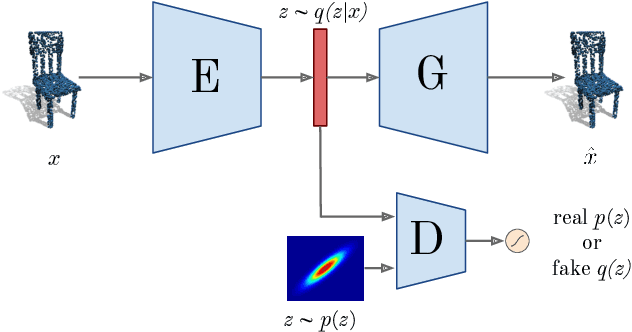

Deep generative architectures provide a way to model not only images, but also complex, 3-dimensional objects, such as point clouds. In this work, we present a novel method to obtain meaningful representations of 3D shapes that can be used for clustering and reconstruction. Contrary to existing methods for 3D point cloud generation that train separate decoupled models for representation learning and generation, our approach is the first end-to-end solution that allows to simultaneously learn a latent space of representation and generate 3D shape out of it. To achieve this goal, we extend a deep Adversarial Autoencoder model (AAE) to accept 3D input and create 3D output. Thanks to our end-to-end training regime, the resulting method called 3D Adversarial Autoencoder (3dAAE) obtains either binary or continuous latent space that covers much wider portion of training data distribution, hence allowing smooth interpolation between the shapes. Finally, our extensive quantitative evaluation shows that 3dAAE provides state-of-the-art results on a set of benchmark tasks.