 Add to Chrome
 Add to Firefox
 Add to Edge
Estimating Force Interactions of Deformable Linear Objects from their Shapes
Feb 01, 2026
This work introduces an analytical approach for detecting and estimating external forces acting on deformable linear objects (DLOs) using only their observed shapes. In many robot-wire interaction tasks, contact occurs not at the end-effector but at other points along the robot's body. Such scenarios arise when robots manipulate wires indirectly (e.g., by nudging) or when wires act as passive obstacles in the environment. Accurately identifying these interactions is crucial for safe and efficient trajectory planning, helping to prevent wire damage, avoid restricted robot motions, and mitigate potential hazards. Existing approaches often rely on expensive external force-torque sensor or that contacts occur at the end-effector for accurate force estimation. Using wire shape information acquired from a depth camera and under the assumption that the wire is in or near its static equilibrium, our method estimates both the location and magnitude of external forces without additional prior knowledge. This is achieved by exploiting derived consistency conditions and solving a system of linear equations based on force-torque balance along the wire. The approach was validated through simulation, where it achieved high accuracy, and through real-world experiments, where accurate estimation was demonstrated in selected interaction scenarios.

Dynamic Manipulation of a Deformable Linear Object: Simulation and Learning
Oct 02, 2023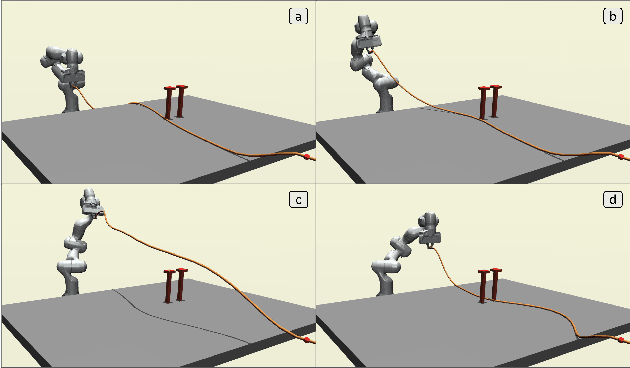
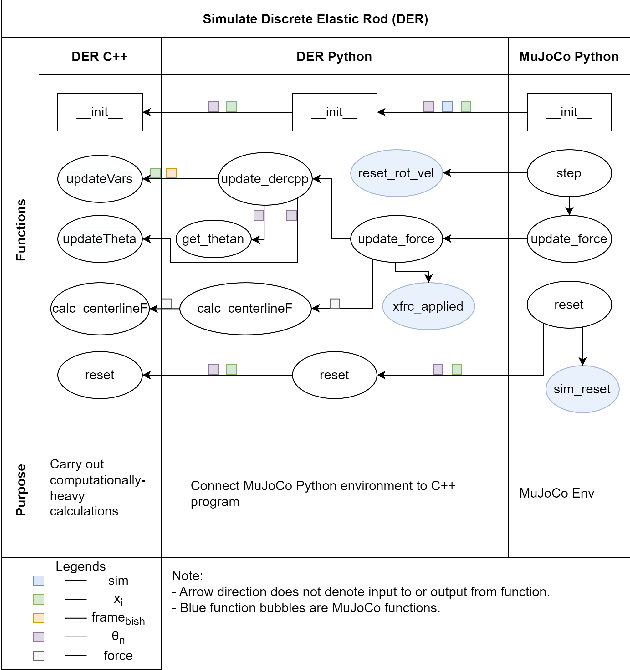
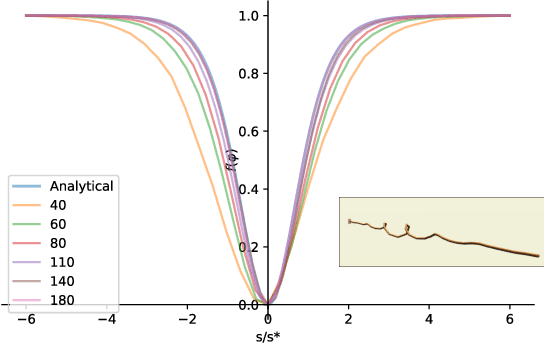
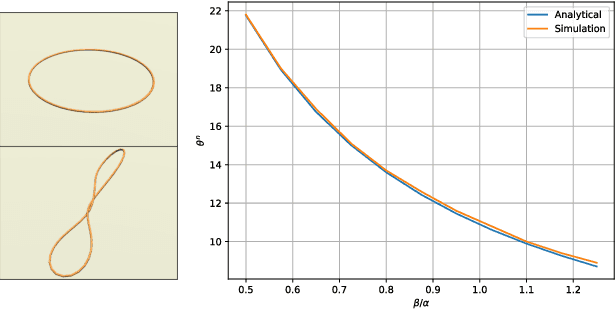
We show that it is possible to learn an open-loop policy in simulation for the dynamic manipulation of a deformable linear object (DLO) -- e.g., a rope, wire, or cable -- that can be executed by a real robot without additional training. Our method is enabled by integrating an existing state-of-the-art DLO model (Discrete Elastic Rods) with MuJoCo, a robot simulator. We describe how this integration was done, check that validation results produced in simulation match what we expect from analysis of the physics, and apply policy optimization to train an open-loop policy from data collected only in simulation that uses a robot arm to fling a wire precisely between two obstacles. This policy achieves a success rate of 76.7% when executed by a real robot in hardware experiments without additional training on the real task.