 Add to Chrome
 Add to Firefox
 Add to Edge
Towards Realistic Synthetic Data for Automatic Drum Transcription
Jan 14, 2026
Deep learning models define the state-of-the-art in Automatic Drum Transcription (ADT), yet their performance is contingent upon large-scale, paired audio-MIDI datasets, which are scarce. Existing workarounds that use synthetic data often introduce a significant domain gap, as they typically rely on low-fidelity SoundFont libraries that lack acoustic diversity. While high-quality one-shot samples offer a better alternative, they are not available in a standardized, large-scale format suitable for training. This paper introduces a new paradigm for ADT that circumvents the need for paired audio-MIDI training data. Our primary contribution is a semi-supervised method to automatically curate a large and diverse corpus of one-shot drum samples from unlabeled audio sources. We then use this corpus to synthesize a high-quality dataset from MIDI files alone, which we use to train a sequence-to-sequence transcription model. We evaluate our model on the ENST and MDB test sets, where it achieves new state-of-the-art results, significantly outperforming both fully supervised methods and previous synthetic-data approaches. The code for reproducing our experiments is publicly available at https://github.com/pier-maker92/ADT_STR

How to Connect Speech Foundation Models and Large Language Models? What Matters and What Does Not
Sep 25, 2024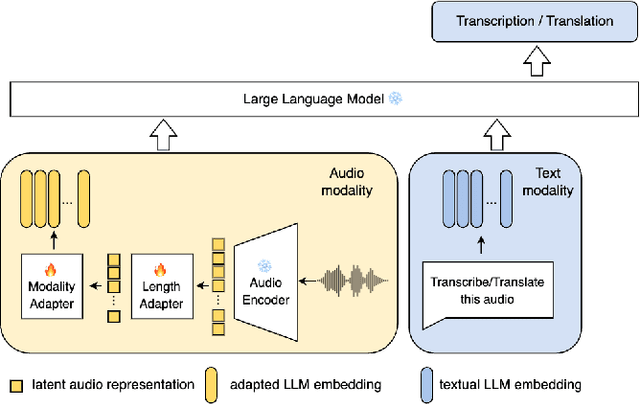
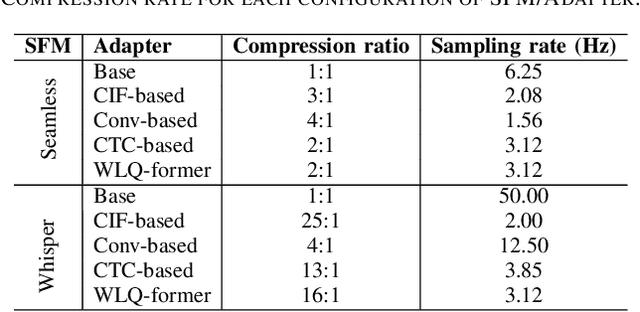
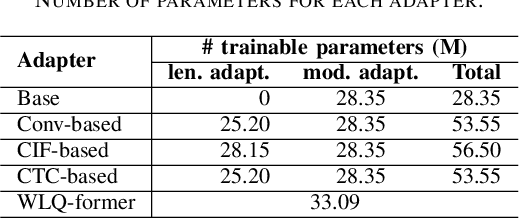
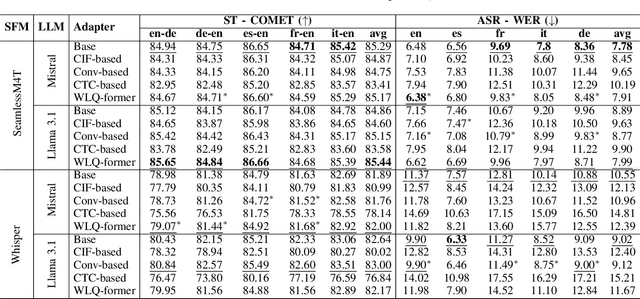
The remarkable performance achieved by Large Language Models (LLM) has driven research efforts to leverage them for a wide range of tasks and input modalities. In speech-to-text (S2T) tasks, the emerging solution consists of projecting the output of the encoder of a Speech Foundational Model (SFM) into the LLM embedding space through an adapter module. However, no work has yet investigated how much the downstream-task performance depends on each component (SFM, adapter, LLM) nor whether the best design of the adapter depends on the chosen SFM and LLM. To fill this gap, we evaluate the combination of 5 adapter modules, 2 LLMs (Mistral and Llama), and 2 SFMs (Whisper and SeamlessM4T) on two widespread S2T tasks, namely Automatic Speech Recognition and Speech Translation. Our results demonstrate that the SFM plays a pivotal role in downstream performance, while the adapter choice has moderate impact and depends on the SFM and LLM.