 Add to Chrome
 Add to Firefox
 Add to Edge
Resolving Predictive Multiplicity for the Rashomon Set
Jan 14, 2026
The existence of multiple, equally accurate models for a given predictive task leads to predictive multiplicity, where a ``Rashomon set'' of models achieve similar accuracy but diverges in their individual predictions. This inconsistency undermines trust in high-stakes applications where we want consistent predictions. We propose three approaches to reduce inconsistency among predictions for the members of the Rashomon set. The first approach is \textbf{outlier correction}. An outlier has a label that none of the good models are capable of predicting correctly. Outliers can cause the Rashomon set to have high variance predictions in a local area, so fixing them can lower variance. Our second approach is local patching. In a local region around a test point, models may disagree with each other because some of them are biased. We can detect and fix such biases using a validation set, which also reduces multiplicity. Our third approach is pairwise reconciliation, where we find pairs of models that disagree on a region around the test point. We modify predictions that disagree, making them less biased. These three approaches can be used together or separately, and they each have distinct advantages. The reconciled predictions can then be distilled into a single interpretable model for real-world deployment. In experiments across multiple datasets, our methods reduce disagreement metrics while maintaining competitive accuracy.

Fair Multivariate Adaptive Regression Splines for Ensuring Equity and Transparency
Feb 23, 2024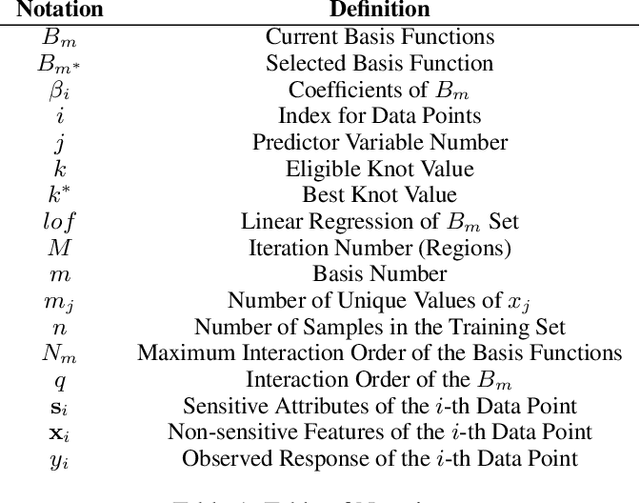
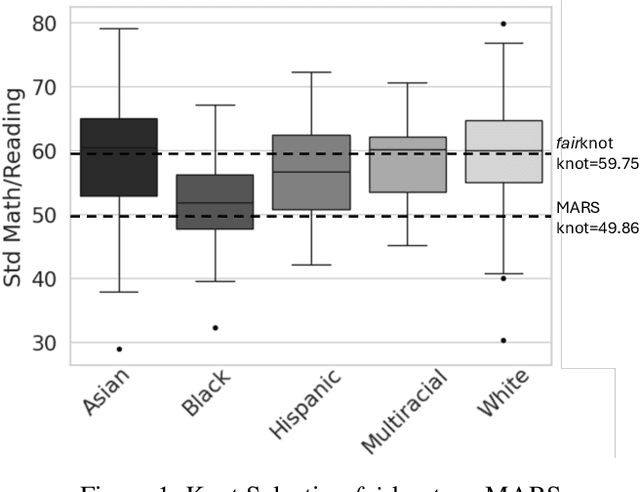
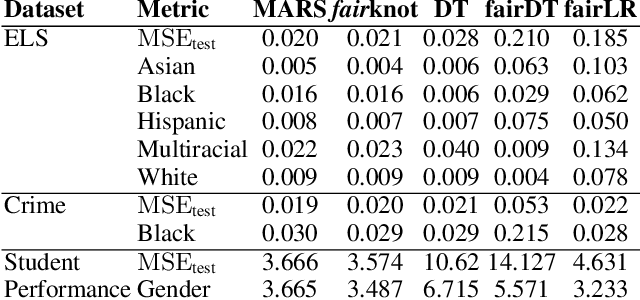
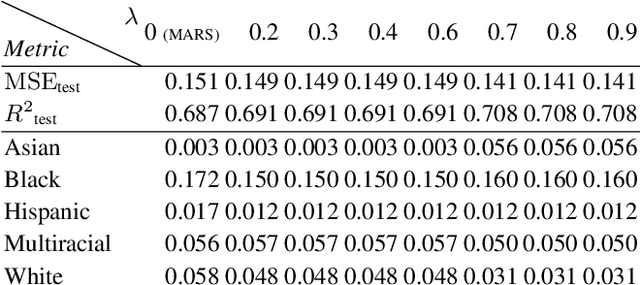
Predictive analytics is widely used in various domains, including education, to inform decision-making and improve outcomes. However, many predictive models are proprietary and inaccessible for evaluation or modification by researchers and practitioners, limiting their accountability and ethical design. Moreover, predictive models are often opaque and incomprehensible to the officials who use them, reducing their trust and utility. Furthermore, predictive models may introduce or exacerbate bias and inequity, as they have done in many sectors of society. Therefore, there is a need for transparent, interpretable, and fair predictive models that can be easily adopted and adapted by different stakeholders. In this paper, we propose a fair predictive model based on multivariate adaptive regression splines(MARS) that incorporates fairness measures in the learning process. MARS is a non-parametric regression model that performs feature selection, handles non-linear relationships, generates interpretable decision rules, and derives optimal splitting criteria on the variables. Specifically, we integrate fairness into the knot optimization algorithm and provide theoretical and empirical evidence of how it results in a fair knot placement. We apply our fairMARS model to real-world data and demonstrate its effectiveness in terms of accuracy and equity. Our paper contributes to the advancement of responsible and ethical predictive analytics for social good.