 Add to Chrome
 Add to Firefox
 Add to Edge
PDRs4All XX. Haute Couture: Spectral stitching of JWST MIRI-IFU cubes with matrix completion
Nov 17, 2025
MIRI is the imager and spectrograph covering wavelengths from $4.9$ to $27.9$ $μ$m onboard the James Webb Space Telescope (JWST). The Medium-Resolution Spectrometer (MRS) consists of four integral field units (IFU), each of which has three sub-channels. The twelve resulting spectral data cubes have different fields of view, spatial, and spectral resolutions. The wavelength range of each cube partially overlaps with the neighboring bands, and the overlap regions typically show flux mismatches which have to be corrected by spectral stitching methods. Stitching methods aim to produce a single data cube incorporating the data of the individual sub-channels, which requires matching the spatial resolution and the flux discrepancies. We present Haute Couture, a novel stitching algorithm which uses non-negative matrix factorization (NMF) to perform a matrix completion, where the available MRS data cubes are treated as twelve sub-matrices of a larger incomplete matrix. Prior to matrix completion, we also introduce a novel pre-processing to homogenize the global intensities of the twelve cubes. Our pre-processing consists in jointly optimizing a set of global scale parameters that maximize the fit between the cubes where spectral overlap occurs. We apply our novel stitching method to JWST data obtained as part of the PDRs4All observing program of the Orion Bar, and produce a uniform cube reconstructed with the best spatial resolution over the full range of wavelengths.

Hyperspectral and multispectral image fusion under spectrally varying spatial blurs -- Application to high dimensional infrared astronomical imaging
Dec 26, 2019


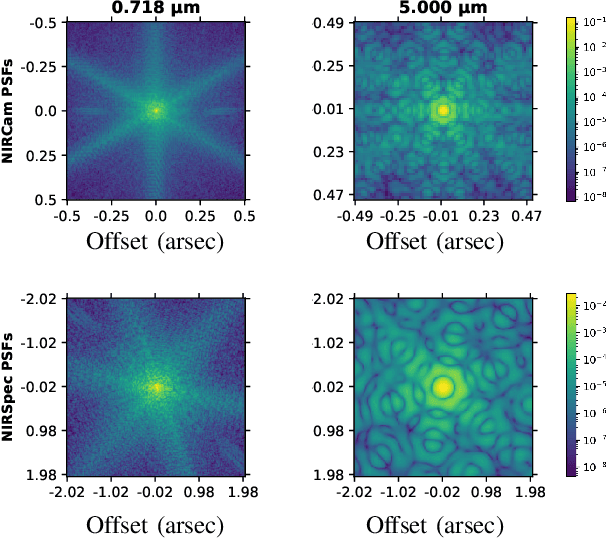
Hyperspectral imaging has become a significant source of valuable data for astronomers over the past decades. Current instrumental and observing time constraints allow direct acquisition of multispectral images, with high spatial but low spectral resolution, and hyperspectral images, with low spatial but high spectral resolution. To enhance scientific interpretation of the data, we propose a data fusion method which combines the benefits of each image to recover a high spatio-spectral resolution datacube. The proposed inverse problem accounts for the specificities of astronomical instruments, such as spectrally variant blurs. We provide a fast implementation by solving the problem in the frequency domain and in a low-dimensional subspace to efficiently handle the convolution operators as well as the high dimensionality of the data. We conduct experiments on a realistic synthetic dataset of simulated observation of the upcoming James Webb Space Telescope, and we show that our fusion algorithm outperforms state-of-the-art methods commonly used in remote sensing for Earth observation.