 Add to Chrome
 Add to Firefox
 Add to Edge
NucFuseRank: Dataset Fusion and Performance Ranking for Nuclei Instance Segmentation
Jan 27, 2026
Nuclei instance segmentation in hematoxylin and eosin (H&E)-stained images plays an important role in automated histological image analysis, with various applications in downstream tasks. While several machine learning and deep learning approaches have been proposed for nuclei instance segmentation, most research in this field focuses on developing new segmentation algorithms and benchmarking them on a limited number of arbitrarily selected public datasets. In this work, rather than focusing on model development, we focused on the datasets used for this task. Based on an extensive literature review, we identified manually annotated, publicly available datasets of H&E-stained images for nuclei instance segmentation and standardized them into a unified input and annotation format. Using two state-of-the-art segmentation models, one based on convolutional neural networks (CNNs) and one based on a hybrid CNN and vision transformer architecture, we systematically evaluated and ranked these datasets based on their nuclei instance segmentation performance. Furthermore, we proposed a unified test set (NucFuse-test) for fair cross-dataset evaluation and a unified training set (NucFuse-train) for improved segmentation performance by merging images from multiple datasets. By evaluating and ranking the datasets, performing comprehensive analyses, generating fused datasets, conducting external validation, and making our implementation publicly available, we provided a new benchmark for training, testing, and evaluating nuclei instance segmentation models on H&E-stained histological images.

ACS-SegNet: An Attention-Based CNN-SegFormer Segmentation Network for Tissue Segmentation in Histopathology
Oct 23, 2025Automated histopathological image analysis plays a vital role in computer-aided diagnosis of various diseases. Among developed algorithms, deep learning-based approaches have demonstrated excellent performance in multiple tasks, including semantic tissue segmentation in histological images. In this study, we propose a novel approach based on attention-driven feature fusion of convolutional neural networks (CNNs) and vision transformers (ViTs) within a unified dual-encoder model to improve semantic segmentation performance. Evaluation on two publicly available datasets showed that our model achieved {\mu}IoU/{\mu}Dice scores of 76.79%/86.87% on the GCPS dataset and 64.93%/76.60% on the PUMA dataset, outperforming state-of-the-art and baseline benchmarks. The implementation of our method is publicly available in a GitHub repository: https://github.com/NimaTorbati/ACS-SegNet
A Multi-Stage Auto-Context Deep Learning Framework for Tissue and Nuclei Segmentation and Classification in H&E-Stained Histological Images of Advanced Melanoma
Mar 31, 2025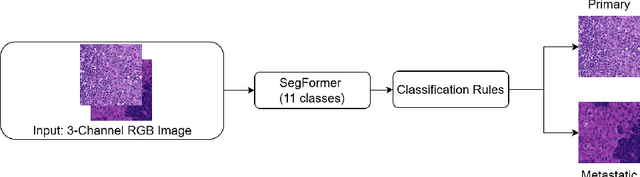
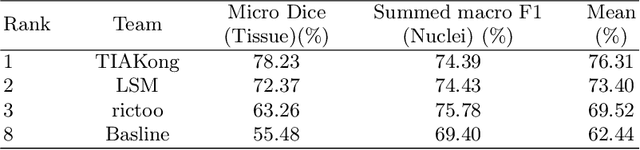
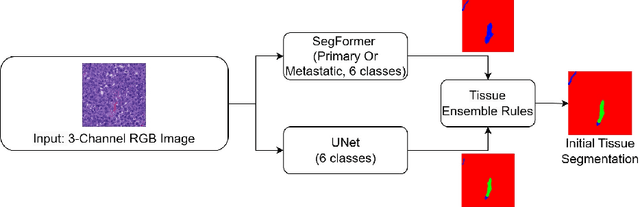
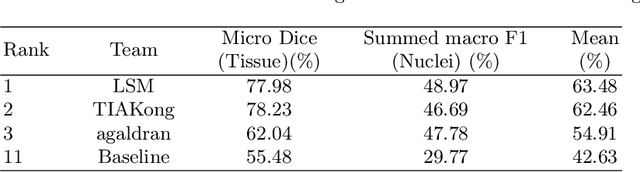
Melanoma is the most lethal form of skin cancer, with an increasing incidence rate worldwide. Analyzing histological images of melanoma by localizing and classifying tissues and cell nuclei is considered the gold standard method for diagnosis and treatment options for patients. While many computerized approaches have been proposed for automatic analysis, most perform tissue-based analysis and nuclei (cell)-based analysis as separate tasks, which might be suboptimal. In this work, using the PUMA challenge dataset, we proposed a novel multi-stage deep learning approach by combining tissue and nuclei information in a unified framework based on the auto-context concept to perform segmentation and classification in histological images of melanoma. Through pre-training and further post-processing, our approach achieved second and first place rankings in the PUMA challenge, with average micro Dice tissue score and summed nuclei F1-score of 73.40% for Track 1 and 63.48% for Track 2, respectively. Our implementation for training and testing is available at: https://github.com/NimaTorbati/PumaSubmit