 Add to Chrome
 Add to Firefox
 Add to Edge
TabPFN for Zero-shot Parametric Engineering Design Generation
Feb 02, 2026
Deep generative models for engineering design often require substantial computational cost, large training datasets, and extensive retraining when design requirements or datasets change, limiting their applicability in real-world engineering design workflow. In this work, we propose a zero-shot generation framework for parametric engineering design based on TabPFN, enabling conditional design generation using only a limited number of reference samples and without any task-specific model training or fine-tuning. The proposed method generates design parameters sequentially conditioned on target performance indicators, providing a flexible alternative to conventional generative models. The effectiveness of the proposed approach is evaluated on three engineering design datasets, i.e., ship hull design, BlendedNet aircraft, and UIUC airfoil. Experimental results demonstrate that the proposed method achieves competitive diversity across highly structured parametric design spaces, remains robust to variations in sampling, resolution and parameter dimensionality of geometry generation, and achieves a low performance error (e.g., less than 2% in generated ship hull designs' performance). Compared with diffusion-based generative models, the proposed framework significantly reduces computational overhead and data requirements while preserving reliable generation performance. These results highlight the potential of zero-shot, data-efficient generation as a practical and efficient tool for engineering design, enabling rapid deployment, flexible adaptation to new design settings, and ease of integration into real-world engineering workflows.

RePaint-Enhanced Conditional Diffusion Model for Parametric Engineering Designs under Performance and Parameter Constraints
Jan 30, 2026This paper presents a RePaint-enhanced framework that integrates a pre-trained performance-guided denoising diffusion probabilistic model (DDPM) for performance- and parameter-constraint engineering design generation. The proposed method enables the generation of missing design components based on a partial reference design while satisfying performance constraints, without retraining the underlying model. By applying mask-based resampling during inference process, RePaint allows efficient and controllable repainting of partial designs under both performance and parameter constraints, which is not supported by conventional DDPM-base methods. The framework is evaluated on two representative design problems, parametric ship hull design and airfoil design, demonstrating its ability to generate novel designs with expected performance based on a partial reference design. Results show that the method achieves accuracy comparable to or better than pre-trained models while enabling controlled novelty through fixing partial designs. Overall, the proposed approach provides an efficient, training-free solution for parameter-constraint-aware generative design in engineering applications.
Adaptation and Fine-tuning with TabPFN for Travelling Salesman Problem
Nov 08, 2025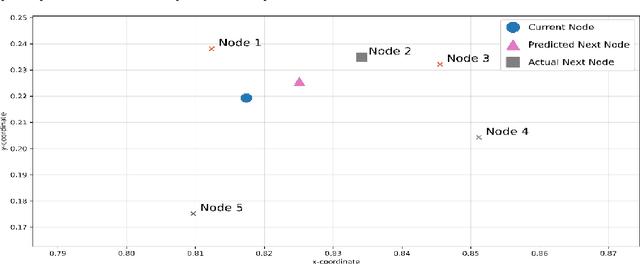
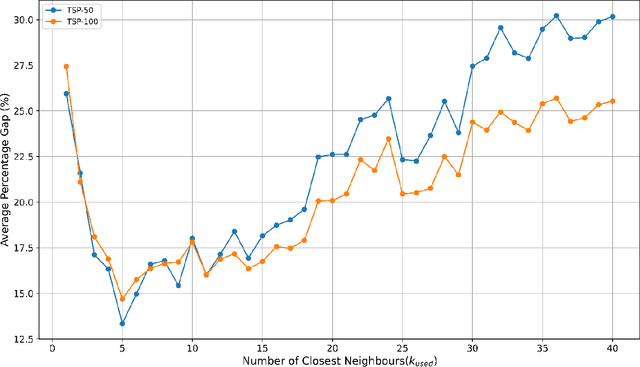
Tabular Prior-Data Fitted Network (TabPFN) is a foundation model designed for small to medium-sized tabular data, which has attracted much attention recently. This paper investigates the application of TabPFN in Combinatorial Optimization (CO) problems. The aim is to lessen challenges in time and data-intensive training requirements often observed in using traditional methods including exact and heuristic algorithms, Machine Learning (ML)-based models, to solve CO problems. Proposing possibly the first ever application of TabPFN for such a purpose, we adapt and fine-tune the TabPFN model to solve the Travelling Salesman Problem (TSP), one of the most well-known CO problems. Specifically, we adopt the node-based approach and the node-predicting adaptation strategy to construct the entire TSP route. Our evaluation with varying instance sizes confirms that TabPFN requires minimal training, adapts to TSP using a single sample, performs better generalization across varying TSP instance sizes, and reduces performance degradation. Furthermore, the training process with adaptation and fine-tuning is completed within minutes. The methodology leads to strong solution quality even without post-processing and achieves performance comparable to other models with post-processing refinement. Our findings suggest that the TabPFN model is a promising approach to solve structured and CO problems efficiently under training resource constraints and rapid deployment requirements.
Hybrid Metaheuristic Vehicle Routing Problem for Security Dispatch Operations
Mar 03, 2025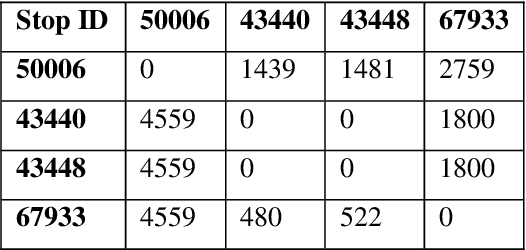
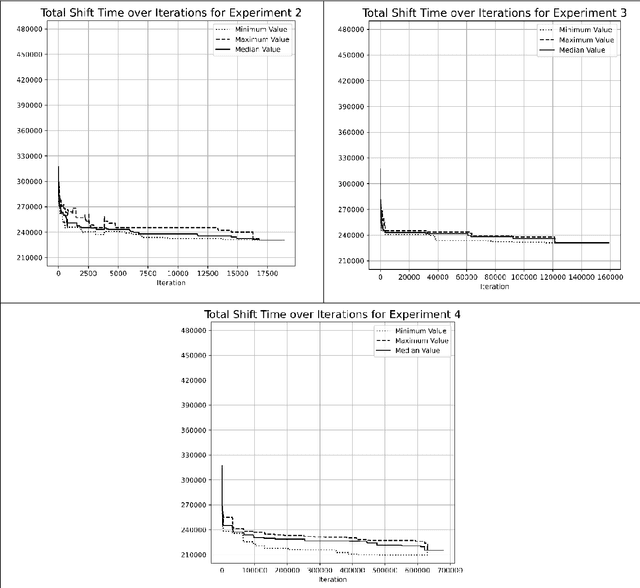
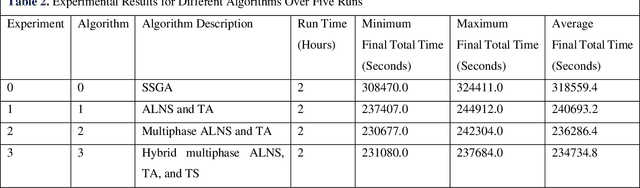

This paper investigates the optimization of the Vehicle Routing Problem for Security Dispatch (VRPSD). VRPSD focuses on security and patrolling applications which involve challenging constraints including precise timing and strict time windows. We propose three algorithms based on different metaheuristics, which are Adaptive Large Neighborhood Search (ALNS), Tabu Search (TS), and Threshold Accepting (TA). The first algorithm combines single-phase ALNS with TA, the second employs a multiphase ALNS with TA, and the third integrates multiphase ALNS, TS, and TA. Experiments are conducted on an instance comprising 251 customer requests. The results demonstrate that the third algorithm, the hybrid multiphase ALNS-TS-TA algorithm, delivers the best performance. This approach simultaneously leverages the large-area search capabilities of ALNS for exploration and effectively escapes local optima when the multiphase ALNS is coupled with TS and TA. Furthermore, in our experiments, the hybrid multiphase ALNS-TS-TA algorithm is the only one that shows potential for improving results with increased computation time across all attempts.