 Add to Chrome
 Add to Firefox
 Add to Edge
Llama-3.1-FoundationAI-SecurityLLM-Reasoning-8B Technical Report
Jan 28, 2026
We present Foundation-Sec-8B-Reasoning, the first open-source native reasoning model for cybersecurity. Built upon our previously released Foundation-Sec-8B base model (derived from Llama-3.1-8B-Base), the model is trained through a two-stage process combining supervised fine-tuning (SFT) and reinforcement learning from verifiable rewards (RLVR). Our training leverages proprietary reasoning data spanning cybersecurity analysis, instruction-following, and mathematical reasoning. Evaluation across 10 cybersecurity benchmarks and 10 general-purpose benchmarks demonstrates performance competitive with significantly larger models on cybersecurity tasks while maintaining strong general capabilities. The model shows effective generalization on multi-hop reasoning tasks and strong safety performance when deployed with appropriate system prompts and guardrails. This work demonstrates that domain-specialized reasoning models can achieve strong performance on specialized tasks while maintaining broad general capabilities. We release the model publicly at https://huggingface.co/fdtn-ai/Foundation-Sec-8B-Reasoning.

SWaRL: Safeguard Code Watermarking via Reinforcement Learning
Jan 05, 2026We present SWaRL, a robust and fidelity-preserving watermarking framework designed to protect the intellectual property of code LLM owners by embedding unique and verifiable signatures in the generated output. Existing approaches rely on manually crafted transformation rules to preserve watermarked code functionality or manipulate token-generation probabilities at inference time, which are prone to compilation errors. To address these challenges, SWaRL employs a reinforcement learning-based co-training framework that uses compiler feedback for functional correctness and a jointly trained confidential verifier as a reward signal to maintain watermark detectability. Furthermore, SWaRL employs low-rank adaptation (LoRA) during fine-tuning, allowing the learned watermark information to be transferable across model updates. Extensive experiments show that SWaRL achieves higher watermark detection accuracy compared to prior methods while fully maintaining watermarked code functionality. The LoRA-based signature embedding steers the base model to generate and solve code in a watermark-specific manner without significant computational overhead. Moreover, SWaRL exhibits strong resilience against refactoring and adversarial transformation attacks.
Key, Value, Compress: A Systematic Exploration of KV Cache Compression Techniques
Mar 14, 2025Large language models (LLMs) have demonstrated exceptional capabilities in generating text, images, and video content. However, as context length grows, the computational cost of attention increases quadratically with the number of tokens, presenting significant efficiency challenges. This paper presents an analysis of various Key-Value (KV) cache compression strategies, offering a comprehensive taxonomy that categorizes these methods by their underlying principles and implementation techniques. Furthermore, we evaluate their impact on performance and inference latency, providing critical insights into their effectiveness. Our findings highlight the trade-offs involved in KV cache compression and its influence on handling long-context scenarios, paving the way for more efficient LLM implementations.
Robust and Secure Code Watermarking for Large Language Models via ML/Crypto Codesign
Feb 04, 2025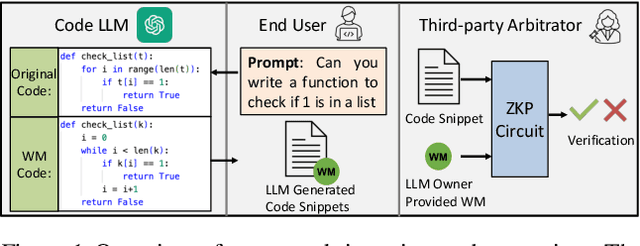
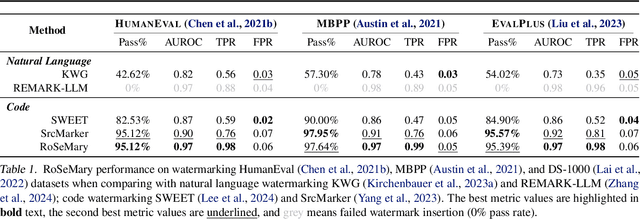
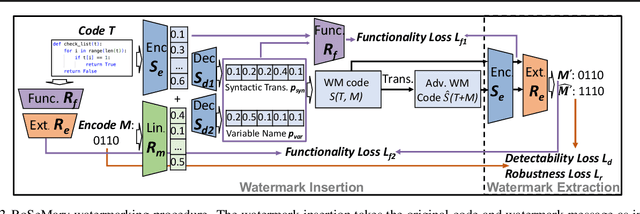

This paper introduces RoSe, the first-of-its-kind ML/Crypto codesign watermarking framework that regulates LLM-generated code to avoid intellectual property rights violations and inappropriate misuse in software development. High-quality watermarks adhering to the detectability-fidelity-robustness tri-objective are limited due to codes' low-entropy nature. Watermark verification, however, often needs to reveal the signature and requires re-encoding new ones for code reuse, which potentially compromising the system's usability. To overcome these challenges, RoSe obtains high-quality watermarks by training the watermark insertion and extraction modules end-to-end to ensure (i) unaltered watermarked code functionality and (ii) enhanced detectability and robustness leveraging pre-trained CodeT5 as the insertion backbone to enlarge the code syntactic and variable rename transformation search space. In the deployment, RoSe uses zero-knowledge proofs for secure verification without revealing the underlying signatures. Extensive evaluations demonstrated RoSe achieves high detection accuracy while preserving the code functionality. RoSe is also robust against attacks and provides efficient secure watermark verification.