 Add to Chrome
 Add to Firefox
 Add to Edge
Beamformed Fingerprint-Based Transformer Network for Trajectory Estimation and Path Determination in Outdoor mmWave MIMO Systems
Feb 05, 2026
Radio transmissions in millimeter wave (mmWave) bands have gained significant interest for applications demanding precise device localization and trajectory estimation. This paper explores novel neural network (NN) architectures suitable for trajectory estimation and path determination in a mmWave multiple-input multiple-output (MIMO) outdoor system based on localization data from beamformed fingerprint (BFF). The NN architecture captures sequences of BFF signals from different users, and through the application of learning mechanisms, subsequently estimate their trajectories. In turn, this information is employed to find the shortest path to the target, thereby enabling more efficient navigation. Specifically, we propose a two-stage procedure for trajectory estimation and optimal path finding. In the first stage, a transformer network (TN) based on attention mechanisms is developed to predict trajectories of wireless devices using BFF sequences captured in a mmWave MIMO outdoor system. In the second stage, a novel algorithm based on Informed Rapidly-exploring Random Trees (iRRT*) is employed to determine the optimal path to target locations using trajectory estimates derived in the first stage. The effectiveness of the proposed schemes is validated through numerical experiments, using a comprehensive dataset of radio measurements, generated using ray tracing simulations to model outdoor propagation at 28 GHz. We show that our proposed TN-based trajectory estimator outperforms other methods from the recent literature and can successfully generalize to new trajectories outside the training set. Furthermore, our proposed iRRT* algorithm is able to consistently provide the shortest path to the target.

A BFF-Based Attention Mechanism for Trajectory Estimation in mmWave MIMO Communications
Jan 23, 2024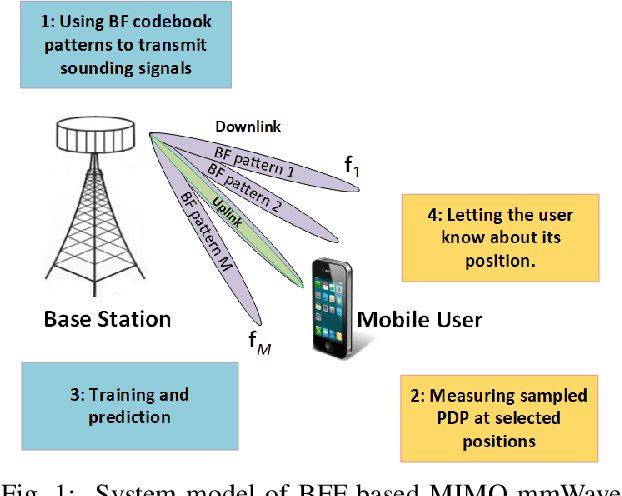
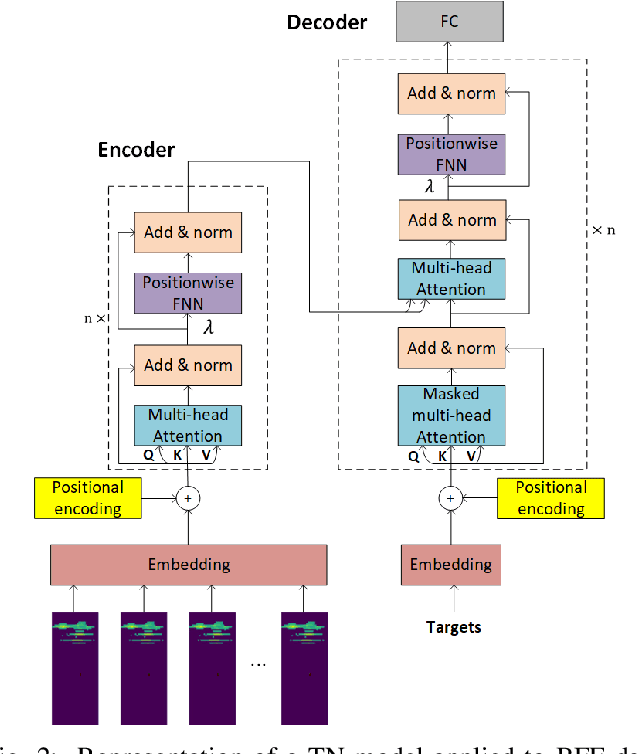
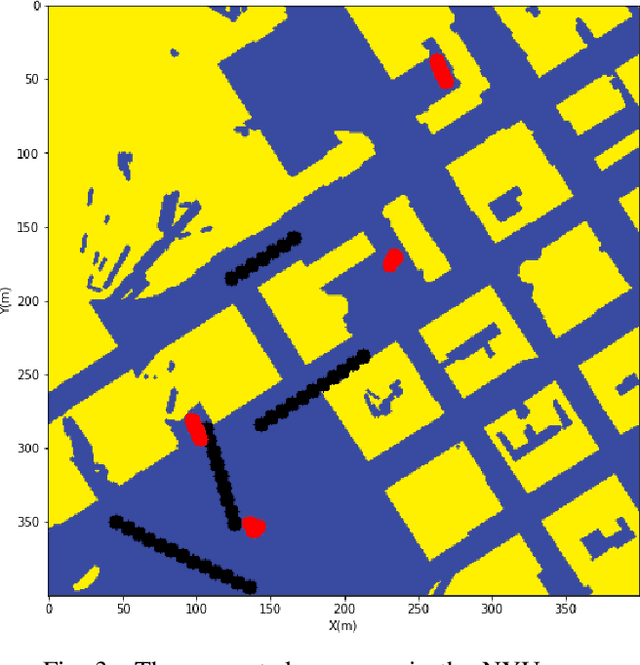
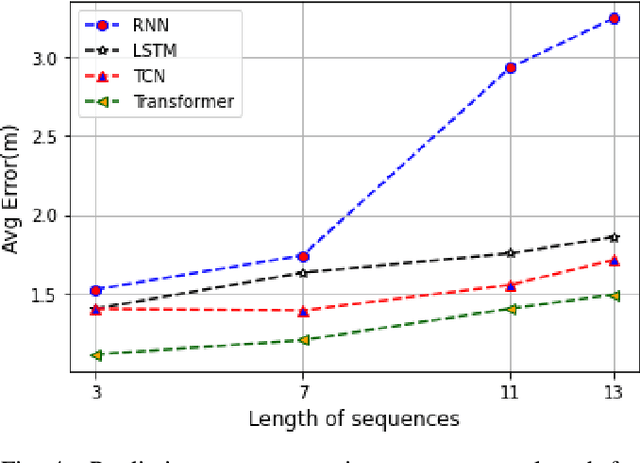
This paper explores a novel Neural Network (NN) architecture suitable for Beamformed Fingerprint (BFF) localization in a millimeter-wave (mmWave) multiple-input multiple-output (MIMO) outdoor system. The mmWave frequency bands have attracted significant attention due to their precise timing measurements, making them appealing for applications demanding accurate device localization and trajectory estimation. The proposed NN architecture captures BFF sequences originating from various user paths, and through the application of learning mechanisms, subsequently estimates these trajectories. Specifically, we propose a method for trajectory estimation, employing a transformer network (TN) that relies on attention mechanisms. This TN-based approach estimates wireless device trajectories using BFF sequences recorded within a mmWave MIMO outdoor system. To validate the efficacy of our proposed approach, numerical experiments are conducted using a comprehensive dataset of radio measurements in an outdoor setting, complemented with ray tracing to simulate wireless signal propagation at 28 GHz. The results illustrate that the TN-based trajectory estimator outperforms other methods from the existing literature and possesses the ability to generalize effectively to new trajectories outside the training dataset.