 Add to Chrome
 Add to Firefox
 Add to Edge
When Iterative RAG Beats Ideal Evidence: A Diagnostic Study in Scientific Multi-hop Question Answering
Jan 27, 2026
Retrieval-Augmented Generation (RAG) extends large language models (LLMs) beyond parametric knowledge, yet it is unclear when iterative retrieval-reasoning loops meaningfully outperform static RAG, particularly in scientific domains with multi-hop reasoning, sparse domain knowledge, and heterogeneous evidence. We provide the first controlled, mechanism-level diagnostic study of whether synchronized iterative retrieval and reasoning can surpass an idealized static upper bound (Gold Context) RAG. We benchmark eleven state-of-the-art LLMs under three regimes: (i) No Context, measuring reliance on parametric memory; (ii) Gold Context, where all oracle evidence is supplied at once; and (iii) Iterative RAG, a training-free controller that alternates retrieval, hypothesis refinement, and evidence-aware stopping. Using the chemistry-focused ChemKGMultiHopQA dataset, we isolate questions requiring genuine retrieval and analyze behavior with diagnostics spanning retrieval coverage gaps, anchor-carry drop, query quality, composition fidelity, and control calibration. Across models, Iterative RAG consistently outperforms Gold Context, with gains up to 25.6 percentage points, especially for non-reasoning fine-tuned models. Staged retrieval reduces late-hop failures, mitigates context overload, and enables dynamic correction of early hypothesis drift, but remaining failure modes include incomplete hop coverage, distractor latch trajectories, early stopping miscalibration, and high composition failure rates even with perfect retrieval. Overall, staged retrieval is often more influential than the mere presence of ideal evidence; we provide practical guidance for deploying and diagnosing RAG systems in specialized scientific settings and a foundation for more reliable, controllable iterative retrieval-reasoning frameworks.

ChemTEB: Chemical Text Embedding Benchmark, an Overview of Embedding Models Performance & Efficiency on a Specific Domain
Nov 30, 2024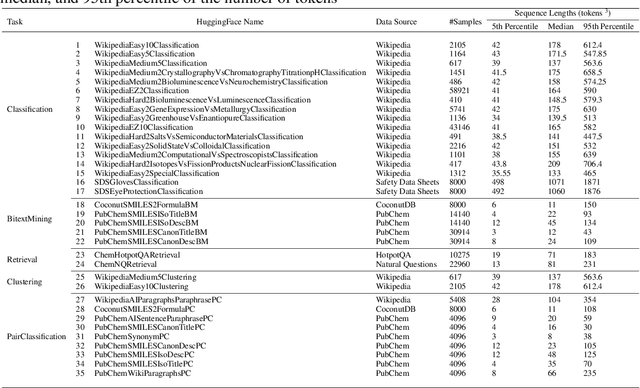
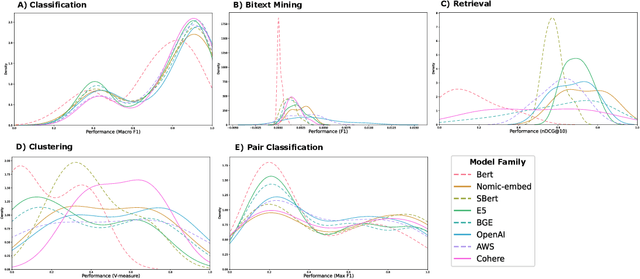
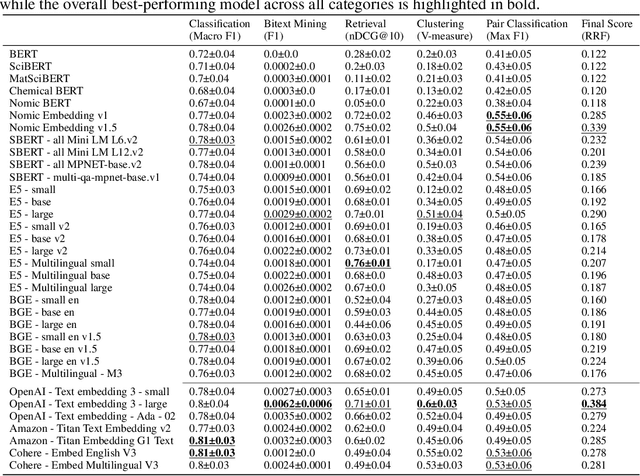
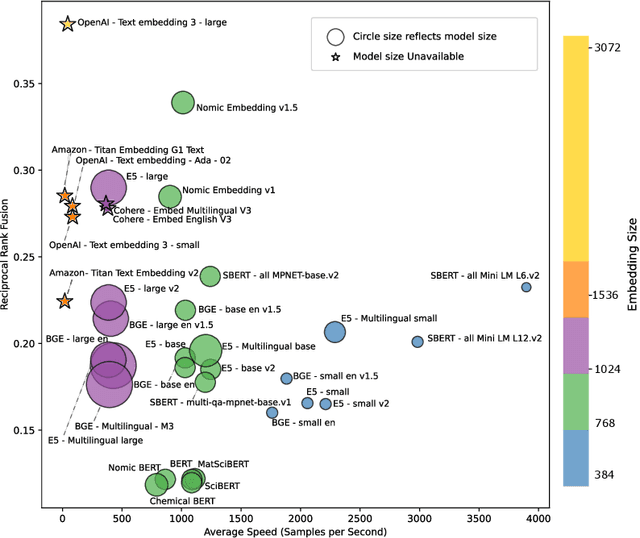
Recent advancements in language models have started a new era of superior information retrieval and content generation, with embedding models playing an important role in optimizing data representation efficiency and performance. While benchmarks like the Massive Text Embedding Benchmark (MTEB) have standardized the evaluation of general domain embedding models, a gap remains in specialized fields such as chemistry, which require tailored approaches due to domain-specific challenges. This paper introduces a novel benchmark, the Chemical Text Embedding Benchmark (ChemTEB), designed specifically for the chemical sciences. ChemTEB addresses the unique linguistic and semantic complexities of chemical literature and data, offering a comprehensive suite of tasks on chemical domain data. Through the evaluation of 34 open-source and proprietary models using this benchmark, we illuminate the strengths and weaknesses of current methodologies in processing and understanding chemical information. Our work aims to equip the research community with a standardized, domain-specific evaluation framework, promoting the development of more precise and efficient NLP models for chemistry-related applications. Furthermore, it provides insights into the performance of generic models in a domain-specific context. ChemTEB comes with open-source code and data, contributing further to its accessibility and utility.