 Add to Chrome
 Add to Firefox
 Add to Edge
Imitation learning-based spacecraft rendezvous and docking method with Expert Demonstration
Jan 19, 2026
Existing spacecraft rendezvous and docking control methods largely rely on predefined dynamic models and often exhibit limited robustness in realistic on-orbit environments. To address this issue, this paper proposes an Imitation Learning-based spacecraft rendezvous and docking control framework (IL-SRD) that directly learns control policies from expert demonstrations, thereby reducing dependence on accurate modeling. We propose an anchored decoder target mechanism, which conditions the decoder queries on state-related anchors to explicitly constrain the control generation process. This mechanism enforces physically consistent control evolution and effectively suppresses implausible action deviations in sequential prediction, enabling reliable six-degree-of-freedom (6-DOF) rendezvous and docking control. To further enhance stability, a temporal aggregation mechanism is incorporated to mitigate error accumulation caused by the sequential prediction nature of Transformer-based models, where small inaccuracies at each time step can propagate and amplify over long horizons. Extensive simulation results demonstrate that the proposed IL-SRD framework achieves accurate and energy-efficient model-free rendezvous and docking control. Robustness evaluations further confirm its capability to maintain competitive performance under significant unknown disturbances. The source code is available at https://github.com/Dongzhou-1996/IL-SRD.

Improving Feature-based Visual Localization by Geometry-Aided Matching
Nov 16, 2022
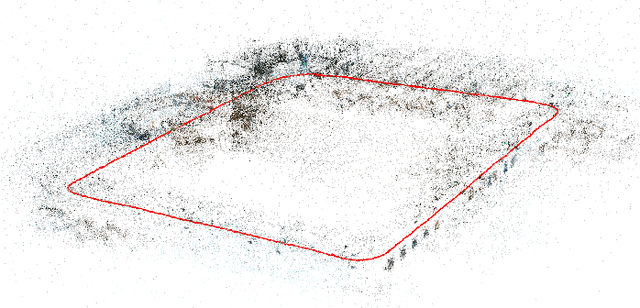
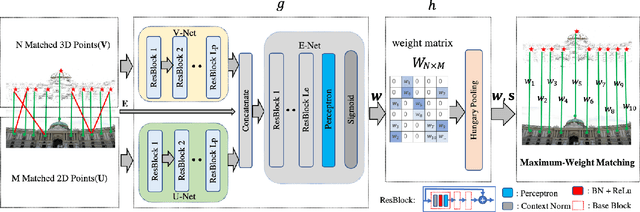
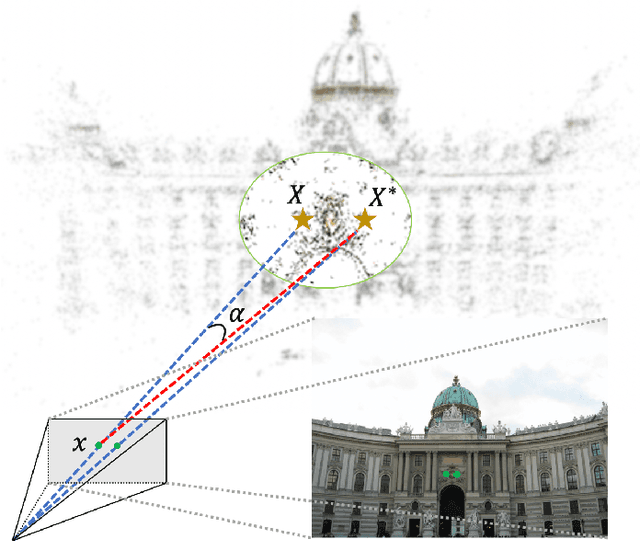
Feature matching is an essential step in visual localization, where the accuracy of camera pose is mainly determined by the established 2D-3D correspondence. Due to the noise, solving the camera pose accurately requires a sufficient number of well-distributed 2D-3D correspondences. Existing 2D-3D feature matching is typically achieved by finding the nearest neighbors in the feature space, and then removing the outliers by some hand-crafted heuristics. However, this may lead to a large number of potentially true matches being missed or the established correct matches being filtered out. In this work, we introduce a novel 2D-3D matching method, Geometry-Aided Matching (GAM), which uses both appearance information and geometric context to improve 2D-3D feature matching. GAM can greatly strengthen the recall of 2D-3D matches while maintaining high precision. We insert GAM into a hierarchical visual localization pipeline and show that GAM can effectively improve the robustness and accuracy of localization. Extensive experiments show that GAM can find more correct matches than hand-crafted heuristics and learning baselines. Our proposed localization method achieves state-of-the-art results on multiple visual localization datasets. Experiments on Cambridge Landmarks dataset show that our method outperforms the existing state-of-the-art methods and is six times faster than the top-performed method.