 Add to Chrome
 Add to Firefox
 Add to Edge
Machine Learning Framework for Thrombosis Risk Prediction in Rotary Blood Pumps
Dec 12, 2025
Thrombosis in rotary blood pumps arises from complex flow conditions that remain difficult to translate into reliable and interpretable risk predictions using existing computational models. This limitation reflects an incomplete understanding of how specific flow features contribute to thrombus initiation and growth. This study introduces an interpretable machine learning framework for spatial thrombosis assessment based directly on computational fluid dynamics-derived flow features. A logistic regression (LR) model combined with a structured feature-selection pipeline is used to derive a compact and physically interpretable feature set, including nonlinear feature combinations. The framework is trained using spatial risk patterns from a validated, macro-scale thrombosis model for two representative scenarios. The model reproduces the labeled risk distributions and identifies distinct sets of flow features associated with increased thrombosis risk. When applied to a centrifugal pump, despite training on a single axial pump operating point, the model predicts plausible thrombosis-prone regions. These results show that interpretable machine learning can link local flow features to thrombosis risk while remaining computationally efficient and mechanistically transparent. The low computational cost enables rapid thrombogenicity screening without repeated or costly simulations. The proposed framework complements physics-based thrombosis modeling and provides a methodological basis for integrating interpretable machine learning into CFD-driven thrombosis analysis and device design workflows.

Spline-PINN: Approaching PDEs without Data using Fast, Physics-Informed Hermite-Spline CNNs
Sep 15, 2021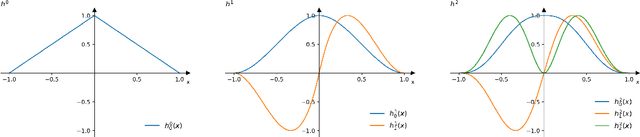

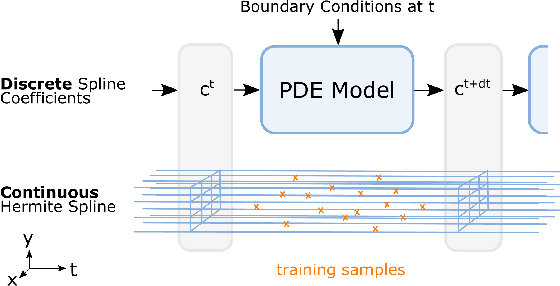
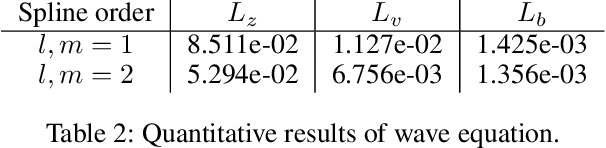
Partial Differential Equations (PDEs) are notoriously difficult to solve. In general, closed-form solutions are not available and numerical approximation schemes are computationally expensive. In this paper, we propose to approach the solution of PDEs based on a novel technique that combines the advantages of two recently emerging machine learning based approaches. First, physics-informed neural networks (PINNs) learn continuous solutions of PDEs and can be trained with little to no ground truth data. However, PINNs do not generalize well to unseen domains. Second, convolutional neural networks provide fast inference and generalize but either require large amounts of training data or a physics-constrained loss based on finite differences that can lead to inaccuracies and discretization artifacts. We leverage the advantages of both of these approaches by using Hermite spline kernels in order to continuously interpolate a grid-based state representation that can be handled by a CNN. This allows for training without any precomputed training data using a physics-informed loss function only and provides fast, continuous solutions that generalize to unseen domains. We demonstrate the potential of our method at the examples of the incompressible Navier-Stokes equation and the damped wave equation. Our models are able to learn several intriguing phenomena such as Karman vortex streets, the Magnus effect, Doppler effect, interference patterns and wave reflections. Our quantitative assessment and an interactive real-time demo show that we are narrowing the gap in accuracy of unsupervised ML based methods to industrial CFD solvers while being orders of magnitude faster.