 Add to Chrome
 Add to Firefox
 Add to Edge
Context-Aware Asymmetric Ensembling for Interpretable Retinopathy of Prematurity Screening via Active Query and Vascular Attention
Feb 05, 2026
Retinopathy of Prematurity (ROP) is among the major causes of preventable childhood blindness. Automated screening remains challenging, primarily due to limited data availability and the complex condition involving both structural staging and microvascular abnormalities. Current deep learning models depend heavily on large private datasets and passive multimodal fusion, which commonly fail to generalize on small, imbalanced public cohorts. We thus propose the Context-Aware Asymmetric Ensemble Model (CAA Ensemble) that simulates clinical reasoning through two specialized streams. First, the Multi-Scale Active Query Network (MS-AQNet) serves as a structure specialist, utilizing clinical contexts as dynamic query vectors to spatially control visual feature extraction for localization of the fibrovascular ridge. Secondly, VascuMIL encodes Vascular Topology Maps (VMAP) within a gated Multiple Instance Learning (MIL) network to precisely identify vascular tortuosity. A synergistic meta-learner ensembles these orthogonal signals to resolve diagnostic discordance across multiple objectives. Tested on a highly imbalanced cohort of 188 infants (6,004 images), the framework attained State-of-the-Art performance on two distinct clinical tasks: achieving a Macro F1-Score of 0.93 for Broad ROP staging and an AUC of 0.996 for Plus Disease detection. Crucially, the system features `Glass Box' transparency through counterfactual attention heatmaps and vascular threat maps, proving that clinical metadata dictates the model's visual search. Additionally, this study demonstrates that architectural inductive bias can serve as an effective bridge for the medical AI data gap.

SYNAPSE-Net: A Unified Framework with Lesion-Aware Hierarchical Gating for Robust Segmentation of Heterogeneous Brain Lesions
Oct 30, 2025Automated segmentation of heterogeneous brain lesions from multi-modal MRI remains a critical challenge in clinical neuroimaging. Current deep learning models are typically specialized `point solutions' that lack generalization and high performance variance, limiting their clinical reliability. To address these gaps, we propose the Unified Multi-Stream SYNAPSE-Net, an adaptive framework designed for both generalization and robustness. The framework is built on a novel hybrid architecture integrating multi-stream CNN encoders, a Swin Transformer bottleneck for global context, a dynamic cross-modal attention fusion (CMAF) mechanism, and a hierarchical gated decoder for high-fidelity mask reconstruction. The architecture is trained with a variance reduction strategy that combines pathology specific data augmentation and difficulty-aware sampling method. The model was evaluated on three different challenging public datasets: the MICCAI 2017 WMH Challenge, the ISLES 2022 Challenge, and the BraTS 2020 Challenge. Our framework attained a state-of-the-art DSC value of 0.831 with the HD95 value of 3.03 in the WMH dataset. For ISLES 2022, it achieved the best boundary accuracy with a statistically significant difference (HD95 value of 9.69). For BraTS 2020, it reached the highest DSC value for the tumor core region (0.8651). These experimental findings suggest that our unified adaptive framework achieves state-of-the-art performance across multiple brain pathologies, providing a robust and clinically feasible solution for automated segmentation. The source code and the pre-trained models are available at https://github.com/mubid-01/SYNAPSE-Net-pre.
Enhancing stroke disease classification through machine learning models via a novel voting system by feature selection techniques
Apr 01, 2025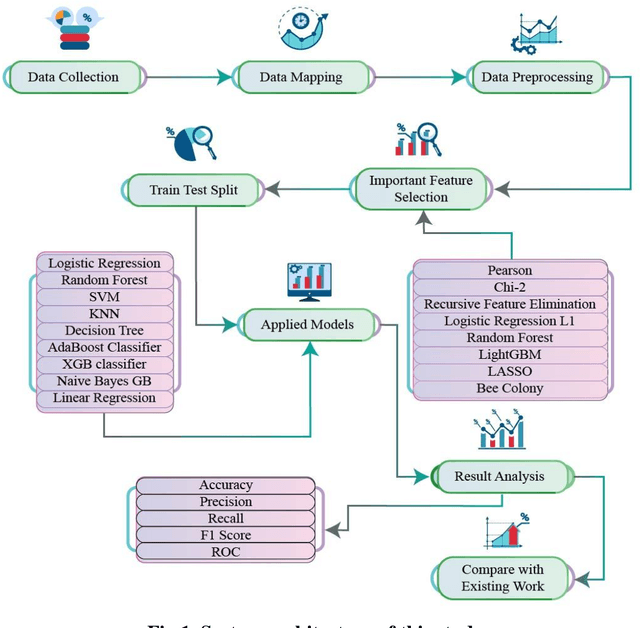
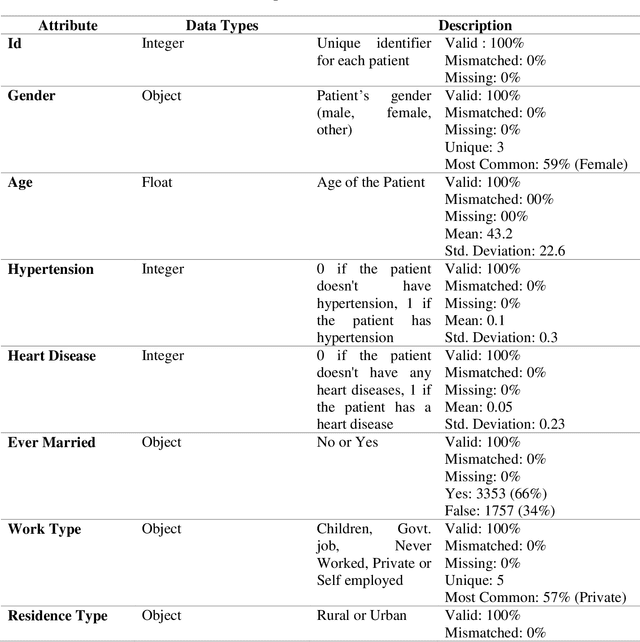
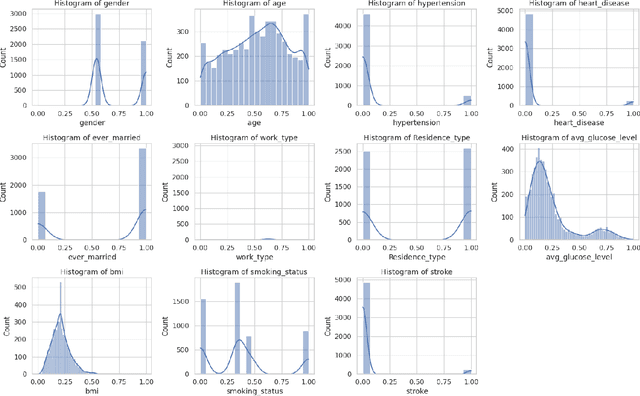
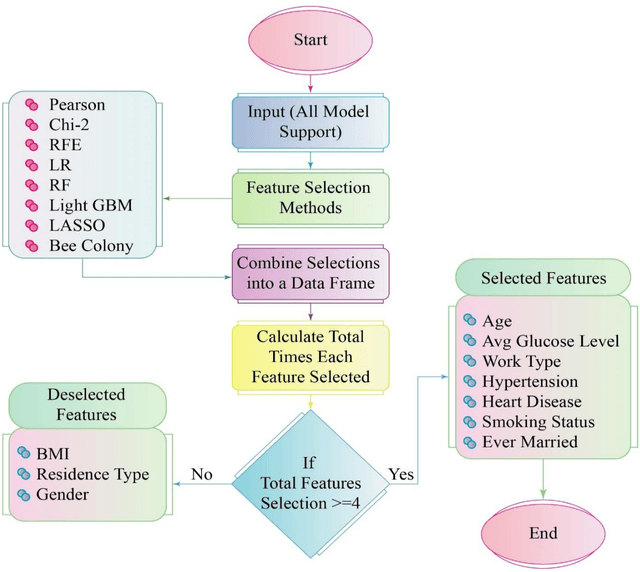
Heart disease remains a leading cause of mortality and morbidity worldwide, necessitating the development of accurate and reliable predictive models to facilitate early detection and intervention. While state of the art work has focused on various machine learning approaches for predicting heart disease, but they could not able to achieve remarkable accuracy. In response to this need, we applied nine machine learning algorithms XGBoost, logistic regression, decision tree, random forest, k-nearest neighbors (KNN), support vector machine (SVM), gaussian na\"ive bayes (NB gaussian), adaptive boosting, and linear regression to predict heart disease based on a range of physiological indicators. Our approach involved feature selection techniques to identify the most relevant predictors, aimed at refining the models to enhance both performance and interpretability. The models were trained, incorporating processes such as grid search hyperparameter tuning, and cross-validation to minimize overfitting. Additionally, we have developed a novel voting system with feature selection techniques to advance heart disease classification. Furthermore, we have evaluated the models using key performance metrics including accuracy, precision, recall, F1-score, and the area under the receiver operating characteristic curve (ROC AUC). Among the models, XGBoost demonstrated exceptional performance, achieving 99% accuracy, precision, F1-Score, 98% recall, and 100% ROC AUC. This study offers a promising approach to early heart disease diagnosis and preventive healthcare.