 Add to Chrome
 Add to Firefox
 Add to Edge
A Streamlined Attention-Based Network for Descriptor Extraction
Jan 19, 2026
We introduce SANDesc, a Streamlined Attention-Based Network for Descriptor extraction that aims to improve on existing architectures for keypoint description. Our descriptor network learns to compute descriptors that improve matching without modifying the underlying keypoint detector. We employ a revised U-Net-like architecture enhanced with Convolutional Block Attention Modules and residual paths, enabling effective local representation while maintaining computational efficiency. We refer to the building blocks of our model as Residual U-Net Blocks with Attention. The model is trained using a modified triplet loss in combination with a curriculum learning-inspired hard negative mining strategy, which improves training stability. Extensive experiments on HPatches, MegaDepth-1500, and the Image Matching Challenge 2021 show that training SANDesc on top of existing keypoint detectors leads to improved results on multiple matching tasks compared to the original keypoint descriptors. At the same time, SANDesc has a model complexity of just 2.4 million parameters. As a further contribution, we introduce a new urban dataset featuring 4K images and pre-calibrated intrinsics, designed to evaluate feature extractors. On this benchmark, SANDesc achieves substantial performance gains over the existing descriptors while operating with limited computational resources.

PyTorchGeoNodes: Enabling Differentiable Shape Programs for 3D Shape Reconstruction
Apr 16, 2024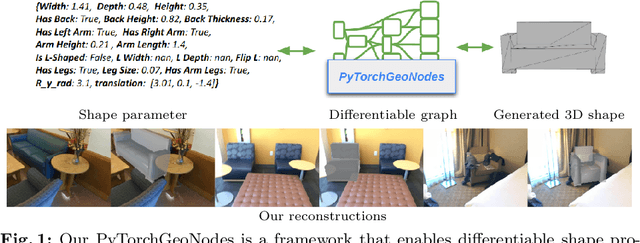
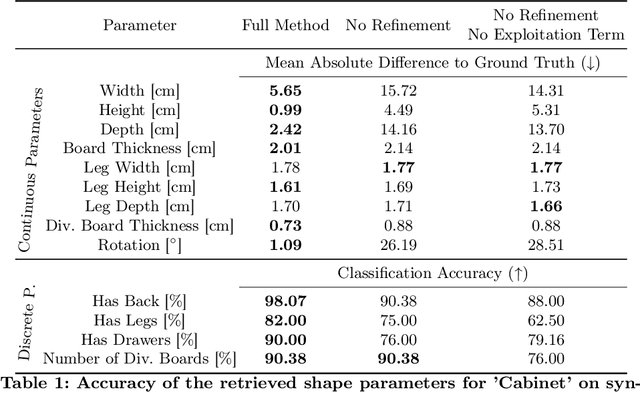

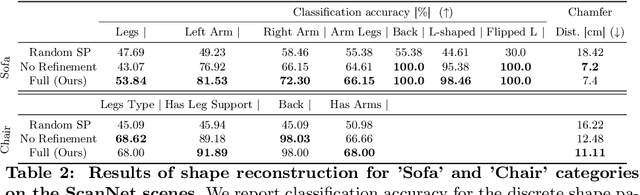
We propose PyTorchGeoNodes, a differentiable module for reconstructing 3D objects from images using interpretable shape programs. In comparison to traditional CAD model retrieval methods, the use of shape programs for 3D reconstruction allows for reasoning about the semantic properties of reconstructed objects, editing, low memory footprint, etc. However, the utilization of shape programs for 3D scene understanding has been largely neglected in past works. As our main contribution, we enable gradient-based optimization by introducing a module that translates shape programs designed in Blender, for example, into efficient PyTorch code. We also provide a method that relies on PyTorchGeoNodes and is inspired by Monte Carlo Tree Search (MCTS) to jointly optimize discrete and continuous parameters of shape programs and reconstruct 3D objects for input scenes. In our experiments, we apply our algorithm to reconstruct 3D objects in the ScanNet dataset and evaluate our results against CAD model retrieval-based reconstructions. Our experiments indicate that our reconstructions match well the input scenes while enabling semantic reasoning about reconstructed objects.