 Add to Chrome
 Add to Firefox
 Add to Edge
Offline Reinforcement Learning of High-Quality Behaviors Under Robust Style Alignment
Jan 30, 2026
We study offline reinforcement learning of style-conditioned policies using explicit style supervision via subtrajectory labeling functions. In this setting, aligning style with high task performance is particularly challenging due to distribution shift and inherent conflicts between style and reward. Existing methods, despite introducing numerous definitions of style, often fail to reconcile these objectives effectively. To address these challenges, we propose a unified definition of behavior style and instantiate it into a practical framework. Building on this, we introduce Style-Conditioned Implicit Q-Learning (SCIQL), which leverages offline goal-conditioned RL techniques, such as hindsight relabeling and value learning, and combine it with a new Gated Advantage Weighted Regression mechanism to efficiently optimize task performance while preserving style alignment. Experiments demonstrate that SCIQL achieves superior performance on both objectives compared to prior offline methods. Code, datasets and visuals are available in: https://sciql-iclr-2026.github.io/.

Offline Learning of Controllable Diverse Behaviors
Apr 25, 2025Imitation Learning (IL) techniques aim to replicate human behaviors in specific tasks. While IL has gained prominence due to its effectiveness and efficiency, traditional methods often focus on datasets collected from experts to produce a single efficient policy. Recently, extensions have been proposed to handle datasets of diverse behaviors by mainly focusing on learning transition-level diverse policies or on performing entropy maximization at the trajectory level. While these methods may lead to diverse behaviors, they may not be sufficient to reproduce the actual diversity of demonstrations or to allow controlled trajectory generation. To overcome these drawbacks, we propose a different method based on two key features: a) Temporal Consistency that ensures consistent behaviors across entire episodes and not just at the transition level as well as b) Controllability obtained by constructing a latent space of behaviors that allows users to selectively activate specific behaviors based on their requirements. We compare our approach to state-of-the-art methods over a diverse set of tasks and environments. Project page: https://mathieu-petitbois.github.io/projects/swr/
Navigation with QPHIL: Quantizing Planner for Hierarchical Implicit Q-Learning
Nov 12, 2024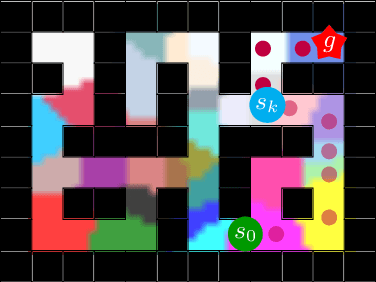
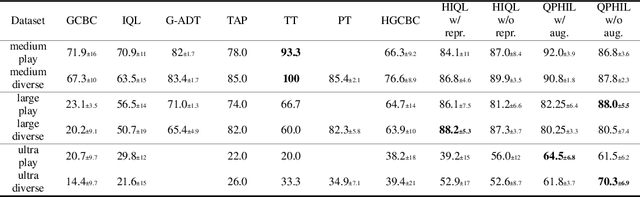
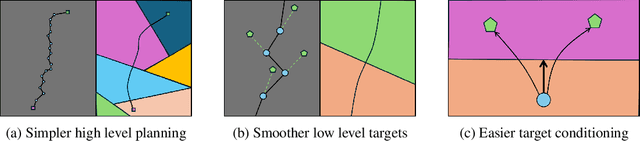
Offline Reinforcement Learning (RL) has emerged as a powerful alternative to imitation learning for behavior modeling in various domains, particularly in complex navigation tasks. An existing challenge with Offline RL is the signal-to-noise ratio, i.e. how to mitigate incorrect policy updates due to errors in value estimates. Towards this, multiple works have demonstrated the advantage of hierarchical offline RL methods, which decouples high-level path planning from low-level path following. In this work, we present a novel hierarchical transformer-based approach leveraging a learned quantizer of the space. This quantization enables the training of a simpler zone-conditioned low-level policy and simplifies planning, which is reduced to discrete autoregressive prediction. Among other benefits, zone-level reasoning in planning enables explicit trajectory stitching rather than implicit stitching based on noisy value function estimates. By combining this transformer-based planner with recent advancements in offline RL, our proposed approach achieves state-of-the-art results in complex long-distance navigation environments.