 Add to Chrome
 Add to Firefox
 Add to Edge
Beyond Holistic Scores: Automatic Trait-Based Quality Scoring of Argumentative Essays
Feb 04, 2026
Automated Essay Scoring systems have traditionally focused on holistic scores, limiting their pedagogical usefulness, especially in the case of complex essay genres such as argumentative writing. In educational contexts, teachers and learners require interpretable, trait-level feedback that aligns with instructional goals and established rubrics. In this paper, we study trait-based Automatic Argumentative Essay Scoring using two complementary modeling paradigms designed for realistic educational deployment: (1) structured in-context learning with small open-source LLMs, and (2) a supervised, encoder-based BigBird model with a CORAL-style ordinal regression formulation, optimized for long-sequence understanding. We conduct a systematic evaluation on the ASAP++ dataset, which includes essay scores across five quality traits, offering strong coverage of core argumentation dimensions. LLMs are prompted with designed, rubric-aligned in-context examples, along with feedback and confidence requests, while we explicitly model ordinality in scores with the BigBird model via the rank-consistent CORAL framework. Our results show that explicitly modeling score ordinality substantially improves agreement with human raters across all traits, outperforming LLMs and nominal classification and regression-based baselines. This finding reinforces the importance of aligning model objectives with rubric semantics for educational assessment. At the same time, small open-source LLMs achieve a competitive performance without task-specific fine-tuning, particularly for reasoning-oriented traits, while enabling transparent, privacy-preserving, and locally deployable assessment scenarios. Our findings provide methodological, modeling, and practical insights for the design of AI-based educational systems that aim to deliver interpretable, rubric-aligned feedback for argumentative writing.

ELLIS Alicante at CQs-Gen 2025: Winning the critical thinking questions shared task: LLM-based question generation and selection
Jun 17, 2025The widespread adoption of chat interfaces based on Large Language Models (LLMs) raises concerns about promoting superficial learning and undermining the development of critical thinking skills. Instead of relying on LLMs purely for retrieving factual information, this work explores their potential to foster deeper reasoning by generating critical questions that challenge unsupported or vague claims in debate interventions. This study is part of a shared task of the 12th Workshop on Argument Mining, co-located with ACL 2025, focused on automatic critical question generation. We propose a two-step framework involving two small-scale open source language models: a Questioner that generates multiple candidate questions and a Judge that selects the most relevant ones. Our system ranked first in the shared task competition, demonstrating the potential of the proposed LLM-based approach to encourage critical engagement with argumentative texts.
Leveraging Small LLMs for Argument Mining in Education: Argument Component Identification, Classification, and Assessment
Feb 20, 2025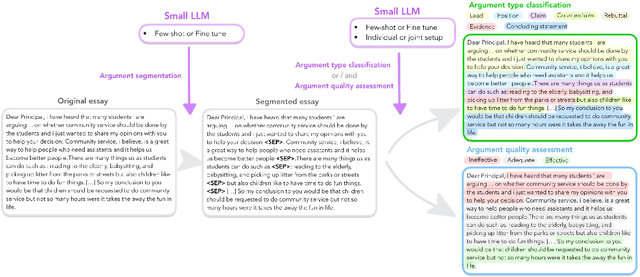
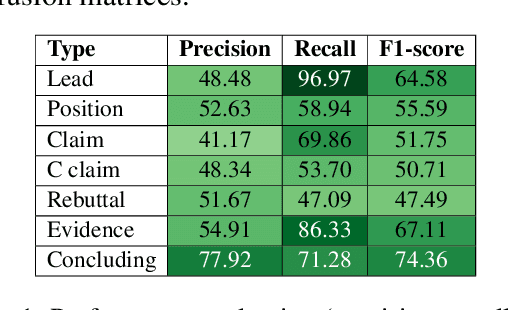
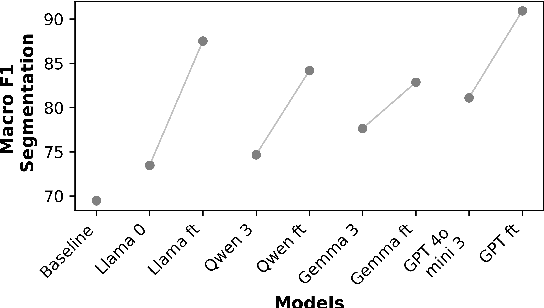
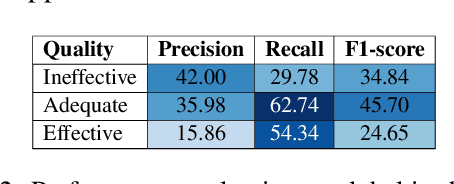
Argument mining algorithms analyze the argumentative structure of essays, making them a valuable tool for enhancing education by providing targeted feedback on the students' argumentation skills. While current methods often use encoder or encoder-decoder deep learning architectures, decoder-only models remain largely unexplored, offering a promising research direction. This paper proposes leveraging open-source, small Large Language Models (LLMs) for argument mining through few-shot prompting and fine-tuning. These models' small size and open-source nature ensure accessibility, privacy, and computational efficiency, enabling schools and educators to adopt and deploy them locally. Specifically, we perform three tasks: segmentation of student essays into arguments, classification of the arguments by type, and assessment of their quality. We empirically evaluate the models on the Feedback Prize - Predicting Effective Arguments dataset of grade 6-12 students essays and demonstrate how fine-tuned small LLMs outperform baseline methods in segmenting the essays and determining the argument types while few-shot prompting yields comparable performance to that of the baselines in assessing quality. This work highlights the educational potential of small, open-source LLMs to provide real-time, personalized feedback, enhancing independent learning and writing skills while ensuring low computational cost and privacy.