 Add to Chrome
 Add to Firefox
 Add to Edge
Benchmarking Empirical Privacy Protection for Adaptations of Large Language Models
Jun 08, 2026
Recent work has applied differential privacy (DP) to adapt large language models (LLMs) for sensitive applications, offering theoretical guarantees. However, its practical effectiveness remains unclear, partly due to LLM pretraining, where overlaps and interdependencies with adaptation data can undermine privacy despite DP efforts. To analyze this issue in practice, we investigate privacy risks under DP adaptations in LLMs using state-of-the-art attacks such as robust membership inference and canary data extraction. We benchmark these risks by systematically varying the adaptation data distribution, from exact overlaps with pretraining data, through in-distribution (IID) cases, to entirely out-of-distribution (OOD) examples. Additionally, we evaluate how different adaptation methods and different privacy regimes impact the vulnerability. Our results show that distribution shifts strongly influence privacy vulnerability: the closer the adaptation data is to the pretraining distribution, the higher the practical privacy risk at the same theoretical guarantee, even without direct data overlap. We find that parameter-efficient fine-tuning methods, such as LoRA, achieve the highest empirical privacy protection for OOD data. Our benchmark identifies key factors for achieving practical privacy in DP LLM adaptation, providing actionable insights for deploying customized models in sensitive settings. Looking forward, we propose a structured framework for holistic privacy assessment beyond adaptation privacy, to identify and evaluate risks across the full pretrain-adapt pipeline of LLMs.

Membership Inference Attacks on Sequence Models
Jun 05, 2025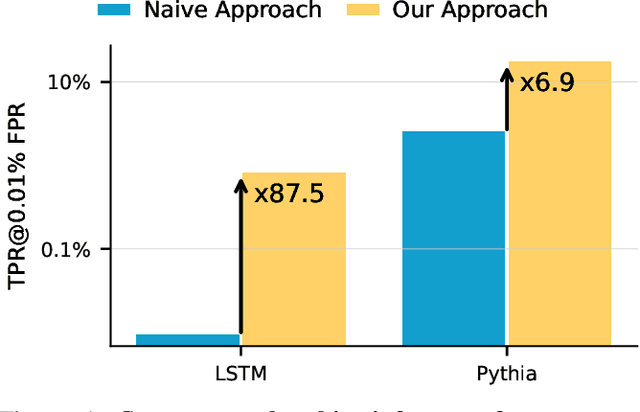


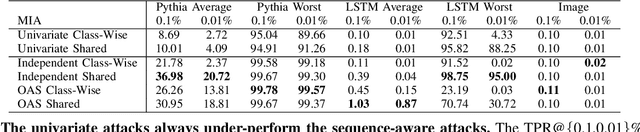
Sequence models, such as Large Language Models (LLMs) and autoregressive image generators, have a tendency to memorize and inadvertently leak sensitive information. While this tendency has critical legal implications, existing tools are insufficient to audit the resulting risks. We hypothesize that those tools' shortcomings are due to mismatched assumptions. Thus, we argue that effectively measuring privacy leakage in sequence models requires leveraging the correlations inherent in sequential generation. To illustrate this, we adapt a state-of-the-art membership inference attack to explicitly model within-sequence correlations, thereby demonstrating how a strong existing attack can be naturally extended to suit the structure of sequence models. Through a case study, we show that our adaptations consistently improve the effectiveness of memorization audits without introducing additional computational costs. Our work hence serves as an important stepping stone toward reliable memorization audits for large sequence models.
DeltaBound Attack: Efficient decision-based attack in low queries regime
Oct 01, 2022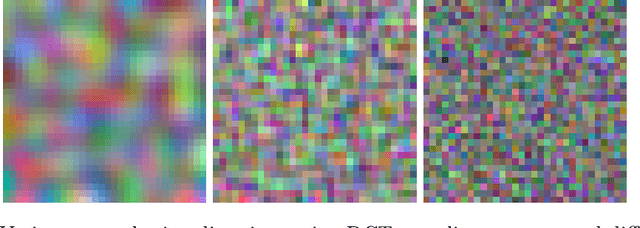
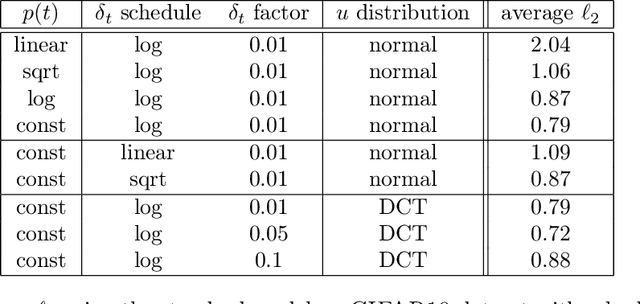
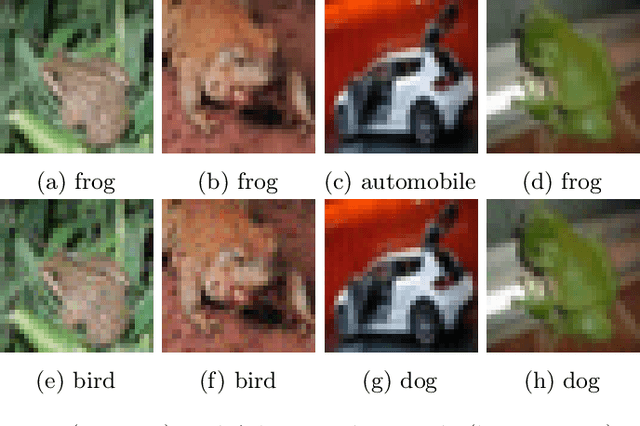
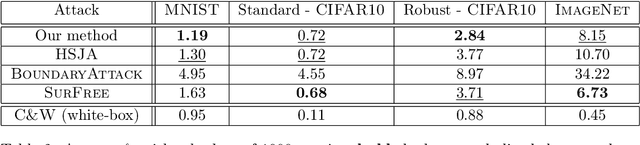
Deep neural networks and other machine learning systems, despite being extremely powerful and able to make predictions with high accuracy, are vulnerable to adversarial attacks. We proposed the DeltaBound attack: a novel, powerful attack in the hard-label setting with $\ell_2$ norm bounded perturbations. In this scenario, the attacker has only access to the top-1 predicted label of the model and can be therefore applied to real-world settings such as remote API. This is a complex problem since the attacker has very little information about the model. Consequently, most of the other techniques present in the literature require a massive amount of queries for attacking a single example. Oppositely, this work mainly focuses on the evaluation of attack's power in the low queries regime $\leq 1000$ queries) with $\ell_2$ norm in the hard-label settings. We find that the DeltaBound attack performs as well and sometimes better than current state-of-the-art attacks while remaining competitive across different kinds of models. Moreover, we evaluate our method against not only deep neural networks, but also non-deep learning models, such as Gradient Boosting Decision Trees and Multinomial Naive Bayes.
Certain and Uncertain Inference with Trivalent Conditionals
Jul 17, 2022

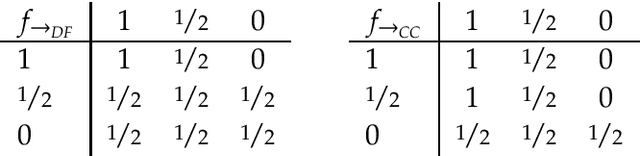
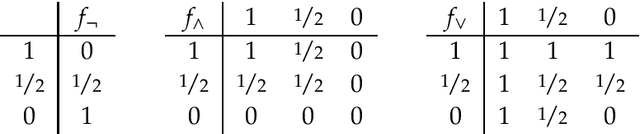
Research on indicative conditionals usually aims either at determining their truth conditions, or at explaining how we should reason with them and when we can assert them. This paper integrates these semantic and epistemological projects by means of articulating trivalent, truth-functional truth conditions for indicative conditionals. Based on this framework, we provide a non-classical account of the probability of conditionals, and two logics of conditional reasoning: (i) a logic C of inference from certain premises that generalizes deductive reasoning; and (ii) a logic U of inference from uncertain premises that generalizes defeasible reasoning. Both logics are highly attractive in their domain. They provide a unified framework for conditional reasoning, generalize existing theories (e.g., Adams's logic of "reasonable inference") and yield an insightful analysis of the controversies about the validity of Modus Ponens, Import-Export, and other principles of conditional logic.