 Add to Chrome
 Add to Firefox
 Add to Edge
Vision-Based Early Fault Diagnosis and Self-Recovery for Strawberry Harvesting Robots
Jan 05, 2026
Strawberry harvesting robots faced persistent challenges such as low integration of visual perception, fruit-gripper misalignment, empty grasping, and strawberry slippage from the gripper due to insufficient gripping force, all of which compromised harvesting stability and efficiency in orchard environments. To overcome these issues, this paper proposed a visual fault diagnosis and self-recovery framework that integrated multi-task perception with corrective control strategies. At the core of this framework was SRR-Net, an end-to-end multi-task perception model that simultaneously performed strawberry detection, segmentation, and ripeness estimation, thereby unifying visual perception with fault diagnosis. Based on this integrated perception, a relative error compensation method based on the simultaneous target-gripper detection was designed to address positional misalignment, correcting deviations when error exceeded the tolerance threshold. To mitigate empty grasping and fruit-slippage faults, an early abort strategy was implemented. A micro-optical camera embedded in the end-effector provided real-time visual feedback, enabling grasp detection during the deflating stage and strawberry slip prediction during snap-off through MobileNet V3-Small classifier and a time-series LSTM classifier. Experiments demonstrated that SRR-Net maintained high perception accuracy. For detection, it achieved a precision of 0.895 and recall of 0.813 on strawberries, and 0.972/0.958 on hands. In segmentation, it yielded a precision of 0.887 and recall of 0.747 for strawberries, and 0.974/0.947 for hands. For ripeness estimation, SRR-Net attained a mean absolute error of 0.035, while simultaneously supporting multi-task perception and sustaining a competitive inference speed of 163.35 FPS.

A Fast Path-Planning Method for Continuous Harvesting of Table-Top Grown Strawberries
Jan 09, 2025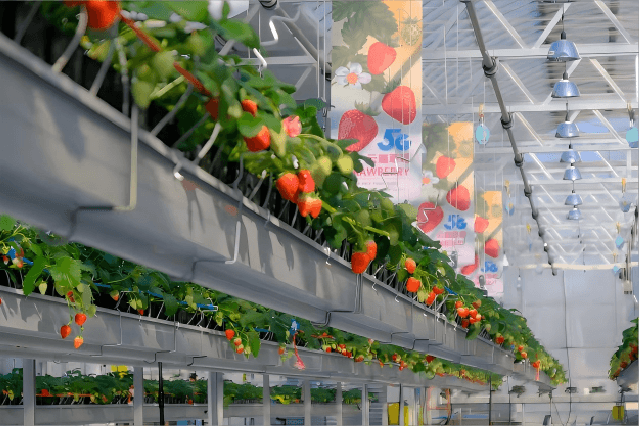
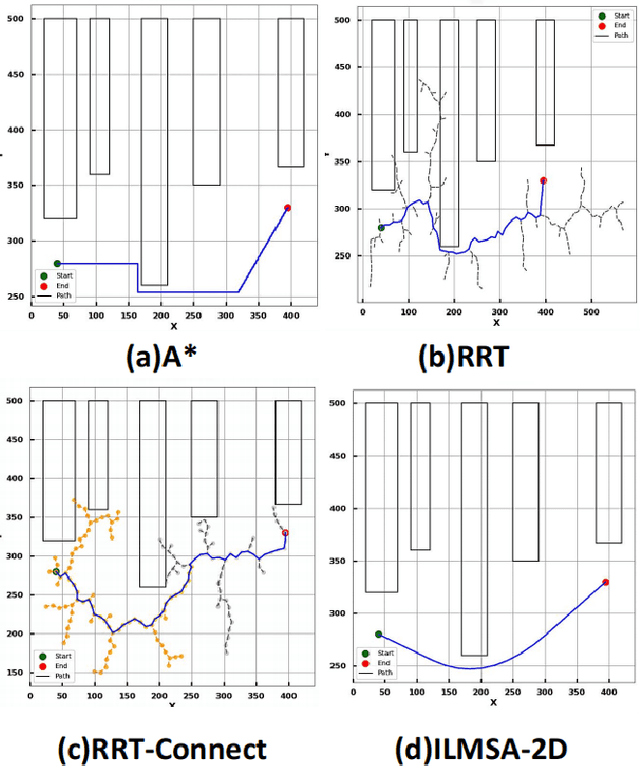
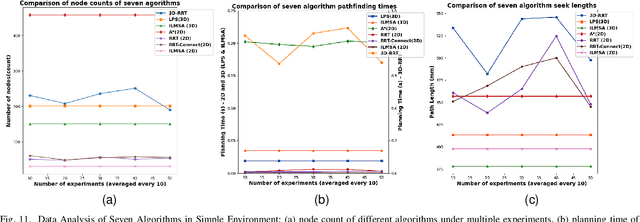
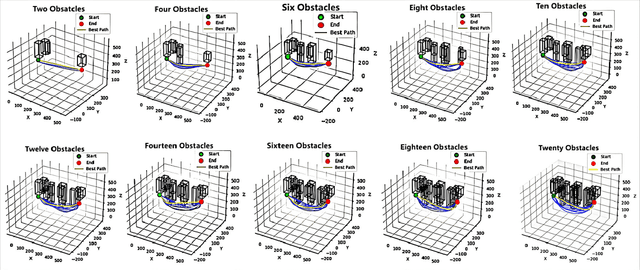
Continuous harvesting and storage of multiple fruits in a single operation allow robots to significantly reduce the travel distance required for repetitive back-and-forth movements. Traditional collision-free path planning algorithms, such as Rapidly-Exploring Random Tree (RRT) and A-star (A), often fail to meet the demands of efficient continuous fruit harvesting due to their low search efficiency and the generation of excessive redundant points. This paper presents the Interactive Local Minima Search Algorithm (ILMSA), a fast path-planning method designed for the continuous harvesting of table-top grown strawberries. The algorithm featured an interactive node expansion strategy that iteratively extended and refined collision-free path segments based on local minima points. To enable the algorithm to function in 3D, the 3D environment was projected onto multiple 2D planes, generating optimal paths on each plane. The best path was then selected, followed by integrating and smoothing the 3D path segments. Simulations demonstrated that ILMSA outperformed existing methods, reducing path length by 21.5% and planning time by 97.1% compared to 3D-RRT, while achieving 11.6% shorter paths and 25.4% fewer nodes than the Lowest Point of the Strawberry (LPS) algorithm in 3D environments. In 2D, ILMSA achieved path lengths 16.2% shorter than A, 23.4% shorter than RRT, and 20.9% shorter than RRT-Connect, while being over 96% faster and generating significantly fewer nodes. Field tests confirmed ILMSA's suitability for complex agricultural tasks, having a combined planning and execution time and an average path length that were approximately 58% and 69%, respectively, of those achieved by the LPS algorithm.