 Add to Chrome
 Add to Firefox
 Add to Edge
Beyond Abstract Compliance: Operationalising trust in AI as a moral relationship
Jan 30, 2026
Dominant approaches, e.g. the EU's "Trustworthy AI framework", treat trust as a property that can be designed for, evaluated, and governed according to normative and technical criteria. They do not address how trust is subjectively cultivated and experienced, culturally embedded, and inherently relational. This paper proposes some expanded principles for trust in AI that can be incorporated into common development methods and frame trust as a dynamic, temporal relationship, which involves transparency and mutual respect. We draw on relational ethics and, in particular, African communitarian philosophies, to foreground the nuances of inclusive, participatory processes and long-term relationships with communities. Involving communities throughout the AI lifecycle can foster meaningful relationships with AI design and development teams that incrementally build trust and promote more equitable and context-sensitive AI systems. We illustrate how trust-enabling principles based on African relational ethics can be operationalised, using two use-cases for AI: healthcare and education.

Socially Responsible Data for Large Multilingual Language Models
Sep 08, 2024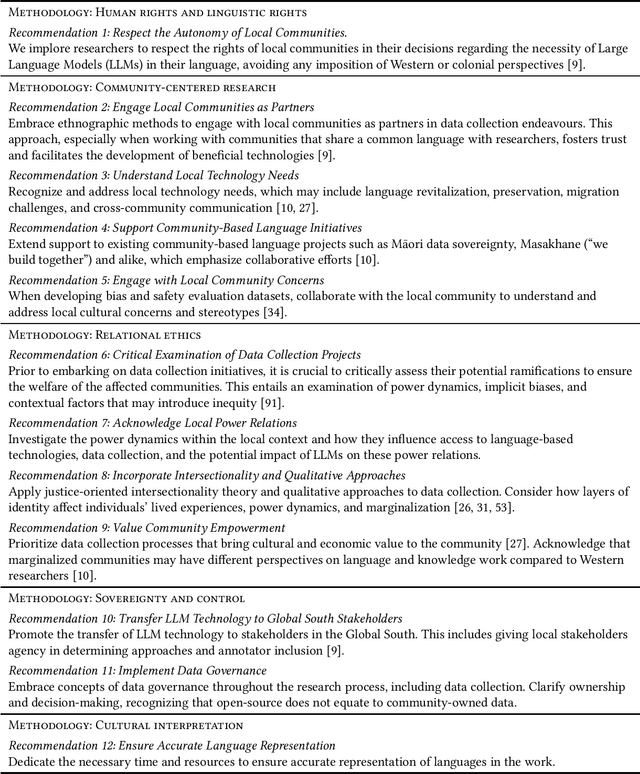
Large Language Models (LLMs) have rapidly increased in size and apparent capabilities in the last three years, but their training data is largely English text. There is growing interest in multilingual LLMs, and various efforts are striving for models to accommodate languages of communities outside of the Global North, which include many languages that have been historically underrepresented in digital realms. These languages have been coined as "low resource languages" or "long-tail languages", and LLMs performance on these languages is generally poor. While expanding the use of LLMs to more languages may bring many potential benefits, such as assisting cross-community communication and language preservation, great care must be taken to ensure that data collection on these languages is not extractive and that it does not reproduce exploitative practices of the past. Collecting data from languages spoken by previously colonized people, indigenous people, and non-Western languages raises many complex sociopolitical and ethical questions, e.g., around consent, cultural safety, and data sovereignty. Furthermore, linguistic complexity and cultural nuances are often lost in LLMs. This position paper builds on recent scholarship, and our own work, and outlines several relevant social, cultural, and ethical considerations and potential ways to mitigate them through qualitative research, community partnerships, and participatory design approaches. We provide twelve recommendations for consideration when collecting language data on underrepresented language communities outside of the Global North.