 Add to Chrome
 Add to Firefox
 Add to Edge
QUPID: A Partitioned Quantum Neural Network for Anomaly Detection in Smart Grid
Jan 16, 2026
Smart grid infrastructures have revolutionized energy distribution, but their day-to-day operations require robust anomaly detection methods to counter risks associated with cyber-physical threats and system faults potentially caused by natural disasters, equipment malfunctions, and cyber attacks. Conventional machine learning (ML) models are effective in several domains, yet they struggle to represent the complexities observed in smart grid systems. Furthermore, traditional ML models are highly susceptible to adversarial manipulations, making them increasingly unreliable for real-world deployment. Quantum ML (QML) provides a unique advantage, utilizing quantum-enhanced feature representations to model the intricacies of the high-dimensional nature of smart grid systems while demonstrating greater resilience to adversarial manipulation. In this work, we propose QUPID, a partitioned quantum neural network (PQNN) that outperforms traditional state-of-the-art ML models in anomaly detection. We extend our model to R-QUPID that even maintains its performance when including differential privacy (DP) for enhanced robustness. Moreover, our partitioning framework addresses a significant scalability problem in QML by efficiently distributing computational workloads, making quantum-enhanced anomaly detection practical in large-scale smart grid environments. Our experimental results across various scenarios exemplifies the efficacy of QUPID and R-QUPID to significantly improve anomaly detection capabilities and robustness compared to traditional ML approaches.

Swift Hydra: Self-Reinforcing Generative Framework for Anomaly Detection with Multiple Mamba Models
Mar 09, 2025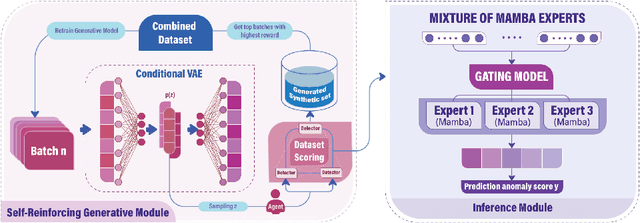
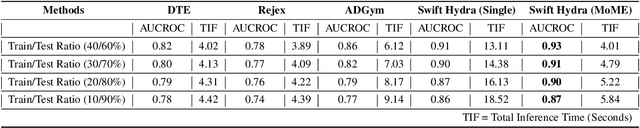
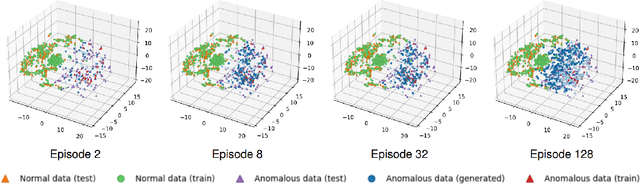
Despite a plethora of anomaly detection models developed over the years, their ability to generalize to unseen anomalies remains an issue, particularly in critical systems. This paper aims to address this challenge by introducing Swift Hydra, a new framework for training an anomaly detection method based on generative AI and reinforcement learning (RL). Through featuring an RL policy that operates on the latent variables of a generative model, the framework synthesizes novel and diverse anomaly samples that are capable of bypassing a detection model. These generated synthetic samples are, in turn, used to augment the detection model, further improving its ability to handle challenging anomalies. Swift Hydra also incorporates Mamba models structured as a Mixture of Experts (MoE) to enable scalable adaptation of the number of Mamba experts based on data complexity, effectively capturing diverse feature distributions without increasing the model's inference time. Empirical evaluations on ADBench benchmark demonstrate that Swift Hydra outperforms other state-of-the-art anomaly detection models while maintaining a relatively short inference time. From these results, our research highlights a new and auspicious paradigm of integrating RL and generative AI for advancing anomaly detection.