 Add to Chrome
 Add to Firefox
 Add to Edge
Length-Aware Adversarial Training for Variable-Length Trajectories: Digital Twins for Mall Shopper Paths
Jan 04, 2026
We study generative modeling of \emph{variable-length trajectories} -- sequences of visited locations/items with associated timestamps -- for downstream simulation and counterfactual analysis. A recurring practical issue is that standard mini-batch training can be unstable when trajectory lengths are highly heterogeneous, which in turn degrades \emph{distribution matching} for trajectory-derived statistics. We propose \textbf{length-aware sampling (LAS)}, a simple batching strategy that groups trajectories by length and samples batches from a single length bucket, reducing within-batch length heterogeneity (and making updates more consistent) without changing the model class. We integrate LAS into a conditional trajectory GAN with auxiliary time-alignment losses and provide (i) a distribution-level guarantee for derived variables under mild boundedness assumptions, and (ii) an IPM/Wasserstein mechanism explaining why LAS improves distribution matching by removing length-only shortcut critics and targeting within-bucket discrepancies. Empirically, LAS consistently improves matching of derived-variable distributions on a multi-mall dataset of shopper trajectories and on diverse public sequence datasets (GPS, education, e-commerce, and movies), outperforming random sampling across dataset-specific metrics.

PCM : Picard Consistency Model for Fast Parallel Sampling of Diffusion Models
Mar 25, 2025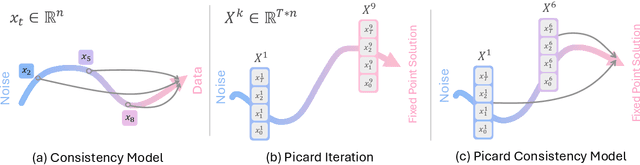
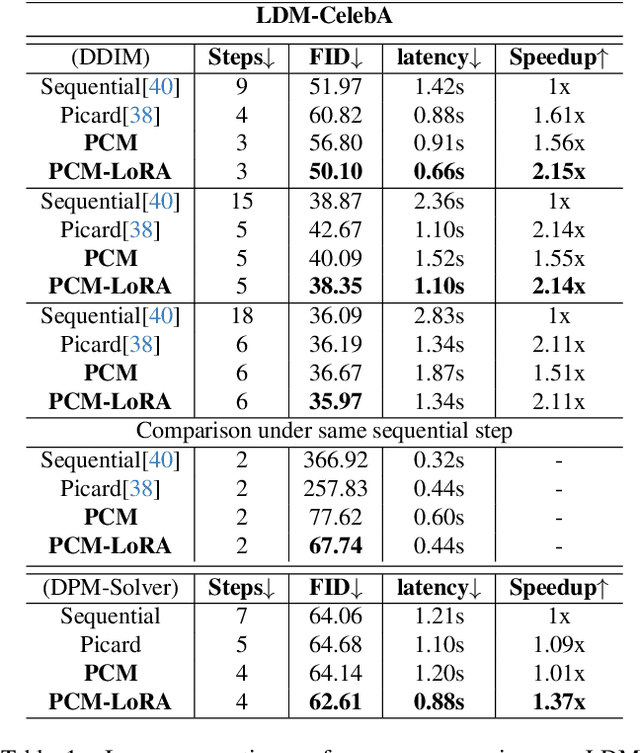
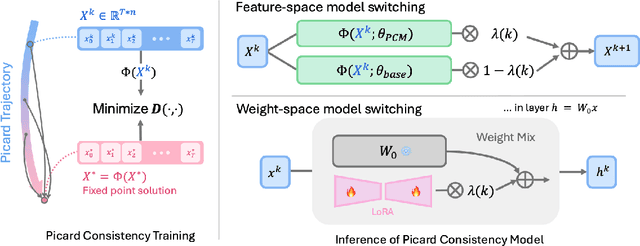

Recently, diffusion models have achieved significant advances in vision, text, and robotics. However, they still face slow generation speeds due to sequential denoising processes. To address this, a parallel sampling method based on Picard iteration was introduced, effectively reducing sequential steps while ensuring exact convergence to the original output. Nonetheless, Picard iteration does not guarantee faster convergence, which can still result in slow generation in practice. In this work, we propose a new parallelization scheme, the Picard Consistency Model (PCM), which significantly reduces the number of generation steps in Picard iteration. Inspired by the consistency model, PCM is directly trained to predict the fixed-point solution, or the final output, at any stage of the convergence trajectory. Additionally, we introduce a new concept called model switching, which addresses PCM's limitations and ensures exact convergence. Extensive experiments demonstrate that PCM achieves up to a 2.71x speedup over sequential sampling and a 1.77x speedup over Picard iteration across various tasks, including image generation and robotic control.