 Add to Chrome
 Add to Firefox
 Add to Edge
WS-IMUBench: Can Weakly Supervised Methods from Audio, Image, and Video Be Adapted for IMU-based Temporal Action Localization?
Feb 02, 2026
IMU-based Human Activity Recognition (HAR) has enabled a wide range of ubiquitous computing applications, yet its dominant clip classification paradigm cannot capture the rich temporal structure of real-world behaviors. This motivates a shift toward IMU Temporal Action Localization (IMU-TAL), which predicts both action categories and their start/end times in continuous streams. However, current progress is strongly bottlenecked by the need for dense, frame-level boundary annotations, which are costly and difficult to scale. To address this bottleneck, we introduce WS-IMUBench, a systematic benchmark study of weakly supervised IMU-TAL (WS-IMU-TAL) under only sequence-level labels. Rather than proposing a new localization algorithm, we evaluate how well established weakly supervised localization paradigms from audio, image, and video transfer to IMU-TAL under only sequence-level labels. We benchmark seven representative weakly supervised methods on seven public IMU datasets, resulting in over 3,540 model training runs and 7,080 inference evaluations. Guided by three research questions on transferability, effectiveness, and insights, our findings show that (i) transfer is modality-dependent, with temporal-domain methods generally more stable than image-derived proposal-based approaches; (ii) weak supervision can be competitive on favorable datasets (e.g., with longer actions and higher-dimensional sensing); and (iii) dominant failure modes arise from short actions, temporal ambiguity, and proposal quality. Finally, we outline concrete directions for advancing WS-IMU-TAL (e.g., IMU-specific proposal generation, boundary-aware objectives, and stronger temporal reasoning). Beyond individual results, WS-IMUBench establishes a reproducible benchmarking template, datasets, protocols, and analyses, to accelerate community-wide progress toward scalable WS-IMU-TAL.

What's on Your Plate? Inferring Chinese Cuisine Intake from Wearable IMUs
Nov 07, 2025Accurate food intake detection is vital for dietary monitoring and chronic disease prevention. Traditional self-report methods are prone to recall bias, while camera-based approaches raise concerns about privacy. Furthermore, existing wearable-based methods primarily focus on a limited number of food types, such as hamburgers and pizza, failing to address the vast diversity of Chinese cuisine. To bridge this gap, we propose CuisineSense, a system that classifies Chinese food types by integrating hand motion cues from a smartwatch with head dynamics from smart glasses. To filter out irrelevant daily activities, we design a two-stage detection pipeline. The first stage identifies eating states by distinguishing characteristic temporal patterns from non-eating behaviors. The second stage then conducts fine-grained food type recognition based on the motions captured during food intake. To evaluate CuisineSense, we construct a dataset comprising 27.5 hours of IMU recordings across 11 food categories and 10 participants. Experiments demonstrate that CuisineSense achieves high accuracy in both eating state detection and food classification, offering a practical solution for unobtrusive, wearable-based dietary monitoring.The system code is publicly available at https://github.com/joeeeeyin/CuisineSense.git.
XRF V2: A Dataset for Action Summarization with Wi-Fi Signals, and IMUs in Phones, Watches, Earbuds, and Glasses
Jan 31, 2025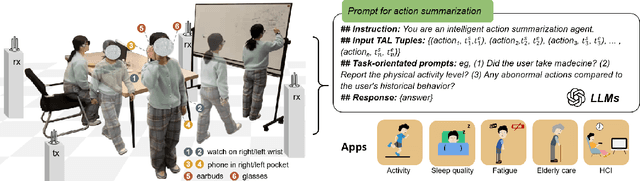

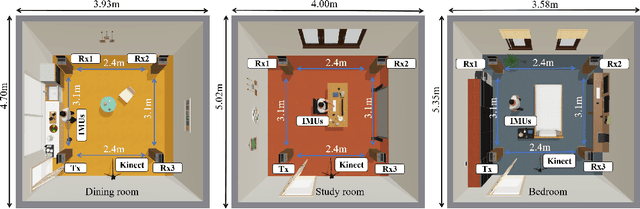
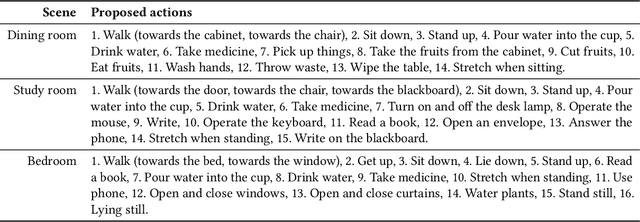
Human Action Recognition (HAR) plays a crucial role in applications such as health monitoring, smart home automation, and human-computer interaction. While HAR has been extensively studied, action summarization, which involves identifying and summarizing continuous actions, remains an emerging task. This paper introduces the novel XRF V2 dataset, designed for indoor daily activity Temporal Action Localization (TAL) and action summarization. XRF V2 integrates multimodal data from Wi-Fi signals, IMU sensors (smartphones, smartwatches, headphones, and smart glasses), and synchronized video recordings, offering a diverse collection of indoor activities from 16 volunteers across three distinct environments. To tackle TAL and action summarization, we propose the XRFMamba neural network, which excels at capturing long-term dependencies in untrimmed sensory sequences and outperforms state-of-the-art methods, such as ActionFormer and WiFiTAD. We envision XRF V2 as a valuable resource for advancing research in human action localization, action forecasting, pose estimation, multimodal foundation models pre-training, synthetic data generation, and more.