 Add to Chrome
 Add to Firefox
 Add to Edge
PhysSFI-Net: Physics-informed Geometric Learning of Skeletal and Facial Interactions for Orthognathic Surgical Outcome Prediction
Jan 06, 2026
Orthognathic surgery repositions jaw bones to restore occlusion and enhance facial aesthetics. Accurate simulation of postoperative facial morphology is essential for preoperative planning. However, traditional biomechanical models are computationally expensive, while geometric deep learning approaches often lack interpretability. In this study, we develop and validate a physics-informed geometric deep learning framework named PhysSFI-Net for precise prediction of soft tissue deformation following orthognathic surgery. PhysSFI-Net consists of three components: a hierarchical graph module with craniofacial and surgical plan encoders combined with attention mechanisms to extract skeletal-facial interaction features; a Long Short-Term Memory (LSTM)-based sequential predictor for incremental soft tissue deformation; and a biomechanics-inspired module for high-resolution facial surface reconstruction. Model performance was assessed using point cloud shape error (Hausdorff distance), surface deviation error, and landmark localization error (Euclidean distances of craniomaxillofacial landmarks) between predicted facial shapes and corresponding ground truths. A total of 135 patients who underwent combined orthodontic and orthognathic treatment were included for model training and validation. Quantitative analysis demonstrated that PhysSFI-Net achieved a point cloud shape error of 1.070 +/- 0.088 mm, a surface deviation error of 1.296 +/- 0.349 mm, and a landmark localization error of 2.445 +/- 1.326 mm. Comparative experiments indicated that PhysSFI-Net outperformed the state-of-the-art method ACMT-Net in prediction accuracy. In conclusion, PhysSFI-Net enables interpretable, high-resolution prediction of postoperative facial morphology with superior accuracy, showing strong potential for clinical application in orthognathic surgical planning and simulation.

SiamTHN: Siamese Target Highlight Network for Visual Tracking
Mar 22, 2023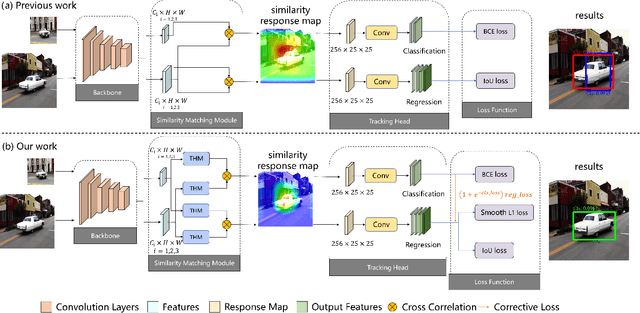
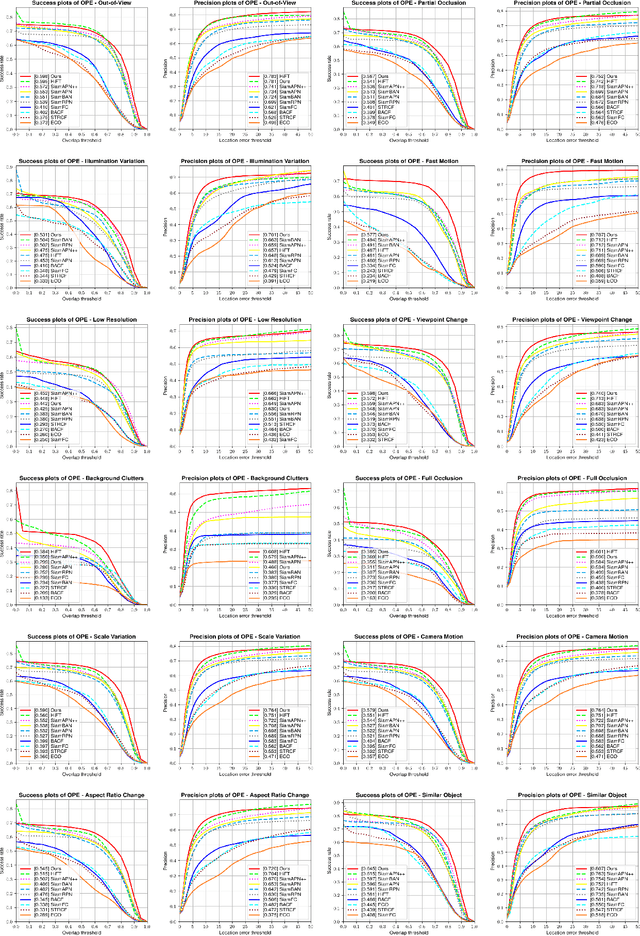
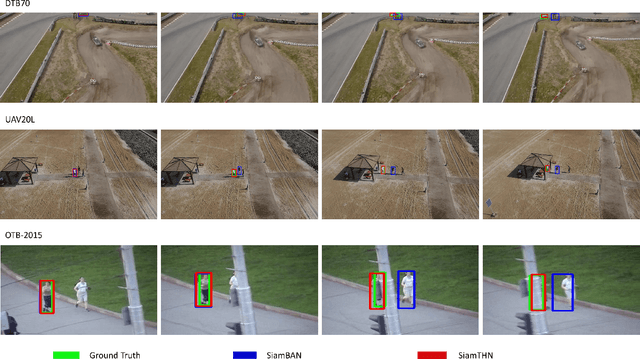
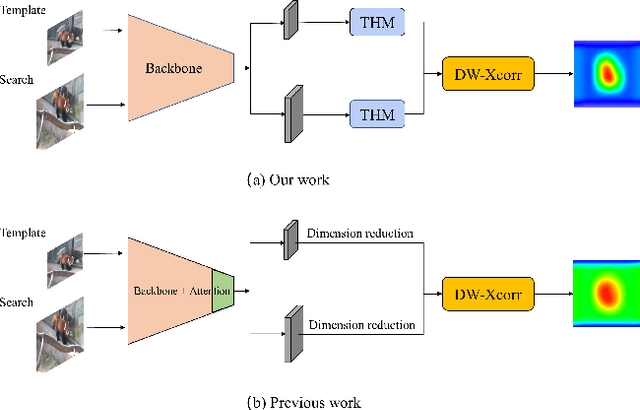
Siamese network based trackers develop rapidly in the field of visual object tracking in recent years. The majority of siamese network based trackers now in use treat each channel in the feature maps generated by the backbone network equally, making the similarity response map sensitive to background influence and hence challenging to focus on the target region. Additionally, there are no structural links between the classification and regression branches in these trackers, and the two branches are optimized separately during training. Therefore, there is a misalignment between the classification and regression branches, which results in less accurate tracking results. In this paper, a Target Highlight Module is proposed to help the generated similarity response maps to be more focused on the target region. To reduce the misalignment and produce more precise tracking results, we propose a corrective loss to train the model. The two branches of the model are jointly tuned with the use of corrective loss to produce more reliable prediction results. Experiments on 5 challenging benchmark datasets reveal that the method outperforms current models in terms of performance, and runs at 38 fps, proving its effectiveness and efficiency.