 Add to Chrome
 Add to Firefox
 Add to Edge
Exploring AI-Augmented Sensemaking of Patient-Generated Health Data: A Mixed-Method Study with Healthcare Professionals in Cardiac Risk Reduction
Feb 05, 2026
Individuals are increasingly generating substantial personal health and lifestyle data, e.g. through wearables and smartphones. While such data could transform preventative care, its integration into clinical practice is hindered by its scale, heterogeneity and the time pressure and data literacy of healthcare professionals (HCPs). We explore how large language models (LLMs) can support sensemaking of patient-generated health data (PGHD) with automated summaries and natural language data exploration. Using cardiovascular disease (CVD) risk reduction as a use case, 16 HCPs reviewed multimodal PGHD in a mixed-methods study with a prototype that integrated common charts, LLM-generated summaries, and a conversational interface. Findings show that AI summaries provided quick overviews that anchored exploration, while conversational interaction supported flexible analysis and bridged data-literacy gaps. However, HCPs raised concerns about transparency, privacy, and overreliance. We contribute empirical insights and sociotechnical design implications for integrating AI-driven summarization and conversation into clinical workflows to support PGHD sensemaking.

The Last JITAI? The Unreasonable Effectiveness of Large Language Models in Issuing Just-in-Time Adaptive Interventions: Fostering Physical Activity in a Prospective Cardiac Rehabilitation Setting
Feb 13, 2024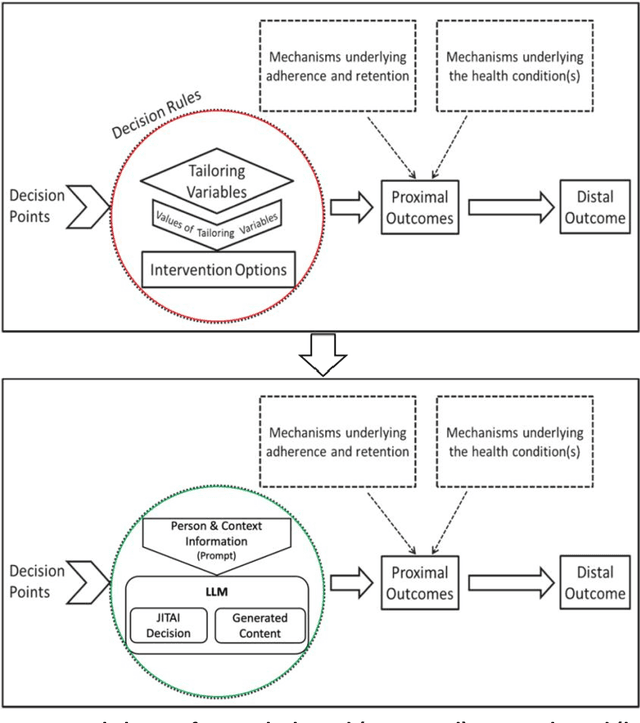
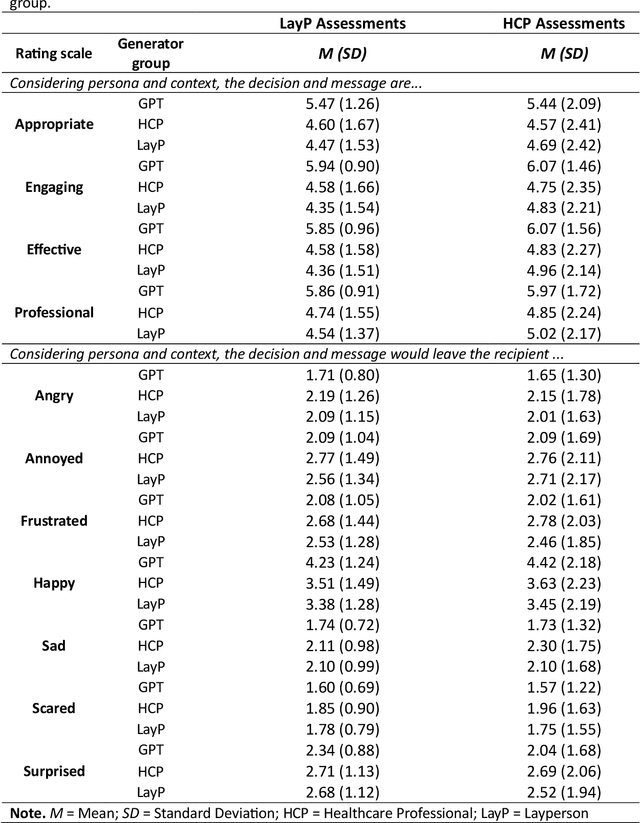
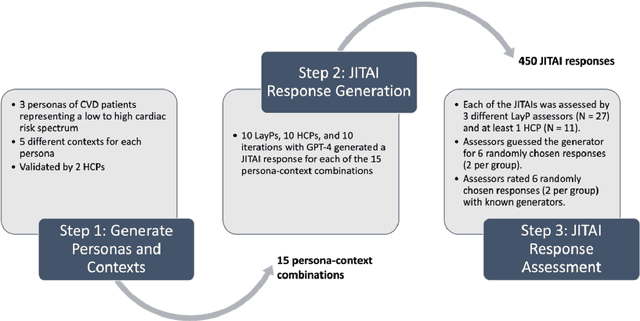
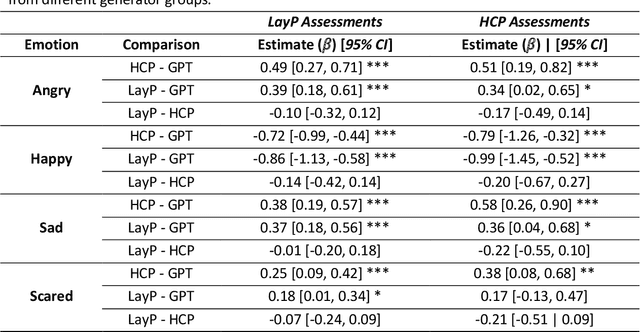
We explored the viability of Large Language Models (LLMs) for triggering and personalizing content for Just-in-Time Adaptive Interventions (JITAIs) in digital health. JITAIs are being explored as a key mechanism for sustainable behavior change, adapting interventions to an individual's current context and needs. However, traditional rule-based and machine learning models for JITAI implementation face scalability and reliability limitations, such as lack of personalization, difficulty in managing multi-parametric systems, and issues with data sparsity. To investigate JITAI implementation via LLMs, we tested the contemporary overall performance-leading model 'GPT-4' with examples grounded in the use case of fostering heart-healthy physical activity in outpatient cardiac rehabilitation. Three personas and five sets of context information per persona were used as a basis of triggering and personalizing JITAIs. Subsequently, we generated a total of 450 proposed JITAI decisions and message content, divided equally into JITAIs generated by 10 iterations with GPT-4, a baseline provided by 10 laypersons (LayPs), and a gold standard set by 10 healthcare professionals (HCPs). Ratings from 27 LayPs indicated that JITAIs generated by GPT-4 were superior to those by HCPs and LayPs over all assessed scales: i.e., appropriateness, engagement, effectiveness, and professionality. This study indicates that LLMs have significant potential for implementing JITAIs as a building block of personalized or "precision" health, offering scalability, effective personalization based on opportunistically sampled information, and good acceptability.