 Add to Chrome
 Add to Firefox
 Add to Edge
Auditing Sybil: Explaining Deep Lung Cancer Risk Prediction Through Generative Interventional Attributions
Jan 30, 2026
Lung cancer remains the leading cause of cancer mortality, driving the development of automated screening tools to alleviate radiologist workload. Standing at the frontier of this effort is Sybil, a deep learning model capable of predicting future risk solely from computed tomography (CT) with high precision. However, despite extensive clinical validation, current assessments rely purely on observational metrics. This correlation-based approach overlooks the model's actual reasoning mechanism, necessitating a shift to causal verification to ensure robust decision-making before clinical deployment. We propose S(H)NAP, a model-agnostic auditing framework that constructs generative interventional attributions validated by expert radiologists. By leveraging realistic 3D diffusion bridge modeling to systematically modify anatomical features, our approach isolates object-specific causal contributions to the risk score. Providing the first interventional audit of Sybil, we demonstrate that while the model often exhibits behavior akin to an expert radiologist, differentiating malignant pulmonary nodules from benign ones, it suffers from critical failure modes, including dangerous sensitivity to clinically unjustified artifacts and a distinct radial bias.

Rethinking Visual Counterfactual Explanations Through Region Constraint
Oct 16, 2024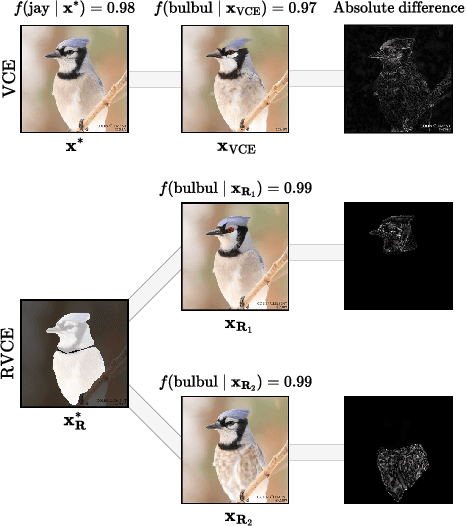
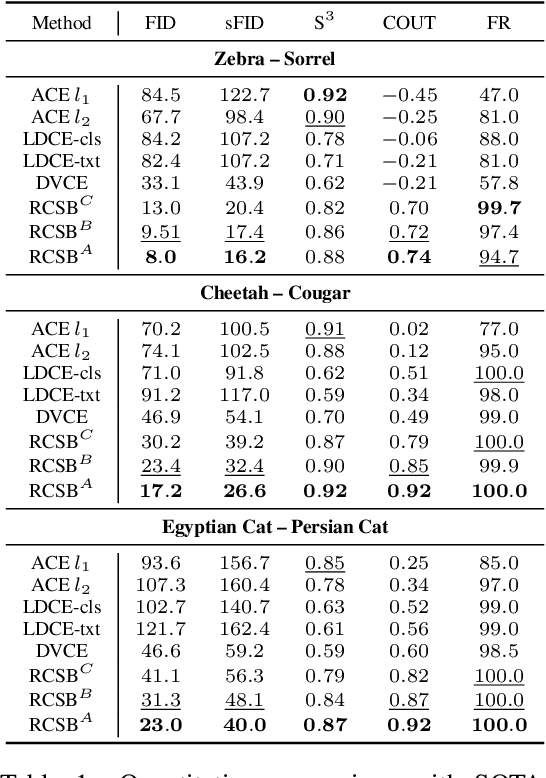
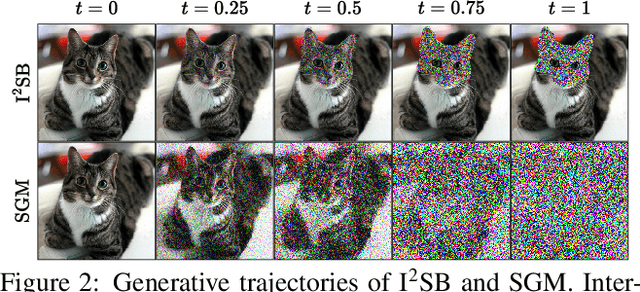
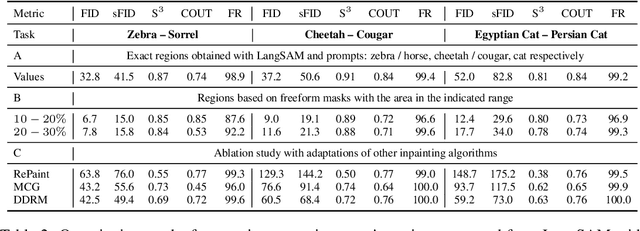
Visual counterfactual explanations (VCEs) have recently gained immense popularity as a tool for clarifying the decision-making process of image classifiers. This trend is largely motivated by what these explanations promise to deliver -- indicate semantically meaningful factors that change the classifier's decision. However, we argue that current state-of-the-art approaches lack a crucial component -- the region constraint -- whose absence prevents from drawing explicit conclusions, and may even lead to faulty reasoning due to phenomenons like confirmation bias. To address the issue of previous methods, which modify images in a very entangled and widely dispersed manner, we propose region-constrained VCEs (RVCEs), which assume that only a predefined image region can be modified to influence the model's prediction. To effectively sample from this subclass of VCEs, we propose Region-Constrained Counterfactual Schr\"odinger Bridges (RCSB), an adaptation of a tractable subclass of Schr\"odinger Bridges to the problem of conditional inpainting, where the conditioning signal originates from the classifier of interest. In addition to setting a new state-of-the-art by a large margin, we extend RCSB to allow for exact counterfactual reasoning, where the predefined region contains only the factor of interest, and incorporating the user to actively interact with the RVCE by predefining the regions manually.