 Add to Chrome
 Add to Firefox
 Add to Edge
SmartMeterFM: Unifying Smart Meter Data Generative Tasks Using Flow Matching Models
Jan 29, 2026
Smart meter data is the foundation for planning and operating the distribution network. Unfortunately, such data are not always available due to privacy regulations. Meanwhile, the collected data may be corrupted due to sensor or transmission failure, or it may not have sufficient resolution for downstream tasks. A wide range of generative tasks is formulated to address these issues, including synthetic data generation, missing data imputation, and super-resolution. Despite the success of machine learning models on these tasks, dedicated models need to be designed and trained for each task, leading to redundancy and inefficiency. In this paper, by recognizing the powerful modeling capability of flow matching models, we propose a new approach to unify diverse smart meter data generative tasks with a single model trained for conditional generation. The proposed flow matching models are trained to generate challenging, high-dimensional time series data, specifically monthly smart meter data at a 15 min resolution. By viewing different generative tasks as distinct forms of partial data observations and injecting them into the generation process, we unify tasks such as imputation and super-resolution with a single model, eliminating the need for re-training. The data generated by our model not only are consistent with the given observations but also remain realistic, showing better performance against interpolation and other machine learning based baselines dedicated to the tasks.

Acquiring Better Load Estimates by Combining Anomaly and Change-point Detection in Power Grid Time-series Measurements
May 28, 2024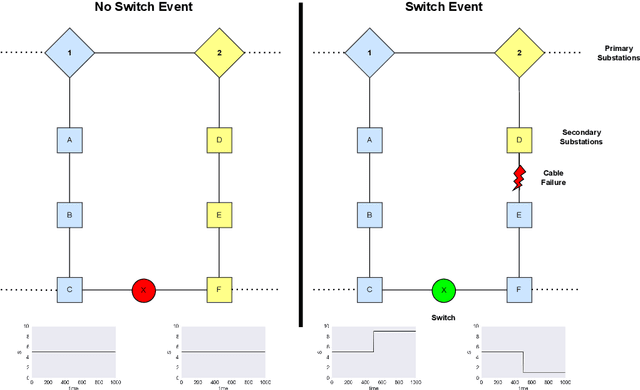
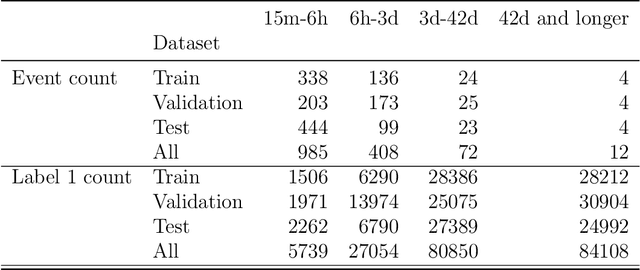
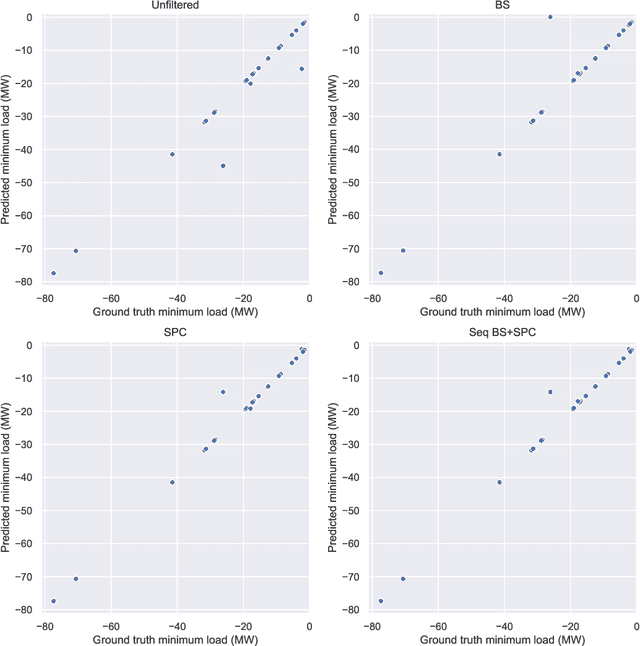
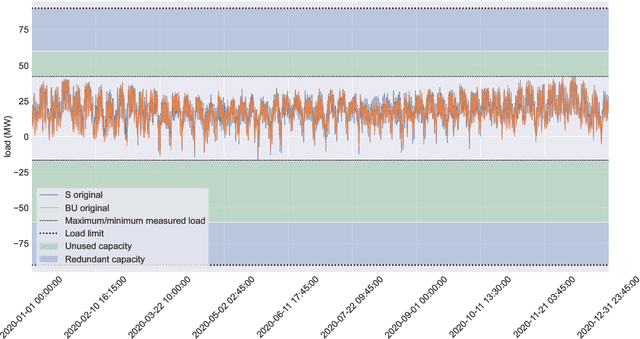
In this paper we present novel methodology for automatic anomaly and switch event filtering to improve load estimation in power grid systems. By leveraging unsupervised methods with supervised optimization, our approach prioritizes interpretability while ensuring robust and generalizable performance on unseen data. Through experimentation, a combination of binary segmentation for change point detection and statistical process control for anomaly detection emerges as the most effective strategy, specifically when ensembled in a novel sequential manner. Results indicate the clear wasted potential when filtering is not applied. The automatic load estimation is also fairly accurate, with approximately 90% of estimates falling within a 10% error margin, with only a single significant failure in both the minimum and maximum load estimates across 60 measurements in the test set. Our methodology's interpretability makes it particularly suitable for critical infrastructure planning, thereby enhancing decision-making processes.
Graph Isomorphic Networks for Assessing Reliability of the Medium-Voltage Grid
Oct 03, 2023Ensuring electricity grid reliability becomes increasingly challenging with the shift towards renewable energy and declining conventional capacities. Distribution System Operators (DSOs) aim to achieve grid reliability by verifying the n-1 principle, ensuring continuous operation in case of component failure. Electricity networks' complex graph-based data holds crucial information for n-1 assessment: graph structure and data about stations/cables. Unlike traditional machine learning methods, Graph Neural Networks (GNNs) directly handle graph-structured data. This paper proposes using Graph Isomorphic Networks (GINs) for n-1 assessments in medium voltage grids. The GIN framework is designed to generalise to unseen grids and utilise graph structure and data about stations/cables. The proposed GIN approach demonstrates faster and more reliable grid assessments than a traditional mathematical optimisation approach, reducing prediction times by approximately a factor of 1000. The findings offer a promising approach to address computational challenges and enhance the reliability and efficiency of energy grid assessments.