 Add to Chrome
 Add to Firefox
 Add to Edge
DSXFormer: Dual-Pooling Spectral Squeeze-Expansion and Dynamic Context Attention Transformer for Hyperspectral Image Classification
Feb 02, 2026
Hyperspectral image classification (HSIC) is a challenging task due to high spectral dimensionality, complex spectral-spatial correlations, and limited labeled training samples. Although transformer-based models have shown strong potential for HSIC, existing approaches often struggle to achieve sufficient spectral discriminability while maintaining computational efficiency. To address these limitations, we propose a novel DSXFormer, a novel dual-pooling spectral squeeze-expansion transformer with Dynamic Context Attention for HSIC. The proposed DSXFormer introduces a Dual-Pooling Spectral Squeeze-Expansion (DSX) block, which exploits complementary global average and max pooling to adaptively recalibrate spectral feature channels, thereby enhancing spectral discriminability and inter-band dependency modeling. In addition, DSXFormer incorporates a Dynamic Context Attention (DCA) mechanism within a window-based transformer architecture to dynamically capture local spectral-spatial relationships while significantly reducing computational overhead. The joint integration of spectral dual-pooling squeeze-expansion and DCA enables DSXFormer to achieve an effective balance between spectral emphasis and spatial contextual representation. Furthermore, patch extraction, embedding, and patch merging strategies are employed to facilitate efficient multi-scale feature learning. Extensive experiments conducted on four widely used hyperspectral benchmark datasets, including Salinas (SA), Indian Pines (IP), Pavia University (PU), and Kennedy Space Center (KSC), demonstrate that DSXFormer consistently outperforms state-of-the-art methods, achieving classification accuracies of 99.95%, 98.91%, 99.85%, and 98.52%, respectively.

Graph Attention-Driven Bayesian Deep Unrolling for Dual-Peak Single-Photon Lidar Imaging
Apr 03, 2025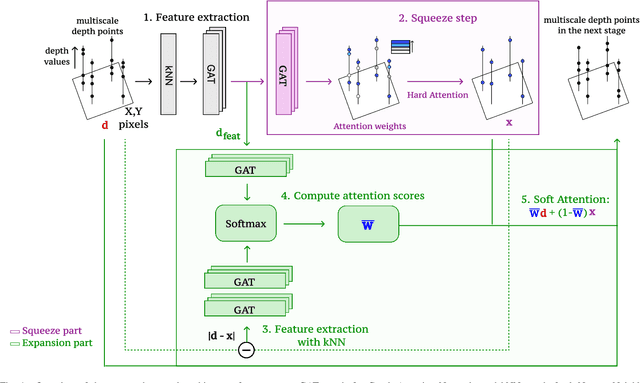

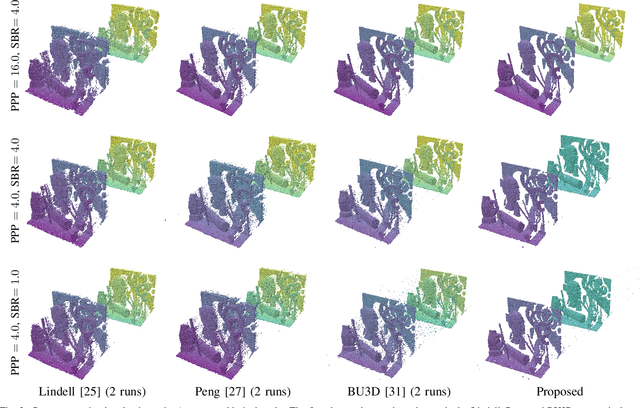
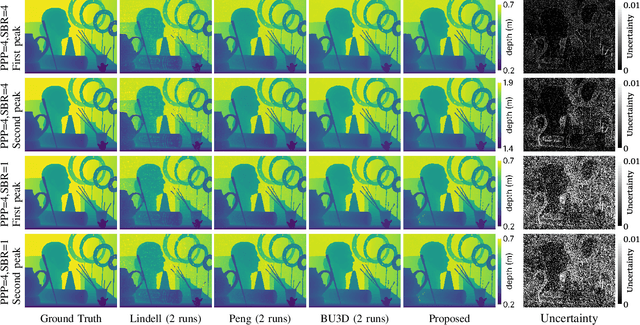
Single-photon Lidar imaging offers a significant advantage in 3D imaging due to its high resolution and long-range capabilities, however it is challenging to apply in noisy environments with multiple targets per pixel. To tackle these challenges, several methods have been proposed. Statistical methods demonstrate interpretability on the inferred parameters, but they are often limited in their ability to handle complex scenes. Deep learning-based methods have shown superior performance in terms of accuracy and robustness, but they lack interpretability or they are limited to a single-peak per pixel. In this paper, we propose a deep unrolling algorithm for dual-peak single-photon Lidar imaging. We introduce a hierarchical Bayesian model for multiple targets and propose a neural network that unrolls the underlying statistical method. To support multiple targets, we adopt a dual depth maps representation and exploit geometric deep learning to extract features from the point cloud. The proposed method takes advantages of statistical methods and learning-based methods in terms of accuracy and quantifying uncertainty. The experimental results on synthetic and real data demonstrate the competitive performance when compared to existing methods, while also providing uncertainty information.