 Add to Chrome
 Add to Firefox
 Add to Edge
The Radon Transform, True Time Delay Beamforming, and Ultra-Wideband Antenna Arrays (Invited Paper)
Apr 22, 2026
The FR3 band has emerged as the major focus of 6G wireless research. FR3 cellular operation presents the challenge of extreme bandwidth combined with physically large antenna arrays. In this regime, conventional phase-shift beamforming entails a loss of coherence (beam-squint), and has to be replaced by true time delay beamforming (TTD). It happens that TTD is mathematically equivalent to taking the Radon transform of the space/time measurements. We exploit fifty years of research in the application of the Radon transform to computer tomography and to seismic exploration to elucidate the workings of TTD. We use the Radon transform combined with semblance detection and Radon slowness filtering to remove far-field signals from the measured space/time signals from a linear array, leaving only near-field signals. In turn we partition the array into sub-arrays. For each sub-array we estimate, via the semblance Radon transform, the angles-of-arrival of the near-field signals. We then use triangulation to estimate the coordinates of the near-field sources. Finally we integrate the original space/time data along hyperbolic trajectories to extract the individual near-field signal envelopes.

Millimeter-Wave True-Time Delay Array Beamforming with Robustness to Mobility
Dec 09, 2025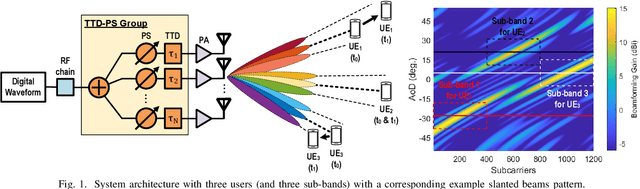
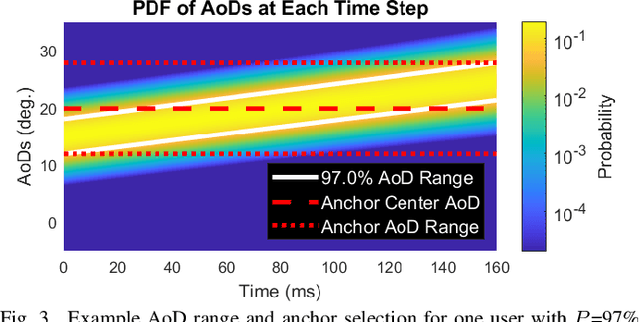
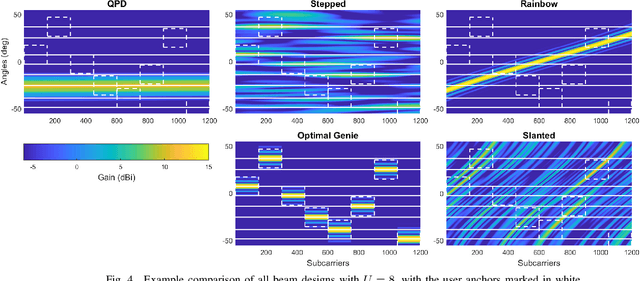
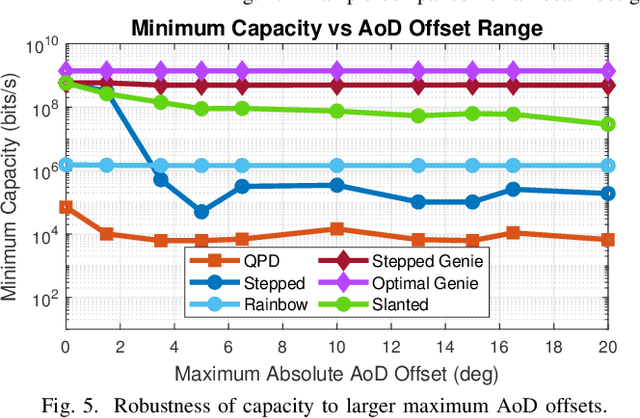
Ultra-reliable and low-latency connectivity is required for real-time and latency-sensitive applications, like wireless augmented and virtual reality streaming. Millimeter-wave (mmW) networks have enabled extremely high data rates through large available bandwidths but struggle to maintain continuous connectivity with mobile users. Achieving the required beamforming gain from large antenna arrays with minimal disruption is particularly challenging with fast-moving users and practical analog mmW array architectures. In this work, we propose frequency-dependent slanted beams from true-time delay (TTD) analog arrays to achieve robust beamforming in wideband, multi-user downlink scenarios. Novel beams with linear angle-frequency relationships for different users and sub-bands provide a trade-off between instantaneous capacity and angular coverage. Compared to alternative analog array beamforming designs, slanted beams provide higher reliability to angle offsets and greater adaptability to varied user movement statistics.
Structured Two-Stage True-Time-Delay Array Codebook Design for Multi-User Data Communication
Nov 15, 2023Wideband millimeter-wave and terahertz (THz) systems can facilitate simultaneous data communication with multiple spatially separated users. It is desirable to orthogonalize users across sub-bands by deploying frequency-dependent beams with a sub-band-specific spatial response. True-Time-Delay (TTD) antenna arrays are a promising wideband architecture to implement sub-band-specific dispersion of beams across space using a single radio frequency (RF) chain. This paper proposes a structured design of analog TTD codebooks to generate beams that exhibit quantized sub-band-to-angle mapping. We introduce a structured Staircase TTD codebook and analyze the frequency-spatial behaviour of the resulting beam patterns. We develop the closed-form two-stage design of the proposed codebook to achieve the desired sub-band-specific beams and evaluate their performance in multi-user communication networks.