 Add to Chrome
 Add to Firefox
 Add to Edge
VCA: Vision-Click-Action Framework for Precise Manipulation of Segmented Objects in Target Ambiguous Environments
Feb 27, 2026
The reliance on language in Vision-Language-Action (VLA) models introduces ambiguity, cognitive overhead, and difficulties in precise object identification and sequential task execution, particularly in environments with multiple visually similar objects. To address these limitations, we propose Vision-Click-Action (VCA), a framework that replaces verbose textual commands with direct, click-based visual interaction using pretrained segmentation models. By allowing operators to specify target objects clearly through visual selection in the robot's 2D camera view, VCA reduces interpretation errors, lowers cognitive load, and provides a practical and scalable alternative to language-driven interfaces for real-world robotic manipulation. Experimental results validate that the proposed VCA framework achieves effective instance-level manipulation of specified target objects. Experiment videos are available at https://robrosinc.github.io/vca/.

Proleptic Temporal Ensemble for Improving the Speed of Robot Tasks Generated by Imitation Learning
Oct 22, 2024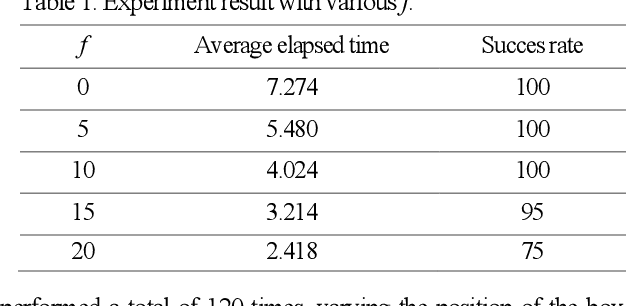
Imitation learning, which enables robots to learn behaviors from demonstrations by non-experts, has emerged as a promising solution for generating robot motions in such environments. The imitation learning based robot motion generation method, however, has the drawback of being limited by the demonstrators task execution speed. This paper presents a novel temporal ensemble approach applied to imitation learning algorithms, allowing for execution of future actions. The proposed method leverages existing demonstration data and pretrained policies, offering the advantages of requiring no additional computation and being easy to implement. The algorithms performance was validated through real world experiments involving robotic block color sorting, demonstrating up to 3x increase in task execution speed while maintaining a high success rate compared to the action chunking with transformer method. This study highlights the potential for significantly improving the performance of imitation learning-based policies, which were previously limited by the demonstrator's speed. It is expected to contribute substantially to future advancements in autonomous object manipulation technologies aimed at enhancing productivity.