 Add to Chrome
 Add to Firefox
 Add to Edge
Reconstruction-Anchored Diffusion Model for Text-to-Motion Generation
Jan 21, 2026
Diffusion models have seen widespread adoption for text-driven human motion generation and related tasks due to their impressive generative capabilities and flexibility. However, current motion diffusion models face two major limitations: a representational gap caused by pre-trained text encoders that lack motion-specific information, and error propagation during the iterative denoising process. This paper introduces Reconstruction-Anchored Diffusion Model (RAM) to address these challenges. First, RAM leverages a motion latent space as intermediate supervision for text-to-motion generation. To this end, RAM co-trains a motion reconstruction branch with two key objective functions: self-regularization to enhance the discrimination of the motion space and motion-centric latent alignment to enable accurate mapping from text to the motion latent space. Second, we propose Reconstructive Error Guidance (REG), a testing-stage guidance mechanism that exploits the diffusion model's inherent self-correction ability to mitigate error propagation. At each denoising step, REG uses the motion reconstruction branch to reconstruct the previous estimate, reproducing the prior error patterns. By amplifying the residual between the current prediction and the reconstructed estimate, REG highlights the improvements in the current prediction. Extensive experiments demonstrate that RAM achieves significant improvements and state-of-the-art performance. Our code will be released.

Towards Variable and Coordinated Holistic Co-Speech Motion Generation
Mar 30, 2024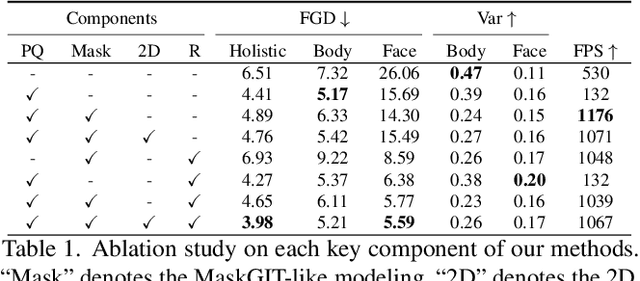
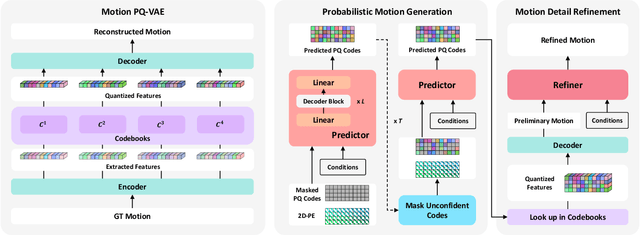
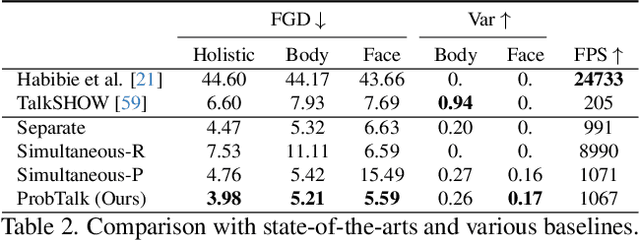
This paper addresses the problem of generating lifelike holistic co-speech motions for 3D avatars, focusing on two key aspects: variability and coordination. Variability allows the avatar to exhibit a wide range of motions even with similar speech content, while coordination ensures a harmonious alignment among facial expressions, hand gestures, and body poses. We aim to achieve both with ProbTalk, a unified probabilistic framework designed to jointly model facial, hand, and body movements in speech. ProbTalk builds on the variational autoencoder (VAE) architecture and incorporates three core designs. First, we introduce product quantization (PQ) to the VAE, which enriches the representation of complex holistic motion. Second, we devise a novel non-autoregressive model that embeds 2D positional encoding into the product-quantized representation, thereby preserving essential structure information of the PQ codes. Last, we employ a secondary stage to refine the preliminary prediction, further sharpening the high-frequency details. Coupling these three designs enables ProbTalk to generate natural and diverse holistic co-speech motions, outperforming several state-of-the-art methods in qualitative and quantitative evaluations, particularly in terms of realism. Our code and model will be released for research purposes at https://feifeifeiliu.github.io/probtalk/.