 Add to Chrome
 Add to Firefox
 Add to Edge
Gradient Regularized Natural Gradients
Jan 26, 2026
Gradient regularization (GR) has been shown to improve the generalizability of trained models. While Natural Gradient Descent has been shown to accelerate optimization in the initial phase of training, little attention has been paid to how the training dynamics of second-order optimizers can benefit from GR. In this work, we propose Gradient-Regularized Natural Gradients (GRNG), a family of scalable second-order optimizers that integrate explicit gradient regularization with natural gradient updates. Our framework provides two complementary algorithms: a frequentist variant that avoids explicit inversion of the Fisher Information Matrix (FIM) via structured approximations, and a Bayesian variant based on a Regularized-Kalman formulation that eliminates the need for FIM inversion entirely. We establish convergence guarantees for GRNG, showing that gradient regularization improves stability and enables convergence to global minima. Empirically, we demonstrate that GRNG consistently enhances both optimization speed and generalization compared to first-order methods (SGD, AdamW) and second-order baselines (K-FAC, Sophia), with strong results on vision and language benchmarks. Our findings highlight gradient regularization as a principled and practical tool to unlock the robustness of natural gradient methods for large-scale deep learning.

LoKO: Low-Rank Kalman Optimizer for Online Fine-Tuning of Large Models
Oct 15, 2024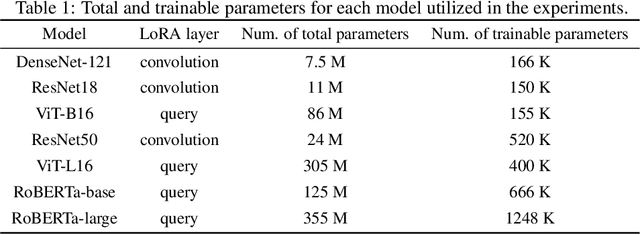
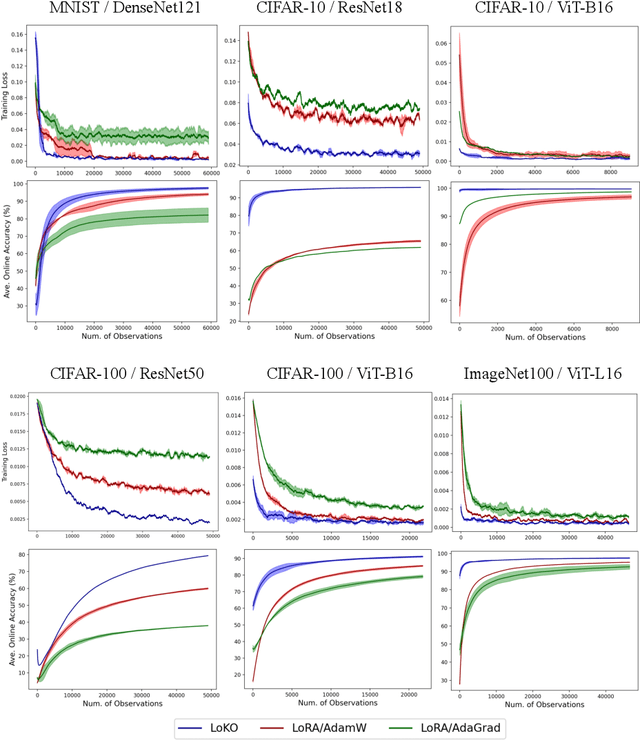
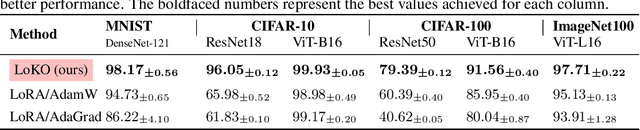
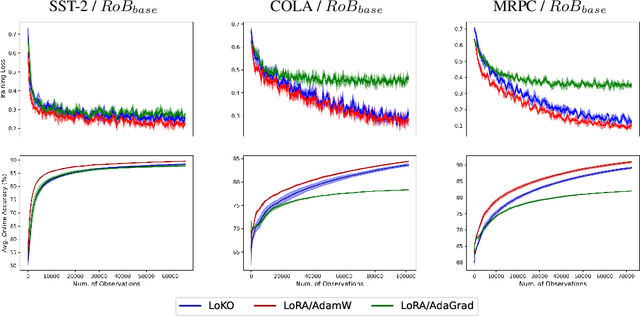
Training large models with millions or even billions of parameters from scratch incurs substantial computational costs. Parameter Efficient Fine-Tuning (PEFT) methods, particularly Low-Rank Adaptation (LoRA), address this challenge by adapting only a reduced number of parameters to specific tasks with gradient-based optimizers. In this paper, we cast PEFT as an optimal filtering/state estimation problem and present Low-Rank Kalman Optimizer (LoKO) to estimate the optimal trainable parameters in an online manner. We leverage the low-rank decomposition in LoRA to significantly reduce matrix sizes in Kalman iterations and further capitalize on a diagonal approximation of the covariance matrix to effectively decrease computational complexity from quadratic to linear in the number of trainable parameters. Moreover, we discovered that the initialization of the covariance matrix within the Kalman algorithm and the accurate estimation of the observation noise covariance are the keys in this formulation, and we propose robust approaches that work well across a vast range of well-established computer vision and language models. Our results show that LoKO converges with fewer iterations and yields better performance models compared to commonly used optimizers with LoRA in both image classifications and language tasks. Our study opens up the possibility of leveraging the Kalman filter as an effective optimizer for the online fine-tuning of large models.