 Add to Chrome
 Add to Firefox
 Add to Edge
ChainRec: An Agentic Recommender Learning to Route Tool Chains for Diverse and Evolving Interests
Feb 11, 2026
Large language models (LLMs) are increasingly integrated into recommender systems, motivating recent interest in agentic and reasoning-based recommendation. However, most existing approaches still rely on fixed workflows, applying the same reasoning procedure across diverse recommendation scenarios. In practice, user contexts vary substantially-for example, in cold-start settings or during interest shifts, so an agent should adaptively decide what evidence to gather next rather than following a scripted process. To address this, we propose ChainRec, an agentic recommender that uses a planner to dynamically select reasoning tools. ChainRec builds a standardized Tool Agent Library from expert trajectories. It then trains a planner using supervised fine-tuning and preference optimization to dynamically select tools, decide their order, and determine when to stop. Experiments on AgentRecBench across Amazon, Yelp, and Goodreads show that ChainRec consistently improves Avg HR@{1,3,5} over strong baselines, with especially notable gains in cold-start and evolving-interest scenarios. Ablation studies further validate the importance of tool standardization and preference-optimized planning.

An Adaptive Framework of Geographical Group-Specific Network on O2O Recommendation
Dec 28, 2023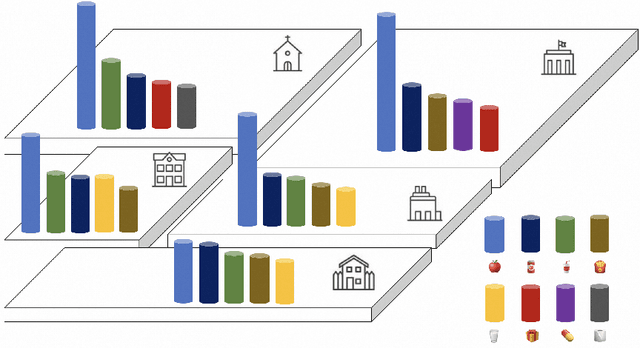
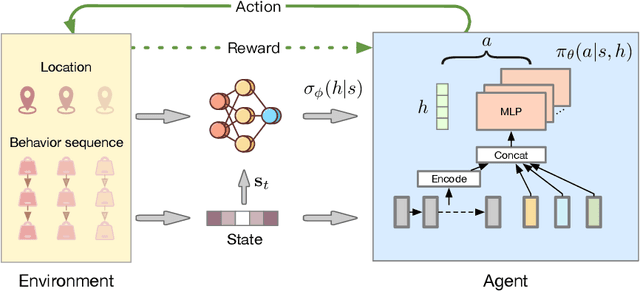
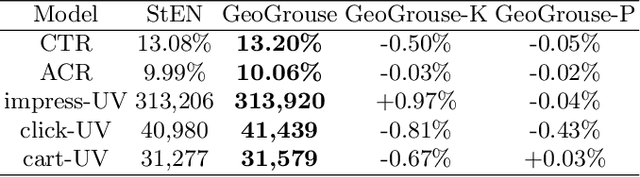
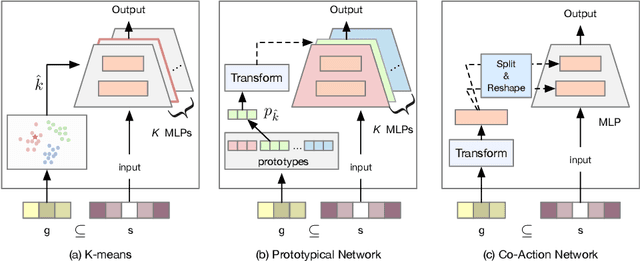
Online to offline recommendation strongly correlates with the user and service's spatiotemporal information, therefore calling for a higher degree of model personalization. The traditional methodology is based on a uniform model structure trained by collected centralized data, which is unlikely to capture all user patterns over different geographical areas or time periods. To tackle this challenge, we propose a geographical group-specific modeling method called GeoGrouse, which simultaneously studies the common knowledge as well as group-specific knowledge of user preferences. An automatic grouping paradigm is employed and verified based on users' geographical grouping indicators. Offline and online experiments are conducted to verify the effectiveness of our approach, and substantial business improvement is achieved.