 Add to Chrome
 Add to Firefox
 Add to Edge
Global-Graph Guided and Local-Graph Weighted Contrastive Learning for Unified Clustering on Incomplete and Noise Multi-View Data
Dec 25, 2025
Recently, contrastive learning (CL) plays an important role in exploring complementary information for multi-view clustering (MVC) and has attracted increasing attention. Nevertheless, real-world multi-view data suffer from data incompleteness or noise, resulting in rare-paired samples or mis-paired samples which significantly challenges the effectiveness of CL-based MVC. That is, rare-paired issue prevents MVC from extracting sufficient multi-view complementary information, and mis-paired issue causes contrastive learning to optimize the model in the wrong direction. To address these issues, we propose a unified CL-based MVC framework for enhancing clustering effectiveness on incomplete and noise multi-view data. First, to overcome the rare-paired issue, we design a global-graph guided contrastive learning, where all view samples construct a global-view affinity graph to form new sample pairs for fully exploring complementary information. Second, to mitigate the mis-paired issue, we propose a local-graph weighted contrastive learning, which leverages local neighbors to generate pair-wise weights to adaptively strength or weaken the pair-wise contrastive learning. Our method is imputation-free and can be integrated into a unified global-local graph-guided contrastive learning framework. Extensive experiments on both incomplete and noise settings of multi-view data demonstrate that our method achieves superior performance compared with state-of-the-art approaches.

Noisy Node Classification by Bi-level Optimization based Multi-teacher Distillation
Apr 27, 2024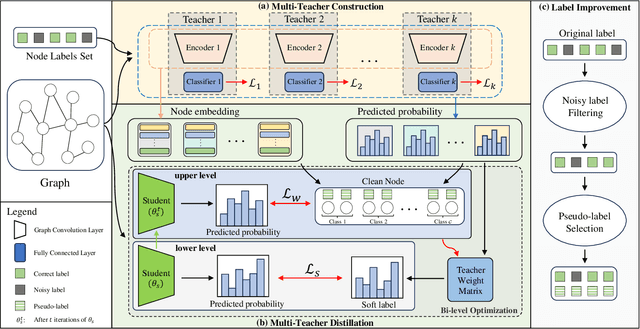
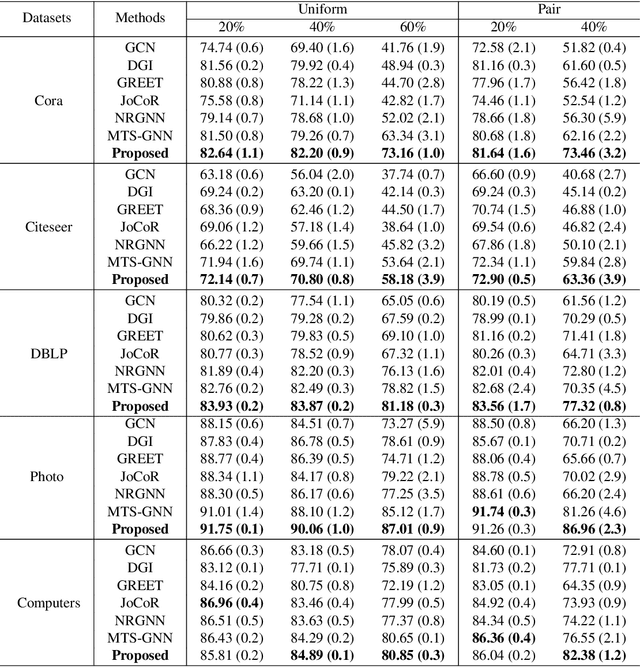
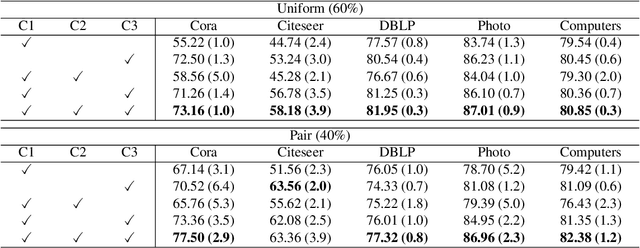
Previous graph neural networks (GNNs) usually assume that the graph data is with clean labels for representation learning, but it is not true in real applications. In this paper, we propose a new multi-teacher distillation method based on bi-level optimization (namely BO-NNC), to conduct noisy node classification on the graph data. Specifically, we first employ multiple self-supervised learning methods to train diverse teacher models, and then aggregate their predictions through a teacher weight matrix. Furthermore, we design a new bi-level optimization strategy to dynamically adjust the teacher weight matrix based on the training progress of the student model. Finally, we design a label improvement module to improve the label quality. Extensive experimental results on real datasets show that our method achieves the best results compared to state-of-the-art methods.